Azoospermia
No sperm found in the semen
Azoospermia means that no sperm have been identified in the ejaculate. It is an important semen-analysis finding — but it is not the final diagnosis.
The important next step is determining why. Sperm may be produced but blocked from reaching the semen, sperm production may be significantly impaired, or another issue such as hormonal suppression, congenital reproductive anatomy or an ejaculation disorder may need to be considered.
Confirm the semen finding
Distinguish blockage from impaired production
Investigate hormonal, genetic & anatomical causes
Choose the fertility pathway only after diagnosis

A zero sperm count tells us what was found — not why it happened
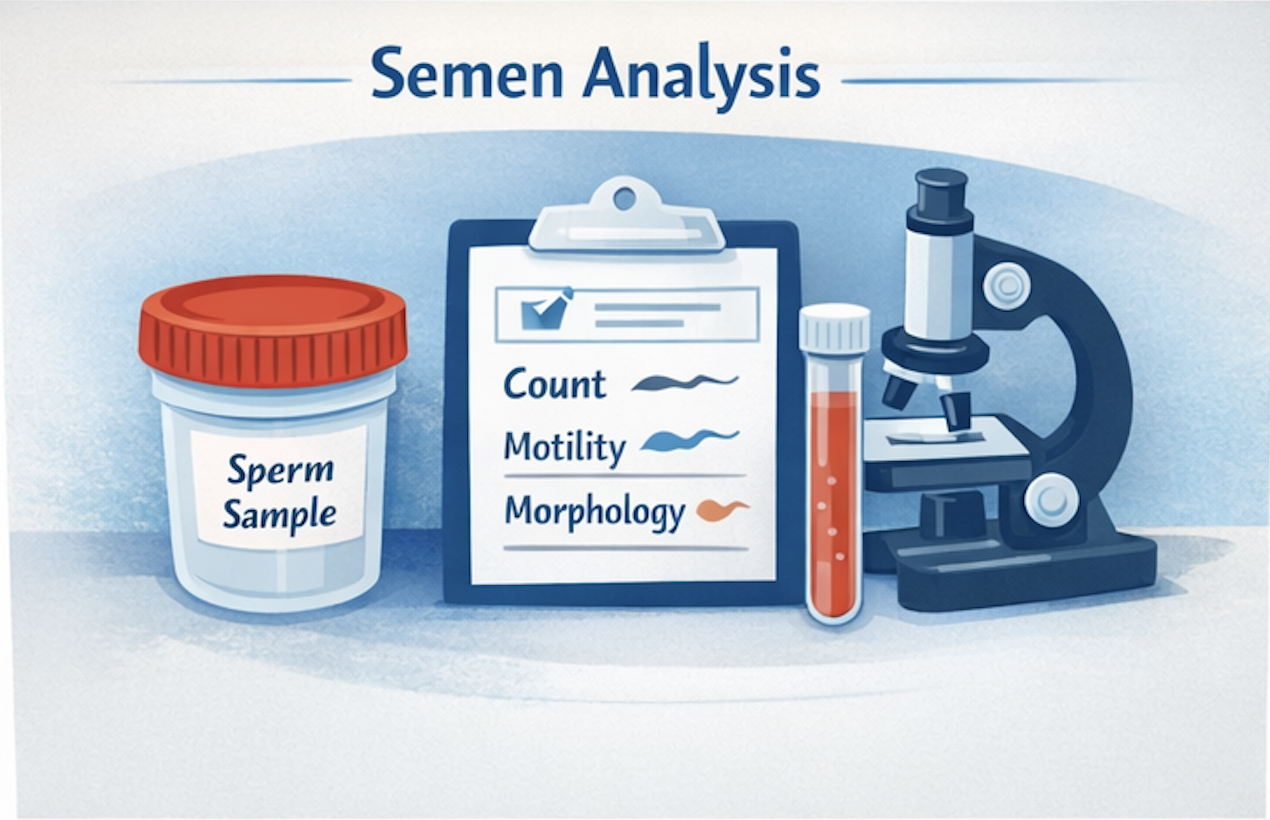
Azoospermia means sperm have not been identified in the semen after appropriate laboratory examination.
It does not automatically mean that sperm are completely absent from the testicle. In some men sperm are being produced but cannot enter the ejaculate. In others, sperm production is severely reduced and may occur only within small areas of the testicle.
This is why the first clinical objective is usually to confirm the finding and establish the likely cause rather than immediately choosing a fertility procedure.

Occasionally very small numbers of sperm are identified only after laboratory concentration and careful examination of the sample.
The first four steps
The pathway becomes much clearer when the result is approached in the correct order.
Confirm
Review the semen analysis and confirm whether true azoospermia is present.
Understand the report →Classify
Decide whether the clinical pattern suggests obstruction, impaired sperm production or another cause.
Compare OA and NOA →Investigate
Use history, examination, hormones, genetics and targeted imaging where appropriate.
Assessment pathway →Plan
Compare medical treatment, reconstruction, sperm retrieval, MicroTESE and assisted reproduction only when relevant.
Explore treatment →Several completely different problems can produce the same semen result
Selecting the branch that best explains the azoospermia is more useful than treating “zero sperm” as a single condition.
Obstructive azoospermia
Sperm production may be preserved, but sperm cannot travel through the reproductive tract into the ejaculate.
Explore obstructive azoospermia → 02 SPERM PRODUCTIONNon-obstructive azoospermia
Sperm production within the testicle is significantly impaired and may occur only in small focal areas.
Explore NOA & MicroTESE → 03 HORMONAL SUPPRESSIONTestosterone or anabolic steroids
External testosterone can suppress LH and FSH signalling and cause severe sperm suppression or azoospermia.
Fertility after testosterone → 04 GENETICGenetic causes
Chromosomal or Y-chromosome abnormalities can affect sperm production and sometimes change sperm-retrieval planning.
Male infertility genetic testing → 05 CONGENITALAbsent or abnormal vas deferens
Some men are born without part of the sperm transport pathway despite sperm production continuing within the testicle.
Congenital absence of the vas → 06 CANCER & TREATMENTPrevious cancer treatment
Cancer, chemotherapy, radiotherapy and testicular treatment can affect future sperm production.
Fertility after cancer treatment → 07 EJACULATIONRetrograde ejaculation or anejaculation
When little or no semen is produced, the problem may involve sperm delivery rather than sperm production itself.
Explore ejaculation disorders → 08 DISTAL OBSTRUCTIONEjaculatory duct obstruction
A small subset of men have obstruction within the prostate that prevents sperm and seminal-vesicle fluid entering the ejaculate.
EDO & TURED guide →Obstructive or non-obstructive azoospermia?
Both can result in a semen analysis reporting no sperm. The underlying biology — and therefore the fertility options — can be very different.
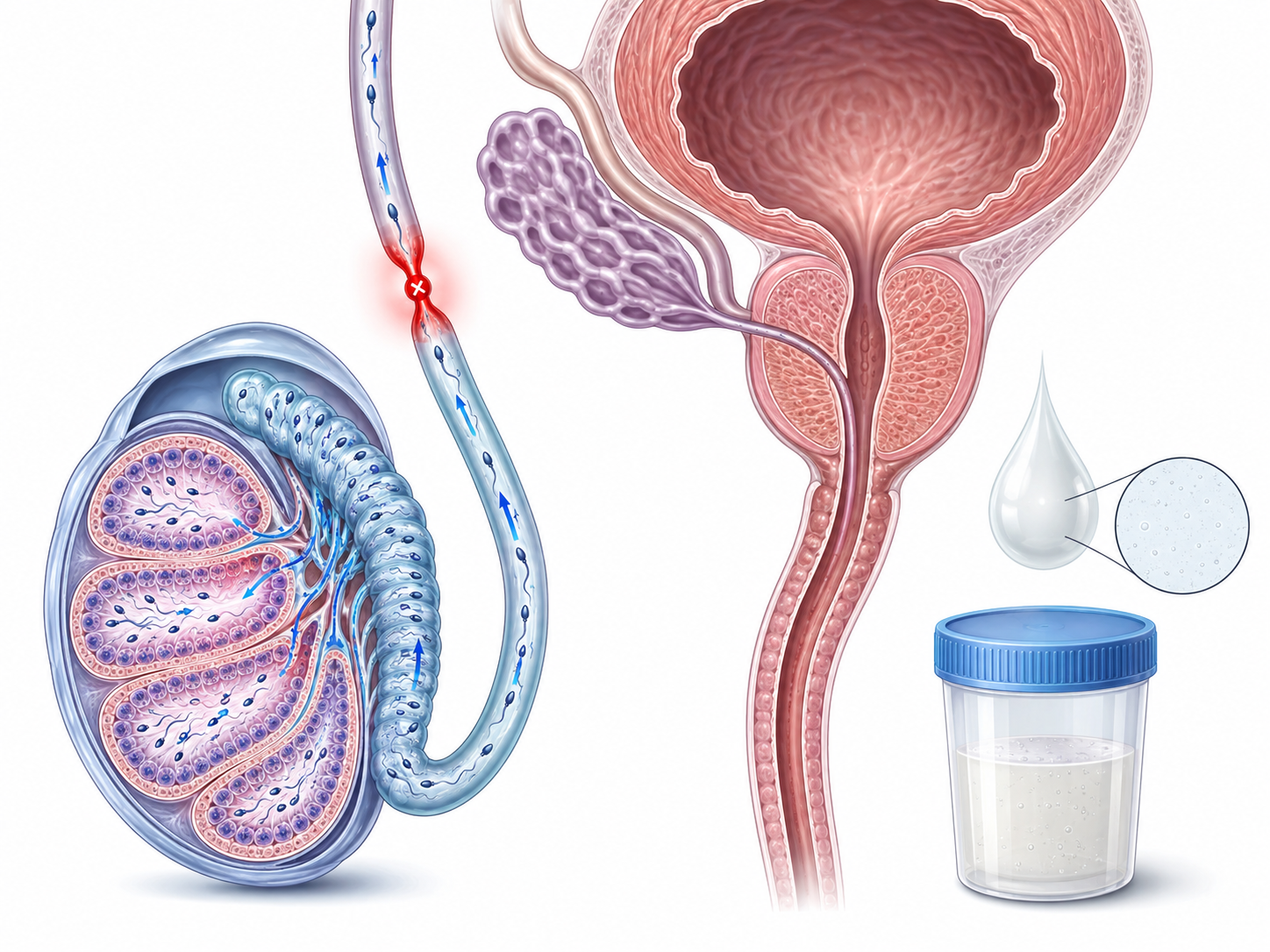
Obstructive azoospermia
Sperm production may remain relatively preserved, but sperm cannot reach the ejaculate because part of the reproductive pathway is blocked or absent.
Potential causes
- Previous vasectomy
- Epididymal obstruction
- Vasal injury or previous surgery
- Congenital absence of the vas deferens
- Ejaculatory duct obstruction
- Previous infection or inflammation
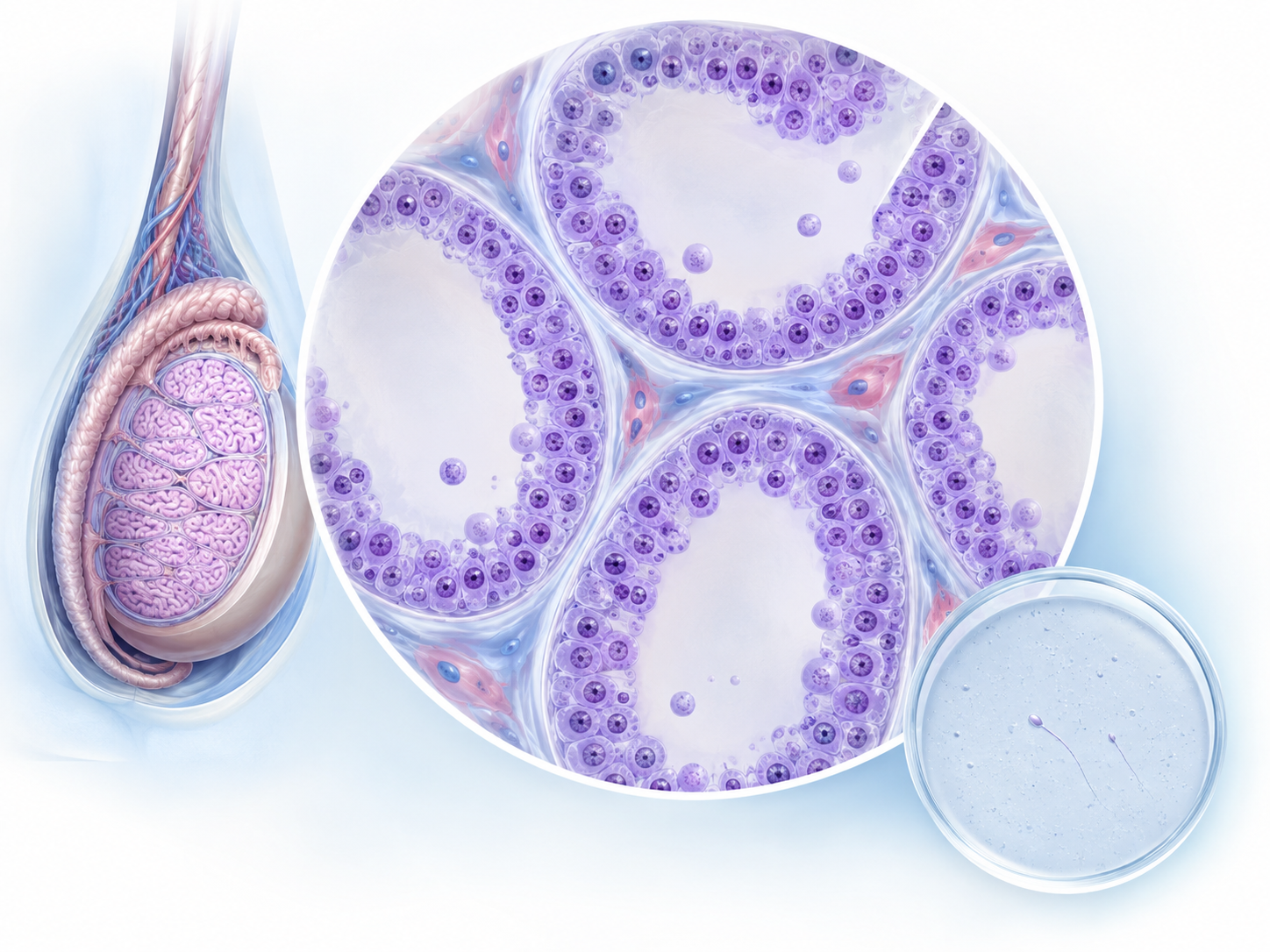
Non-obstructive azoospermia
Sperm production within the testicle is significantly impaired. In some men small isolated areas of sperm production may remain.
Potential causes
- Genetic conditions
- Klinefelter syndrome
- Previous undescended testes
- Chemotherapy or radiotherapy
- Testicular injury or disease
- Primary testicular dysfunction
No single test gives the entire answer
Azoospermia assessment combines multiple pieces of information rather than relying on one hormone result, ultrasound or semen measurement.
High FSH does not prove that no sperm exist
Elevated FSH can support impaired sperm production, but it cannot determine whether small focal areas of sperm production remain.
Normal FSH does not prove obstruction
Hormonal results are interpreted with testicular examination, reproductive history and semen findings.
Normal semen volume does not exclude obstruction
Much of the semen volume comes from the prostate and seminal vesicles, downstream from many sites of obstruction.
Very low semen volume raises a different set of possibilities
Incomplete collection, retrograde ejaculation, congenital anatomy and ejaculatory duct obstruction may need consideration.
Ultrasound cannot classify every azoospermia case
Imaging is best used to answer a specific anatomical question rather than as a universal diagnostic test.
Diagnostic testicular biopsy is often unnecessary
History, examination, semen testing, hormones and selected investigations can frequently establish the likely pattern without a separate diagnostic operation.
How is azoospermia investigated?
Investigation is directed at identifying the underlying reproductive problem rather than simply ordering every available fertility test.
Confirm the semen finding
Review previous semen analyses and whether laboratory concentration identified rare sperm.
Review reproductive history
Previous fertility, testicular development, vasectomy, surgery, infection, cancer treatment and medications can provide important clues.
Male reproductive examination
Testicular size, epididymal findings and whether the vas deferens is present can help distinguish potential pathways.
Reproductive hormones
FSH, LH and testosterone help assess pituitary–testicular signalling and provide context about sperm production.
Selected genetic investigation
Karyotype, Y-chromosome microdeletion or CFTR testing may be appropriate depending on the suspected cause.
Targeted imaging
Ultrasound, transrectal ultrasound or other imaging is selected when there is a specific anatomical question.

- Previous semen analyses
- FSH, LH and testosterone
- Genetic test results
- Ultrasound or imaging reports
- Previous fertility or IVF records
- Prior sperm retrieval reports
- Previous reproductive surgery reports
- Testosterone / anabolic steroid history
Not sure which azoospermia pathway fits your situation?
The Azoospermia Pathway Finder helps organise information commonly considered after a semen analysis reports no sperm — including semen confirmation, reproductive history, hormones, testosterone exposure, previous surgery and other relevant factors.
Educational tool only. It does not diagnose the cause of azoospermia or predict sperm retrieval.
Launch the Azoospermia Pathway Finder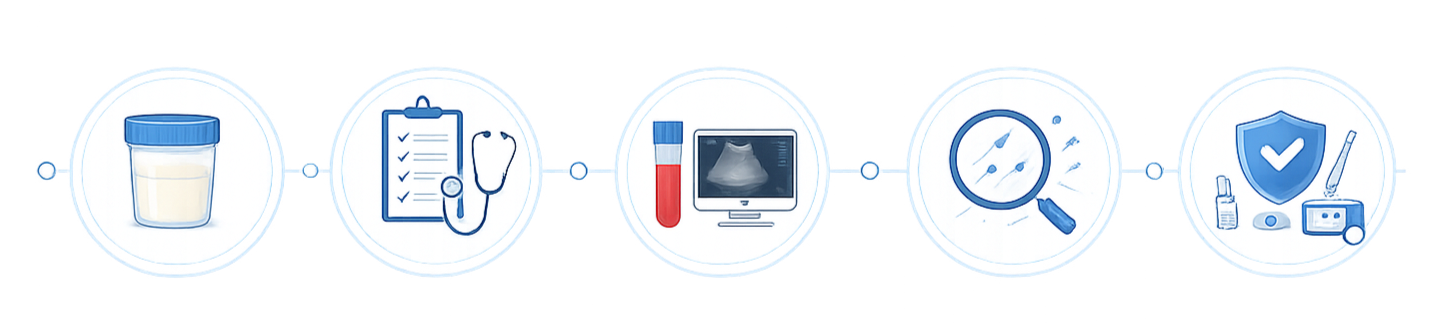
Genetic testing can sometimes change the fertility pathway
Genetic investigation is not identical for every man with azoospermia. The appropriate test depends on whether the pattern suggests impaired sperm production, congenital obstruction or another reproductive abnormality.
Male Infertility Genetic Testing
Understand when karyotype, Y-chromosome microdeletion testing, CFTR testing or genetic counselling may be relevant.
Complete genetic-testing guide → SPERM PRODUCTIONKlinefelter Syndrome & Fertility
Learn how Klinefelter syndrome can affect testosterone, sperm production and consideration of sperm retrieval.
Explore Klinefelter fertility → OBSTRUCTIONCongenital Absence of the Vas Deferens
Understand CBAVD, obstructive azoospermia, CFTR assessment and fertility options when the sperm pathway is absent.
Explore congenital obstruction →There is no single treatment for azoospermia
The appropriate pathway depends on what caused the azoospermia and on the wider fertility circumstances of the patient or couple.
Reconstruct the sperm pathway
Selected vasal or epididymal blockages may be reconstructed with reproductive microsurgery.
Retrieve sperm for IVF / ICSI
When sperm production is preserved, sperm may be retrieved from the epididymis or testicle rather than reconstructing the pathway.
MicroTESE
Microsurgical testicular sperm extraction may be considered in appropriately selected men with severely impaired, potentially focal sperm production.
Treat an identified endocrine cause
Some hormonal causes require treatment directed at reproductive signalling rather than immediate sperm retrieval.
Support recovery of sperm production
Azoospermia after testosterone or anabolic steroids is approached as a hormonal suppression problem, not automatically as primary testicular failure.
Treat selected ejaculatory duct obstruction
When a genuine surgically correctable distal obstruction is confirmed, endoscopic treatment such as TURED may be considered.
Assisted ejaculation pathways
Neurological anejaculation and related disorders can require a different semen-retrieval strategy from true testicular azoospermia.
Coordinate with IVF / ICSI when required
The male diagnosis, egg-provider fertility, treatment timing and desired family size can all influence the final reproductive strategy.
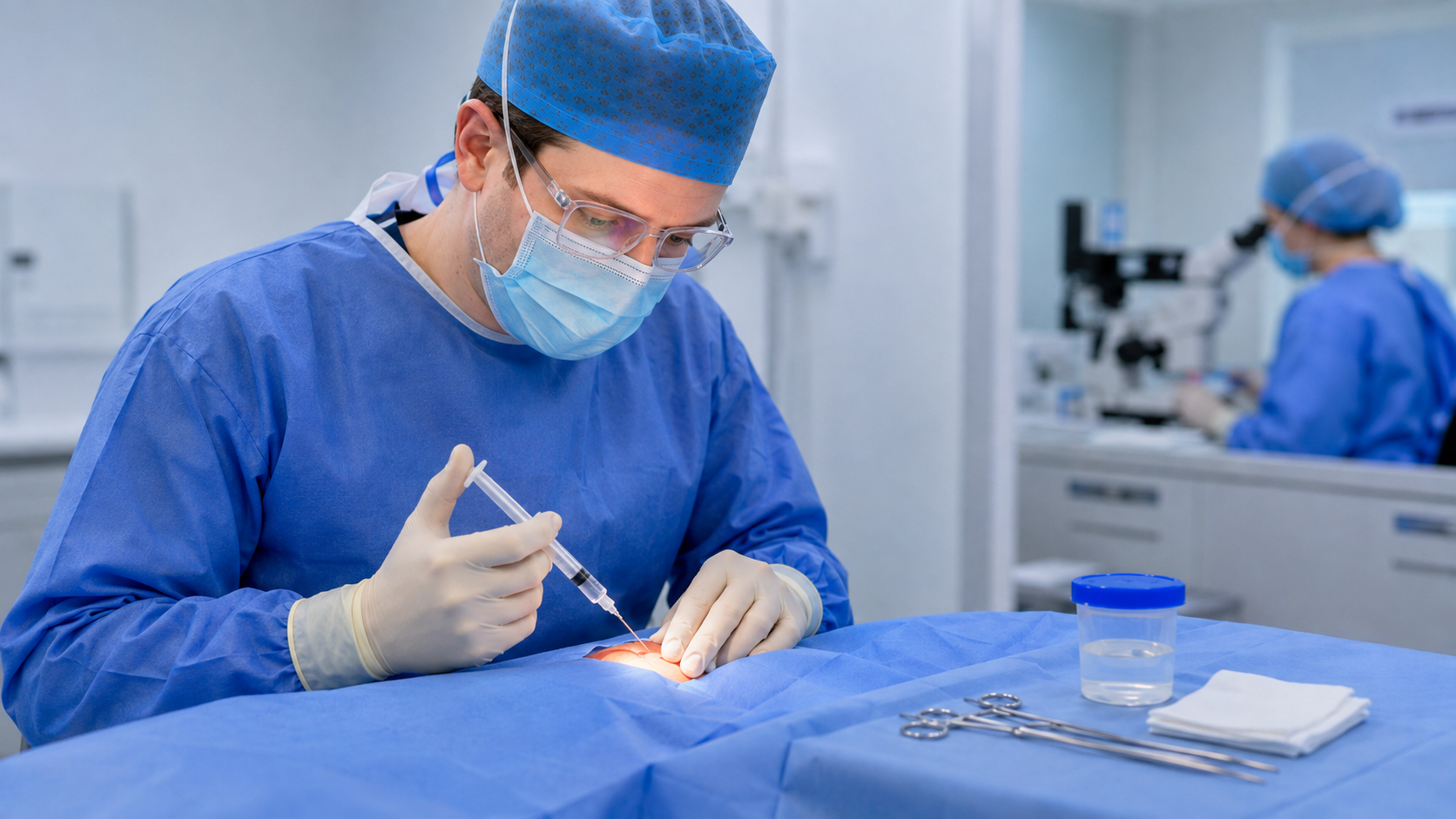
“Sperm retrieval” is not one operation
Several different procedures can retrieve sperm directly from the male reproductive tract. The correct technique depends primarily on why sperm are absent from the ejaculate.
Finding sperm, fertilisation, embryo development, pregnancy and live birth are separate outcomes.
Are you taking — or have you previously taken — testosterone?
Testosterone replacement therapy and anabolic-androgenic steroids can markedly suppress sperm production and may result in azoospermia.
This can look very different biologically from primary non-obstructive azoospermia. The clinical priority is usually to understand the hormonal suppression pattern and potential recovery pathway before considering invasive sperm retrieval.

The male diagnosis is only one part of the decision
Fertility treatment should be planned around the circumstances and reproductive goals of the patient or couple rather than a semen-analysis result in isolation.
What caused the azoospermia?
Obstruction, impaired sperm production and hormonal suppression have different options.
Can the reproductive tract be reconstructed?
Selected obstruction may be suitable for microsurgery rather than immediate IVF.
How time-sensitive is the fertility plan?
Reproductive age and ovarian reserve may influence how long is reasonable to wait.
Is IVF already required?
If IVF is needed for another reason, retrieval may become more attractive than reconstruction.
How many pregnancies are desired?
Family-size goals can influence discussion between restoring sperm to the semen and IVF-based pathways.
What happens if sperm are not found?
Alternative plans should be understood before retrieval surgery where appropriate.
Azoospermia sometimes sits within a wider reproductive problem
Fertility After Cancer Treatment
Fertility assessment following chemotherapy, radiotherapy, cancer surgery or other treatment.
ONCO-FERTILITYTesticular Cancer & Fertility
Fertility preservation and selected sperm retrieval considerations around testicular cancer treatment.
SPERM DELIVERYAnejaculation & Retrograde Ejaculation
When ejaculation rather than sperm production is the central problem.
NEUROLOGICAL FERTILITYElectroejaculation
Specialist semen retrieval for selected men unable to ejaculate, particularly after neurological injury.
PREVIOUS TREATMENTPrevious Fertility Treatment Hasn't Worked
Reassess the male diagnosis when previous treatment or sperm retrieval has not produced the expected outcome.
COMPLEX CASESAndrology Case Navigator
Navigate complex reproductive and andrological presentations that do not fit neatly into a single pathway.
Understand your results before your appointment
Educational tools can help organise existing information and prepare useful questions for specialist assessment.
Semen Analysis Interpreter
Understand semen volume, sperm concentration, motility, morphology and whether rare or absent sperm have been reported.
Open interpreter →Azoospermia Pathway Finder
Review information commonly considered after a zero-sperm semen analysis.
Open pathway finder →Male Fertility Assessment Checklist
Organise semen results, hormone testing, imaging, medications and reproductive history.
Build checklist →Patient Tools
Explore the complete collection of male fertility and urological educational tools.
View all tools →Explore every relevant pathway
Use the main azoospermia page as your starting point, then move into the specific condition, procedure or decision guide that matches the clinical situation.
Start with the result
Obstruction & reconstruction
Sperm-production disorders
Sperm retrieval & procedures
Related male fertility problems
Complex fertility decisions
Common questions after a zero-sperm result
Specialist azoospermia assessment in Brisbane
Dr Jack Crozier is a Brisbane urologist and fellowship-trained andrologist with a subspecialty practice in male infertility, azoospermia, reproductive microsurgery and surgical sperm retrieval.
Assessment focuses on establishing the underlying cause before deciding whether observation, medical treatment, reconstruction, conventional sperm retrieval, MicroTESE or assisted reproduction should be considered.

Travelling to Brisbane for complex azoospermia care?
Existing semen analyses, reproductive hormone results, genetic tests, previous sperm-retrieval reports and fertility records can be useful when clarifying the likely pathway before major travel arrangements are made.
Azoospermia FAQs
Does azoospermia mean I am permanently infertile?
Not necessarily. Azoospermia describes the absence of sperm in the semen rather than the cause. Some causes involve obstruction, some may be hormonally reversible, and some men with severely impaired sperm production may still have focal areas of sperm within the testicle.
Should a zero-sperm result be confirmed?
Confirmation is generally important before making major fertility treatment decisions. Careful laboratory examination may occasionally identify very small numbers of sperm and change the classification from azoospermia to cryptozoospermia.
What is the difference between obstructive and non-obstructive azoospermia?
In obstructive azoospermia sperm production may be preserved but sperm cannot reach the ejaculate. In non-obstructive azoospermia, sperm production within the testicle is significantly impaired.
Does high FSH mean MicroTESE will fail?
No. Elevated FSH can support impaired sperm production but cannot determine whether small areas of sperm production remain. FSH should not be used on its own to predict sperm-retrieval outcome.
Does every man with azoospermia need MicroTESE?
No. MicroTESE is principally relevant to appropriately selected men with non-obstructive azoospermia. Men with obstruction, testosterone suppression or ejaculation disorders usually require different pathways.
Can testosterone cause azoospermia?
Yes. External testosterone and anabolic-androgenic steroids can suppress the hormonal signals needed for sperm production and may result in severe oligozoospermia or azoospermia.
Which genetic tests may be relevant?
Depending on the clinical pattern, investigation can include karyotype analysis, Y-chromosome microdeletion testing or CFTR testing. Genetic testing should be selected according to the likely diagnosis rather than ordered identically for every patient.
Can men with Klinefelter syndrome have sperm retrieved?
Some men with Klinefelter syndrome may retain focal areas of sperm production despite azoospermia. Individual assessment, genetic counselling and discussion of sperm-retrieval options are important.
Can an absent vas deferens cause azoospermia?
Yes. Congenital absence of both vas deferens can prevent sperm from reaching the semen even when sperm production within the testes is present. Genetic assessment can also be relevant.
Can cancer treatment cause azoospermia?
Chemotherapy, radiotherapy, testicular disease and some forms of surgery can affect sperm production or sperm delivery. The likely recovery pattern depends on the treatment and the underlying reproductive situation.
What happens if no sperm are found during MicroTESE?
The operative findings, genetic results, underlying diagnosis, previous sperm-retrieval history and wider fertility circumstances can be reviewed before deciding whether any further retrieval attempt is reasonable. Alternative family-building pathways can also be discussed with the treating fertility team.
Can I still have a biological child with azoospermia?
It may be possible depending on the cause. Potential pathways include treatment of selected hormonal disorders, reconstruction of a blockage, sperm retrieval with IVF/ICSI and MicroTESE in selected non-obstructive azoospermia. Individual outcomes cannot be guaranteed.
Have you been told that no sperm were found?
The next step is not simply choosing a procedure. A structured male fertility assessment can help determine whether the problem relates to obstruction, impaired sperm production, hormonal suppression or another reproductive factor — and which fertility pathways are actually relevant.
This page provides general educational information and does not replace individual medical advice, diagnosis or informed consent. Azoospermia has multiple possible causes and investigation and treatment must be individualised. Sperm retrieval, return of sperm to the ejaculate, fertilisation, embryo development, pregnancy and live birth cannot be guaranteed. Do not start, stop or alter prescribed medicines or hormonal treatment without discussing this with your treating clinician.
Explore More About Male Fertility