

Testicular Cancer • Brisbane
Testicular Cancer Assessment & Treatment
Specialist assessment and surgical care for suspected or confirmed testicular cancer, with early consideration of fertility, appropriate cancer staging and longer-term testicular health.
A testicular lump does not automatically mean cancer. However, a new lump, focal firmness or persistent change within a testicle should be assessed promptly even when it is painless.

When to seek assessment
What can testicular cancer feel like?
Testicular cancer commonly presents as a painless change in one testicle, although symptoms vary. Pain does not exclude cancer, and many painful scrotal problems are caused by something else.
New lump or firmness
A new focal lump, hard area or change within the testicle warrants examination.
Change in size or shape
One testicle may become larger, feel heavier or develop a persistent change in its contour.
Dull ache or heaviness
Some tumours cause discomfort, heaviness or an ache rather than a completely painless lump.
Ultrasound-detected mass
Some lesions are found incidentally during ultrasound performed for pain, fertility assessment or another scrotal problem.
Change in consistency
A testicle that feels persistently harder or different from the opposite side deserves assessment.
Symptoms elsewhere
Less commonly, more advanced disease can produce symptoms related to lymph nodes or other areas of the body.
Sudden severe testicular pain requires urgent medical assessment because testicular torsion is a time-sensitive emergency and should not wait for a routine cancer appointment.
Diagnosis
How is suspected testicular cancer assessed?
The first step is to establish whether the abnormality is within the testicle, how suspicious it appears and whether a conventional cancer surgical pathway is required.
History & examination
Both testes are examined and relevant history is reviewed, including previous undescended testis, prior testicular cancer and fertility considerations.
Bilateral scrotal ultrasound
Ultrasound helps determine whether a mass is intratesticular and assesses both the lesion and the opposite testicle.
Tumour markers
Serum AFP, beta-hCG and LDH contribute to diagnosis, staging and subsequent follow-up.
Decide the surgical pathway
A mass suspicious for a germ-cell tumour usually proceeds to an inguinal surgical approach rather than needle biopsy through the scrotum.
Normal tumour markers do not exclude testicular cancer. Some testicular cancers do not produce elevated blood markers.
Standard initial operation
Radical inguinal orchidectomy
When a typical testicular germ-cell cancer is suspected, removal of the affected testicle through an incision in the groin is the standard initial surgical pathway.
The testicle and spermatic cord are removed through the inguinal approach rather than through the scrotum. The tissue is then assessed by pathology to determine the tumour type and local stage.
For many patients, orchidectomy provides both the definitive diagnosis and the first part of cancer treatment.
A testicular prosthesis is optional and can be discussed before surgery. It may be inserted at the same operation or at a later stage depending on individual circumstances and preference.
Why this approach?
The operation provides diagnosis and cancer control
A different surgical pathway
What if testis-sparing surgery is being considered?
Testis-sparing surgery is not the routine alternative to orchidectomy when a typical germ-cell cancer is strongly suspected.
Selected testicular masses can follow a different pathway in which preservation of functioning testicular tissue may be appropriate. Suitability depends on the individual lesion and clinical circumstances.
Detailed discussion of patient selection, frozen-section examination, preservation of testicular tissue and the possibility of completion orchidectomy is reserved for the dedicated page.

Before cancer treatment
Fertility preservation should be considered early
Testicular cancer commonly occurs during reproductive years. Fertility planning is therefore best considered before definitive treatment where clinically feasible.
Sperm production may already be impaired before treatment, and additional cancer therapy can affect future fertility depending on the individual situation.
Semen analysis
A pre-treatment semen analysis can identify whether sperm production is normal, reduced or absent.
Sperm cryopreservation
Sperm banking should be discussed before treatment where feasible, particularly when future fertility is important.
Opposite testicle
The health and previous history of the other testicle can influence fertility planning.
Severe sperm impairment
If sperm are absent or severely reduced, a more specialised fertility-preservation plan may be required.
Selected fertility situations
What if no sperm are found in the semen before surgery?
For selected patients with testicular cancer and azoospermia or severe sperm impairment, surgical sperm retrieval may sometimes be coordinated with orchidectomy.
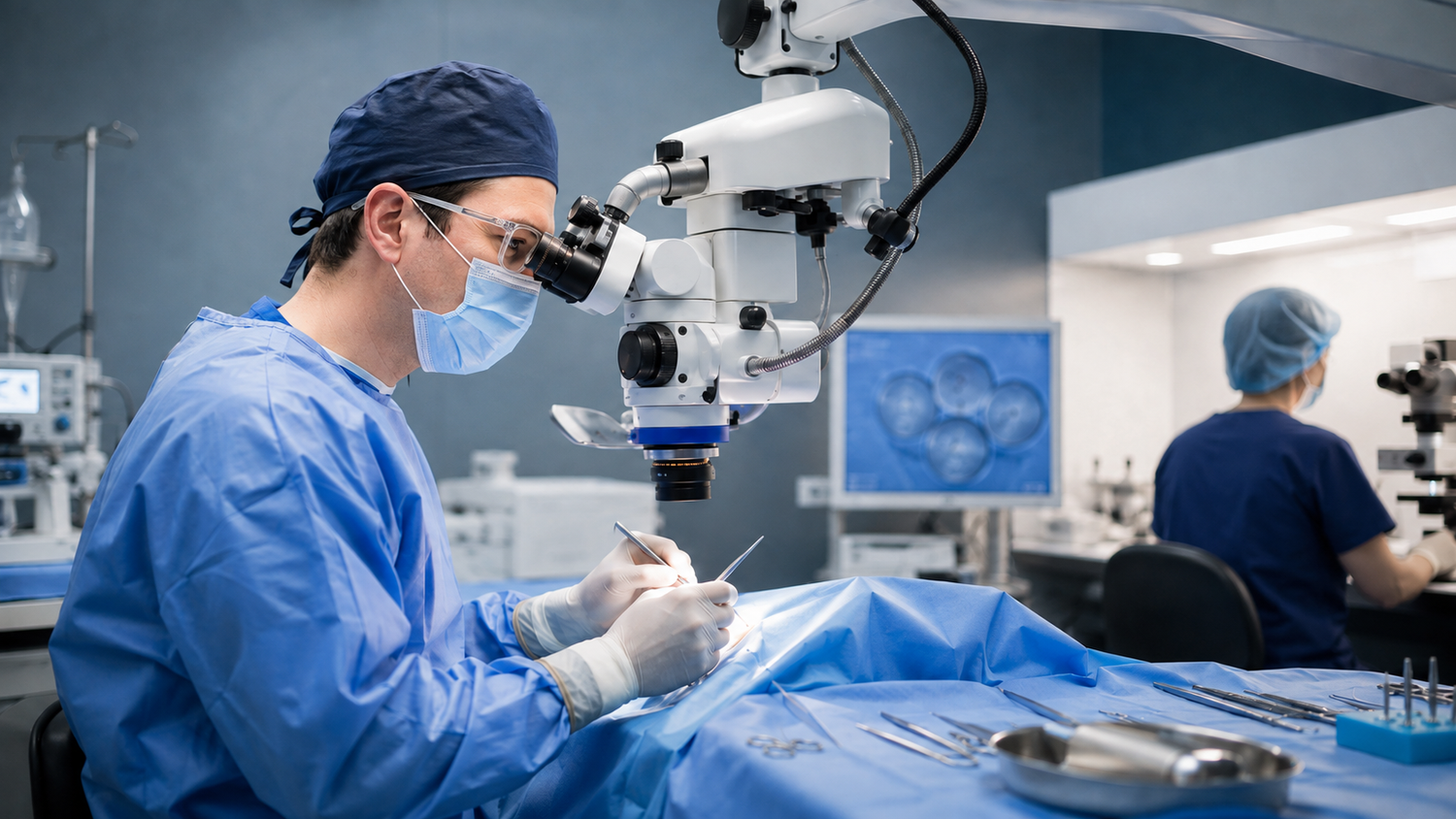
Surgical sperm retrieval
Onco-TESE
Onco-TESE refers to testicular sperm extraction performed in association with testicular cancer surgery when ejaculated sperm banking is not possible.
Selected non-tumour testicular tissue may be assessed by the fertility laboratory for viable sperm that can potentially be cryopreserved for future assisted reproduction.

Fertility planning
Early coordination matters
Men with severe sperm impairment or azoospermia are ideally identified before definitive cancer surgery where clinically feasible.
This can allow coordination between the cancer surgeon, fertility laboratory and fertility team without creating inappropriate delay to cancer treatment.
Surgical sperm retrieval does not guarantee that sperm will be found or that future assisted reproduction will result in pregnancy or live birth. The appropriate fertility-preservation pathway depends on the individual cancer and reproductive circumstances.
After orchidectomy
What happens once the testicle has been removed?
The next step depends on the final pathology, post-operative tumour markers and staging rather than the ultrasound appearance alone.
Final pathology
Pathology establishes the tumour type and identifies important local pathological features.
Repeat tumour markers
AFP, beta-hCG and LDH are reassessed after surgery and interpreted according to the expected change over time.
Staging imaging
Cross-sectional imaging assesses whether cancer is confined to the testicle or whether lymph-node or distant disease is present.
Determine the stage
Pathology, imaging and tumour-marker information are combined to define the appropriate cancer stage and risk group.
Plan the next step
Management may involve surveillance or additional oncological treatment depending on tumour type, stage, markers and individual circumstances.
Understanding the pathology
Seminoma and non-seminoma follow different pathways
Germ-cell cancers are broadly divided into seminoma and non-seminoma. The distinction affects staging, surveillance and which additional treatments may be appropriate.
Seminoma
Seminoma has its own staging and surveillance pathway. Many patients with cancer confined to the testicle can be managed with structured surveillance after orchidectomy.
More advanced disease may require additional oncological treatment according to disease extent and individual circumstances.
Non-seminoma
Non-seminomatous germ-cell tumours can contain several different pathological components and may produce tumour markers.
Management after orchidectomy depends on stage, marker behaviour and pathology and can include surveillance, systemic treatment or selected additional surgery.
Not every patient with testicular cancer requires chemotherapy after orchidectomy. Some patients with early-stage disease are appropriately managed with structured surveillance.
When cancer has spread
Treatment beyond the testicle
Testicular cancer can spread to lymph nodes in the retroperitoneum and, in more advanced cases, to other parts of the body.
Treatment is guided by tumour type, tumour-marker levels, disease distribution, previous treatment and the patient's overall clinical circumstances.
Care may involve medical oncology, urology, radiology and other specialists. Selected patients may require additional surgery to retroperitoneal or residual disease.
Multidisciplinary planning
More advanced testicular cancer is not managed on the basis of the testicular operation alone.
Pathology, imaging, tumour markers and previous treatment are considered together before the next stage of treatment is selected.
The other testicle
What happens to testosterone and fertility with one testicle?
Many men maintain adequate testosterone production and fertility with one healthy remaining testicle.
Individual outcomes vary, particularly in men with pre-existing fertility problems, previous undescended testis, impaired sperm production or abnormalities affecting the opposite testicle.
Previous undescended testis?
A history of cryptorchidism is relevant to testicular cancer risk, fertility and assessment of the remaining testicle.
Survivorship
Follow-up after testicular cancer
Follow-up is tailored to tumour type, stage and treatment received. Longer-term care can also address testicular, hormonal and reproductive health.
Cancer surveillance
Clinical review, tumour markers and imaging are scheduled according to the individual cancer pathway.
Remaining testicle
A new lump or persistent change in the opposite testicle should be assessed rather than waiting for a routine visit.
Hormonal health
Symptoms suggesting low testosterone can be assessed clinically and with appropriate blood testing.
Fertility & sexual health
Fertility goals, sexual health, body image and treatment-related concerns can remain part of longer-term care.

Regional, interstate & international patients
Travelling to Brisbane with a testicular cancer diagnosis?
Testicular cancer assessment can be time-sensitive. Patients travelling from regional Queensland, interstate Australia or overseas can provide existing records before major travel arrangements are made where appropriate.
An in-person examination or additional investigations may still be required before definitive treatment can be confirmed.
Useful information to provide
- Scrotal ultrasound report and images
- Tumour-marker results
- CT or other staging imaging
- Previous pathology reports
- Previous operation reports
- Semen analysis if fertility is relevant
- Specialist or oncology correspondence
Frequently asked questions
Testicular cancer questions
Does every testicular lump mean cancer?
Can testicular cancer be diagnosed with ultrasound alone?
Can I have testicular cancer if my tumour markers are normal?
Why is testicular cancer surgery performed through the groin?
Can the tumour be removed without removing the whole testicle?
Should I bank sperm before testicular cancer surgery?
What if there are no sperm in my semen before orchidectomy?
Will I definitely need chemotherapy after orchidectomy?
Can I have a testicular prosthesis?
Does one healthy testicle usually make enough testosterone?
What if the lump is beside rather than inside the testicle?
Related specialist pathways
Testicular cancer, fertility & testicular surgery
Testicular Masses & Testis-Sparing Surgery
Dedicated information about selected testicular masses where preservation of testicular tissue may be considered.
Explore testis preservation →Testicular Prosthesis
Information about optional prosthesis placement following orchidectomy or previous loss of a testicle.
Explore prosthesis surgery →Male Fertility
Fertility assessment and preservation where testicular cancer or its treatment may affect sperm production.
Explore male fertility →Paratesticular Tumours
Assessment of masses arising beside the testicle from the epididymis, spermatic cord or surrounding tissues.
Explore paratesticular masses →Adult Undescended Testis
Assessment of cryptorchidism including cancer-risk, fertility and hormonal considerations.
Explore undescended testis →Penile & Testicular Cancer
Return to the broader specialist urological cancer pathway.
Explore cancer care →
Specialist urological care
Dr Jack Crozier
Dr Jack Crozier is a Brisbane urologist with advanced fellowship experience in uro-oncology, andrology and reconstructive urology.
His practice includes testicular cancer, testicular and paratesticular tumours, testicular surgery and male fertility. Cancer treatment can incorporate appropriate fertility, hormonal and reconstructive considerations while maintaining oncological priorities.
Testicular cancer assessment • Brisbane
Have you found a testicular lump or been told you have a testicular mass?
Individual assessment can help clarify the level of concern, the appropriate surgical pathway, staging requirements and whether fertility preservation should be considered before treatment.
Medical disclaimer: This page provides general educational information and does not replace individual medical advice, diagnosis or informed consent. A website cannot determine whether a testicular lump or ultrasound abnormality is cancer. Investigation and treatment depend on examination, ultrasound findings, tumour markers, pathology, cancer stage, fertility considerations, general health and individual circumstances. Surgery and cancer treatments have potential benefits, limitations and risks that require individual assessment. Sudden severe testicular pain requires urgent medical assessment because testicular torsion is a time-sensitive emergency.