

Kidney Stone Treatment Explorer
Explore which kidney or ureteric stone treatment pathways may be discussed based on stone size, location, symptoms, previous treatment and selected CT characteristics.
An infected obstructed urinary system can require emergency drainage. Do not rely on an online decision tool if you are acutely unwell, unable to pass urine or have severe uncontrolled symptoms.
The same size stone can lead to very different treatment pathways
Kidney stone treatment is influenced by where the stone is, its likelihood of passing, whether it is causing obstruction or infection, CT characteristics, previous treatment and individual circumstances.
Kidney or ureter?
A renal stone and a ureteric stone of identical size can have very different natural histories and treatment options.
Stone burden
Size affects spontaneous passage, likelihood of SWL success and whether ureteroscopy or PCNL may be more suitable.
Density & anatomy
Hounsfield units, lower-pole anatomy and skin-to-stone distance can materially affect the suitability of shock wave treatment.
Previous treatment
Residual stones, previously failed SWL and impacted stones may need a different strategy from a newly diagnosed uncomplicated stone.
Explore your treatment pathways
Use your radiology report where possible. You do not need to know every CT measurement to use the explorer.
Is there anything that may require urgent assessment?
Infection, threatened kidney function or uncontrolled symptoms can make urgent drainage or medical treatment more important than choosing the definitive stone procedure.
What does your scan show?
Stone location and size provide the starting point for the treatment algorithm.
Add any additional information you know
These details improve the treatment ranking, particularly when considering SWL, residual stone disease or an impacted upper ureteric stone.
If several options are reasonable, what matters most?
Patient priorities can influence the choice when more than one guideline-concordant treatment is available.
Explore the issue identified by your scan or result
These dedicated pages allow the Treatment Explorer to take you beyond a generic kidney-stone treatment overview.
Shock Wave Lithotripsy
Understand which stones are most suitable for SWL and why density, location and anatomy matter.
Explore SWL →Medical Expulsive Therapy
Learn when observation and an alpha-blocker may be discussed for an appropriate ureteric stone.
Explore MET →Uric Acid Stones
Some uric acid stones can potentially be dissolved with urinary alkalinisation rather than immediately removed surgically.
Explore uric acid stones →Kidney Stones in Pregnancy
Pregnancy changes imaging, observation, drainage and procedural treatment considerations.
Explore pregnancy pathway →Asymptomatic Stone Surveillance
Understand when a renal stone may be followed rather than removed immediately.
Explore surveillance →Hounsfield Units & Stone Density
Learn how CT density can influence expected fragmentation and the suitability of treatments such as SWL.
Understand HU →Impacted Upper Ureteric Stones
Longstanding impacted proximal ureteric stones can require more individualised endoscopic or antegrade planning.
Explore impacted stones →Residual Stones After Treatment
Understand what residual stone fragments mean and when observation or further treatment may be considered.
Explore residual stones →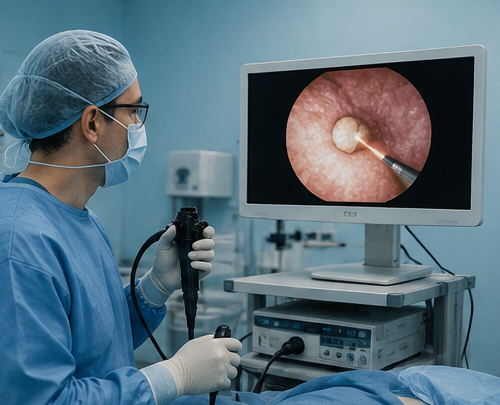
The explorer ranks pathways rather than prescribing treatment
A scan can identify several technically possible treatments. The decision then becomes a balance between effectiveness, invasiveness, repeat procedures, stent use and individual circumstances.
Observation, SWL, ureteroscopy and PCNL each have a different role
Treatment should be selected for the individual stone rather than assuming one procedure is best for every patient.
Surveillance
Selected stable and asymptomatic renal stones can sometimes be monitored.
Explore surveillance →Shock Wave Lithotripsy
Externally generated shock waves fragment appropriately selected stones.
Explore SWL →Ureteroscopy & Laser
Fine endoscopic instruments allow direct treatment within the ureter or kidney.
Explore ureteroscopy →PCNL
Direct keyhole access to the kidney is particularly important for larger or complex stone burdens.
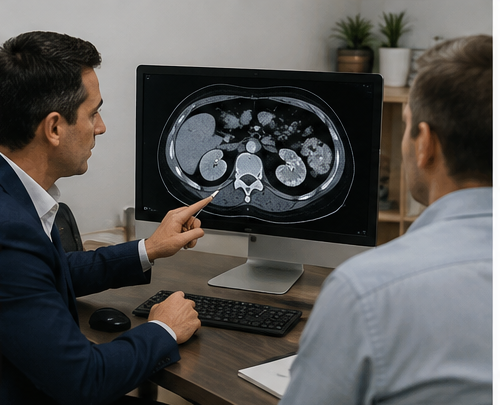
Explore PCNL →A CT provides much more information than stone size alone
Reviewing the actual imaging can help determine not only how large a stone is, but whether treatment is needed and which treatment is technically most suitable.
Based on current international stone-management principles
The Treatment Explorer uses recommendations and treatment principles from major international urolithiasis guidelines. It is an independent educational tool and is not an official calculator produced or endorsed by any guideline organisation.
Provides detailed size- and location-based algorithms together with guidance on MET, SWL characteristics, ureteroscopy, PCNL, renal stones and special situations.
Provides a contemporary US framework for surgical treatment selection and shared decision-making in kidney and ureteric stones.
Provides an independent UK framework covering observation, medical expulsive therapy and procedural stone treatment.
Common questions
Can this tool tell me which operation I should have?
Why does the explorer ask about Hounsfield units?
Why does previous treatment matter?
What is an impacted ureteric stone?
Can uric acid kidney stones be dissolved?
Does every asymptomatic kidney stone need surgery?
When should I not use this tool?
Have the actual scan reviewed rather than relying on stone size alone
Existing imaging can be reviewed together with stone location, obstruction, density, previous treatment, kidney function, infection risk and your individual treatment priorities.
Medical information disclaimer: This page and Kidney Stone Treatment Explorer provide general educational information only. They do not diagnose a medical condition, determine whether surgery is required or recommend an individual treatment. Treatment can be altered by factors that cannot be assessed by an online tool, including the complete CT appearance, stone number and distribution, renal function, infection, urinary anatomy, medications, pregnancy, previous surgery, stone composition, anaesthetic considerations and individual circumstances. Seek urgent medical assessment for fever or significant illness with suspected urinary obstruction, inability to pass urine, uncontrolled symptoms or other concerning deterioration.