

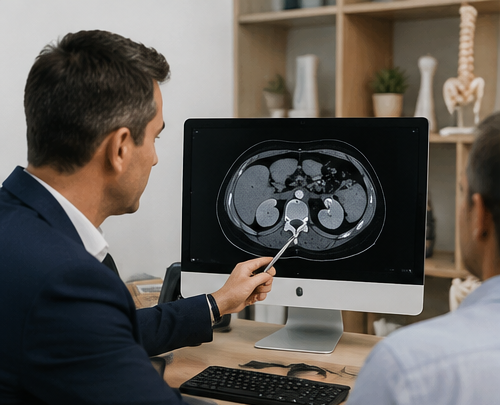
Kidney Stone Density & Hounsfield Units
A CT scan can tell us more than the size and position of a kidney stone. Its density — measured in Hounsfield units or HU — can provide additional information about how hard the stone may be, possible stone composition and how likely some treatments are to fragment it.
What does HU mean on a kidney stone CT?
Hounsfield units describe how strongly a structure absorbs X-rays on CT imaging. Kidney stones usually appear much denser than the surrounding urine, but different stones can have considerably different HU measurements.
What is a Hounsfield unit?
CT images are created by measuring how much different tissues attenuate, or weaken, an X-ray beam. Hounsfield units provide a standard scale for expressing that attenuation.
Water is approximately 0 HU, air is approximately −1000 HU and dense structures such as bone have much higher positive values. Kidney stones generally have positive HU measurements, although the exact value varies considerably according to their composition and internal structure.
When assessing a urinary stone, the radiologist or urologist can place a measurement area over the stone on the non-contrast CT images to estimate its density.
Size tells us how large the stone is.
Location tells us where it is.
HU adds information about stone density.
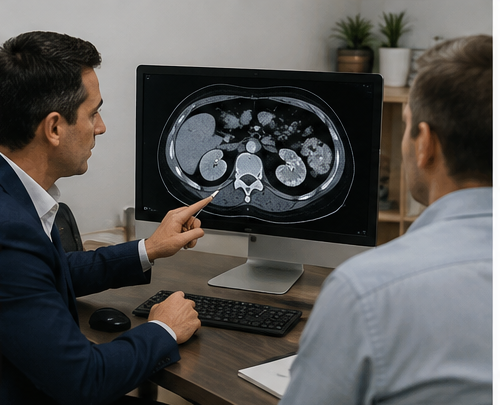
What do different HU measurements mean?
There is no universal HU value that identifies every stone type. Measurements overlap, and scanner technique can influence the result. The ranges below are therefore best considered practical guides rather than diagnostic cut-offs.
Lower density
A lower-density stone may increase suspicion for uric acid, particularly when the clinical and imaging features also fit.
Learn about uric acid stones →Intermediate density
Many urinary stones fall within an overlapping intermediate range. HU alone usually cannot reliably determine their precise composition.
Compare stone treatments →Higher density
Higher-density homogeneous renal stones are less likely to fragment successfully with shock-wave lithotripsy and may influence treatment selection.
Learn about shock-wave treatment →These ranges are deliberately approximate. Stone size, scan technique, measurement method and mixed stone composition can all influence HU.
Have you been given an HU measurement?
Enter the approximate Hounsfield-unit measurement from your non-contrast CT report. This provides general context only — it does not determine your stone type or which treatment you should have.
Why does stone density matter?
Hounsfield units are most useful when they are combined with the other characteristics visible on CT.
Shock-Wave Fragmentation
Dense, homogeneous stones are generally more difficult to disintegrate using externally generated shock waves.
Possible Composition
Very low density may raise suspicion for a uric acid stone, while denser stones are more commonly associated with calcium-containing compositions. There is substantial overlap.
Treatment Selection
Density may help determine whether shock-wave treatment is likely to be effective or whether an endoscopic approach should also be considered.
Treatment Counselling
Understanding the stone before treatment helps provide a more realistic discussion about fragmentation, clearance and the possibility of additional procedures.
Why is HU particularly important for shock-wave treatment?
Shock-wave lithotripsy uses externally generated energy to break a kidney or ureteric stone into fragments that can subsequently pass through the urinary tract.
The European Association of Urology notes that renal stones with a density above approximately 1000 HU, particularly when homogeneous on non-contrast CT, are less likely to disintegrate successfully with shock-wave lithotripsy.
That does not mean that every stone below 1000 HU should undergo shock-wave treatment or that every stone above 1000 HU requires surgery. Density is only one part of the decision.
Explore Shock Wave Lithotripsy →What else affects success?
Stone size
Stone location
Stone density & composition
Skin-to-stone distance
Kidney anatomy
Ability to target the stone
Can HU tell whether my stone is uric acid?
A relatively low-density stone can increase suspicion for uric acid, and uric acid stones commonly have lower CT attenuation than many calcium-containing stones.
However, there is no single HU threshold that proves the diagnosis. Measurements overlap between stone types, particularly in mixed stones, and factors such as urine pH, stone appearance, previous stone analysis and dual-energy CT may provide additional information.
Distinguishing uric acid can be clinically important because selected uric acid stones may be suitable for medical dissolution using carefully monitored urinary alkalinisation rather than mechanical stone removal.
Learn About Uric Acid Kidney StonesThe most reliable way to determine the exact composition of a passed or surgically removed stone remains laboratory stone analysis.
CT density can suggest certain compositions and can help guide treatment planning, but it should not be treated as a chemical analysis of the stone.
Does a high HU mean laser surgery will not work?
No. The relationship between density and shock-wave treatment should not be confused with endoscopic laser treatment.
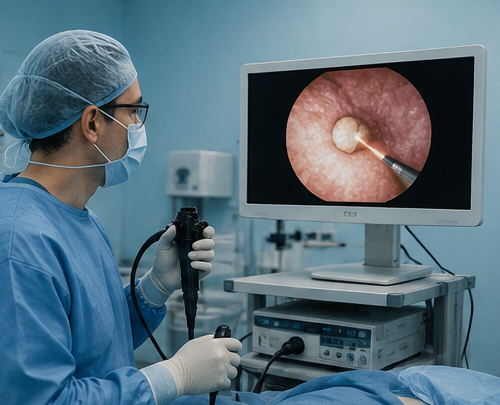
During ureteroscopy or flexible pyeloscopy, the stone is reached directly through the urinary tract. Laser energy can then be delivered under direct vision to fragment or dust the stone.
Stone composition and hardness can influence how a stone behaves during laser treatment, but a high HU measurement does not by itself mean that ureteroscopy cannot treat the stone.
Learn About Ureteroscopy & Laser →HU is only one part of kidney stone assessment
Treatment should not be selected from the density measurement alone. The CT provides several different pieces of information that need to be considered together.
Stone size
Size affects spontaneous passage, treatment options and the likelihood that more than one procedure may be required.
Stone location
A stone in the ureter behaves differently from one in the kidney, while renal calyx location may also influence treatment.
Number of stones
Multiple stones or a large overall stone burden may change the most appropriate treatment strategy.
Obstruction
CT can show hydronephrosis and other evidence that a stone is interfering with urinary drainage.
Kidney anatomy
The collecting-system anatomy may influence access, fragment clearance and procedural selection.
Hounsfield units
Density provides additional information about stone hardness, possible composition and likely response to selected treatments.
Why might my HU measurement vary?
An HU value is not as absolute as measuring the length of an object with a ruler. Several technical factors can change the number recorded.
Where the stone is measured
Mixed stones may contain areas with very different densities.
Stone size
Very small stones are particularly susceptible to partial-volume
effects.
CT technique
Scanner settings, reconstruction and slice thickness can influence
attenuation measurements.
Region of interest
A small central measurement can differ from an average taken
across a larger portion of the stone.
Contrast administration
Stone-density assessment is generally based on unenhanced,
non-contrast CT images.
A report saying a stone measures “950 HU” does not mean that every part of the stone measures exactly 950 HU or that a particular treatment is automatically appropriate.
How does this affect treatment?
Shock Wave Lithotripsy
Understand how size, location, density and anatomy influence whether shock-wave treatment may be suitable.
Ureteroscopy & Laser
Learn how stones can be reached and treated directly through the natural urinary tract.
PCNL
Explore direct keyhole treatment for selected larger, staghorn and complex renal stones.
Kidney Stone Treatment Options
Compare observation, shock-wave treatment, ureteroscopy and PCNL according to the characteristics of the stone.
Does a high-density kidney stone automatically need surgery?
No. Stone density helps with how a stone might be treated; it does not by itself determine whether a stone needs treatment.
An asymptomatic renal stone may sometimes be observed even when it is relatively dense. Conversely, a lower-density stone may still require active treatment if it is causing significant symptoms, persistent obstruction or another clinical problem.
Stone density does not determine urgency
Fever, chills or significant illness with an obstructed urinary system can represent an infected obstructed kidney and requires urgent medical assessment. Do not wait for a routine appointment because the stone happens to have a particular HU measurement.
Learn about blocked or infected kidney stones →Kidney Stone Hounsfield Unit FAQs
What is a normal HU for a kidney stone? +
There is no single “normal” Hounsfield-unit measurement for a kidney stone. Different stone compositions and even different regions within the same stone can have substantially different densities.
Is a 1000 HU kidney stone hard? +
A stone around or above 1000 HU is relatively dense on CT. This becomes particularly relevant when considering shock-wave lithotripsy because high-density homogeneous stones are less likely to fragment successfully with shock waves. HU alone does not determine the treatment.
What HU suggests a uric acid kidney stone? +
Uric acid stones often have relatively low CT attenuation, with values below approximately 500 HU increasing suspicion in the appropriate clinical setting. There is overlap between stone types, so HU alone should not be considered diagnostic.
Can CT tell exactly what my kidney stone is made of? +
Standard single-energy CT can provide clues but cannot reliably determine the precise composition of every stone. Dual-energy CT can provide additional compositional information, particularly when distinguishing uric-acid from non-uric-acid stones. Laboratory analysis of a retrieved stone remains particularly useful.
Is a low-HU stone easier to break? +
Lower density can be favourable when shock-wave lithotripsy is being considered, but treatment success also depends on stone size, position, internal structure, skin-to-stone distance, anatomy and the ability to accurately target the stone.
Can a high-HU stone still be treated with laser? +
Yes. High density does not by itself prevent ureteroscopy and laser treatment. Laser energy is applied directly to the stone under endoscopic vision. Stone hardness may affect how the stone behaves during treatment, but HU is not a stand-alone contraindication to ureteroscopy.
Will my CT report always include the stone HU? +
No. Some radiology reports provide an attenuation measurement and others do not. When clinically useful, the non-contrast CT images themselves can often be reviewed and the stone density measured.
Does HU tell me whether my kidney stone needs surgery? +
No. The decision to observe or treat a kidney stone also depends on symptoms, stone size and location, growth, obstruction, infection, kidney function, anatomy and individual circumstances.
Explore your kidney stone pathway
Already have a CT scan?
Your existing imaging can be reviewed to assess the stone's size, location, density and effect on urinary drainage and to determine which treatment pathways may be appropriate.
This information is general educational information and does not replace individual medical advice. Hounsfield-unit measurements vary according to CT technique, stone size, composition and measurement method. Kidney stone treatment depends on factors including stone size and location, symptoms, obstruction, infection, kidney function, anatomy, previous treatment and individual clinical circumstances.