

Kidney Stone
Treatment Options
Kidney stones are not all treated in the same way. Depending on the stone and your clinical circumstances, options may include observation, allowing a ureteric stone to pass, shock-wave lithotripsy, ureteroscopy and laser, PCNL, stone dissolution or urgent kidney drainage.
Fever with an obstructing kidney stone needs urgent assessment
Fever, chills, significant illness or difficulty passing urine with suspected urinary obstruction should not wait for a routine outpatient appointment.
The stone size is important — but it is not the whole decision.
Treatment starts by understanding the stone itself, where it is located and what effect it is having on the kidney and urinary system.
A small ureteric stone may pass naturally. A stable kidney stone may be suitable for surveillance. Selected stones may suit shock-wave treatment, while ureteroscopy provides direct endoscopic access and larger or more complex renal stone burdens may favour PCNL.
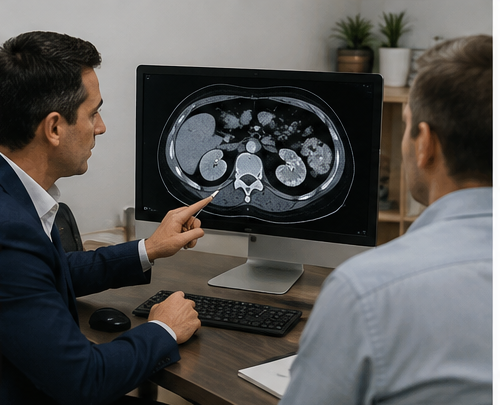
Already know the size and location of your stone?
The Kidney Stone Treatment Explorer can help organise the treatment pathways commonly considered for different stone sizes and locations. It is educational and does not replace review of the actual CT scan or individual medical assessment.
What are the main kidney stone treatment options?
Modern stone management ranges from no immediate procedure through to endoscopic or percutaneous stone surgery.
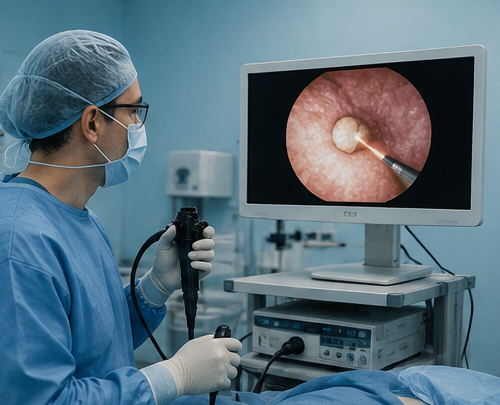
Ureteroscopy reaches the stone through the natural urinary tract.
A fine telescope passes through the urethra and bladder and into the ureter. Flexible instruments can continue into the kidney collecting system when required.
Laser energy can fragment or dust the stone under direct vision. Ureteroscopy is commonly used for ureteric stones and can also treat many renal stones.
How does stone size influence treatment?
Size helps narrow the options, but the same-sized stone can require a different approach depending on where it is located.
These categories are deliberately simplified. They show how the treatment discussion may change as stone burden increases rather than providing an individual recommendation.
First ask whether spontaneous passage is reasonable.
Smaller ureteric stones may pass naturally. Active treatment becomes more relevant with persistent symptoms, obstruction, infection or a low likelihood of passage.
Explore ureteric stones →Several pathways may be reasonable.
Depending on symptoms, location and stone characteristics, options can include surveillance, shock-wave lithotripsy or flexible ureteroscopy.
Surveillance options →Location and stone characteristics become more important.
Flexible ureteroscopy, shock-wave treatment and selected percutaneous strategies can have a role. Lower-pole anatomy and stone density may influence suitability for SWL.
Understand stone density →PCNL commonly becomes the principal treatment pathway.
For larger renal stone burdens requiring active removal, direct percutaneous access can allow treatment of a larger amount of stone. Other approaches may still be considered in selected circumstances.
Explore PCNL →Total stone distribution may matter more than one measurement.
Multiple stones, staghorn calculi or stones occupying several parts of the collecting system may require PCNL, staged treatment or a combined strategy.
Large & complex stones →Sometimes total stone burden matters more than the largest stone.
Several separate stones, branching staghorn calculi, stones in difficult locations and residual stones after previous treatment can require more detailed planning.
How do the treatment options differ?
This comparison explains the broad differences between pathways. It is not intended to select a procedure for an individual stone.
| Treatment | How it works | Typical role | Skin incision? | Repeat treatment possible? |
|---|---|---|---|---|
| Observation | No immediate stone procedure | Selected stable or asymptomatic renal stones | No | Intervention may become appropriate later |
| Spontaneous passage | The ureteric stone is given time to pass naturally | Selected ureteric stones | No | Treatment may be required if passage fails |
| Shock-wave lithotripsy | External acoustic energy fragments the stone | Selected kidney and ureteric stones | No | Yes, sometimes |
| Ureteroscopy & laser | Fine telescope passes through the urinary tract | Many ureteric and renal stones | No external incision | Possible with larger burdens |
| PCNL | Direct percutaneous tract into the kidney | Larger and complex renal stones | Small access tract | Possible with extensive stone burdens |
| Kidney drainage | Stent or nephrostomy restores drainage | Urgent obstruction, particularly with infection | Depends on method | Definitive stone treatment usually occurs later |
Stone density can influence treatment planning.
Hounsfield units measured on a non-contrast CT provide an estimate of radiological stone density. This can be useful when considering whether a stone is likely to fragment effectively with shock-wave treatment.
What if the kidney is blocked and infected?
This situation is different from routine elective stone surgery. Infection behind an obstruction can require urgent decompression of the kidney rather than immediate laser treatment of the stone.
Drainage may be achieved with an internal ureteric stent or a percutaneous nephrostomy. Definitive stone removal can then be planned after the acute infection has been appropriately treated.
Removing the stone does not necessarily explain why it formed.
Surgery or spontaneous passage deals with the stone that exists now. Recurrent or higher-risk stone formers may benefit from investigation of the underlying stone-forming environment.
Assessment can include stone analysis, blood testing and, where appropriate, metabolic evaluation with a 24-hour urine collection.
Kidney Stone Treatment FAQs
What is the best treatment for a kidney stone?
There is no single best treatment for every stone. Treatment depends on stone size, location, density, overall stone burden, symptoms, obstruction, infection, kidney function, anatomy, previous treatment and individual circumstances.
Can a kidney stone be treated without surgery?
Yes. Selected kidney stones can be monitored and some ureteric stones can pass naturally. Selected stones may also be treated with shock-wave lithotripsy, while some uric acid stones can potentially be treated with medical dissolution.
What size kidney stone may need PCNL?
For renal stone burdens greater than approximately 2 cm where active removal is required, PCNL commonly becomes the principal treatment pathway. Stone distribution, anatomy, infection risk and individual circumstances still influence the final plan.
Is ureteroscopy better than shock-wave lithotripsy?
Neither is universally better. Ureteroscopy provides direct access to the stone, while shock-wave lithotripsy avoids endoscopic access but is more dependent on stone size, location, density and anatomy.
Does kidney stone density matter?
Yes. Hounsfield units on non-contrast CT provide information about radiological stone density. Higher-density stones can be less favourable for shock-wave fragmentation, although density is only one part of treatment planning.
Will I need a ureteric stent?
Not necessarily. Stents are used selectively when temporary drainage or ureteric healing is considered helpful. They are not required after every uncomplicated stone procedure.
Can a large kidney stone require more than one procedure?
Yes. Extensive, multiple or complex stone burdens may require staged treatment. In some circumstances this is preferable to attempting to treat the entire stone burden during one operation.
When is a kidney stone an emergency?
Urinary obstruction associated with infection can be a urological emergency. Fever, chills, significant illness, clinical deterioration or inability to pass urine with suspected obstruction requires urgent medical assessment.
Can kidney stones return after surgery?
Yes. Removing a current stone does not necessarily remove the underlying tendency to form future stones. Recurrent or higher-risk stone formers may benefit from further investigation and an individualised prevention strategy.
Already have a CT scan showing a kidney or ureteric stone?
Existing imaging can be reviewed together with your symptoms, kidney function and stone history to establish whether observation, spontaneous passage, shock-wave treatment, ureteroscopy, PCNL or another pathway may be appropriate.
Radiology report
Urine results
Blood tests
Previous stone history
This information is general educational information and does not replace individual medical advice. Kidney stone treatment depends on factors including stone size and location, overall stone burden, symptoms, obstruction, infection, kidney function, urinary anatomy, stone composition, previous treatment, medications and individual clinical circumstances. Acute symptoms associated with fever, significant illness or suspected urinary obstruction require appropriate urgent medical assessment.