Erectile Dysfunction, Penile Implants & Peyronie’s Disease
Specialist assessment for erectile dysfunction, penile curvature, complex penile deformity, penile implant surgery and problems following previous penile treatment.
Treatment planning begins by defining whether the main problem is erectile rigidity, penile shape, structural instability, previous surgery — or a combination of these.
Find a Condition, Treatment or Resource
Search across conditions, procedures, patient tools, specialist pathways and information for referring doctors.
What are you trying to understand?
Erectile dysfunction, penile curvature and implant problems often overlap. The first step is defining which component is creating the main functional difficulty.
Erectile Dysfunction
Difficulty achieving or maintaining sufficient rigidity may have vascular, neurological, hormonal, medication-related, psychological or mixed contributors.
Explore Erectile Dysfunction →Penile Implant Surgery
Penile prosthetic surgery may be considered for selected men with significant erectile dysfunction after assessment and discussion of reasonable alternatives.
Explore Penile Implant Surgery →Peyronie’s Disease
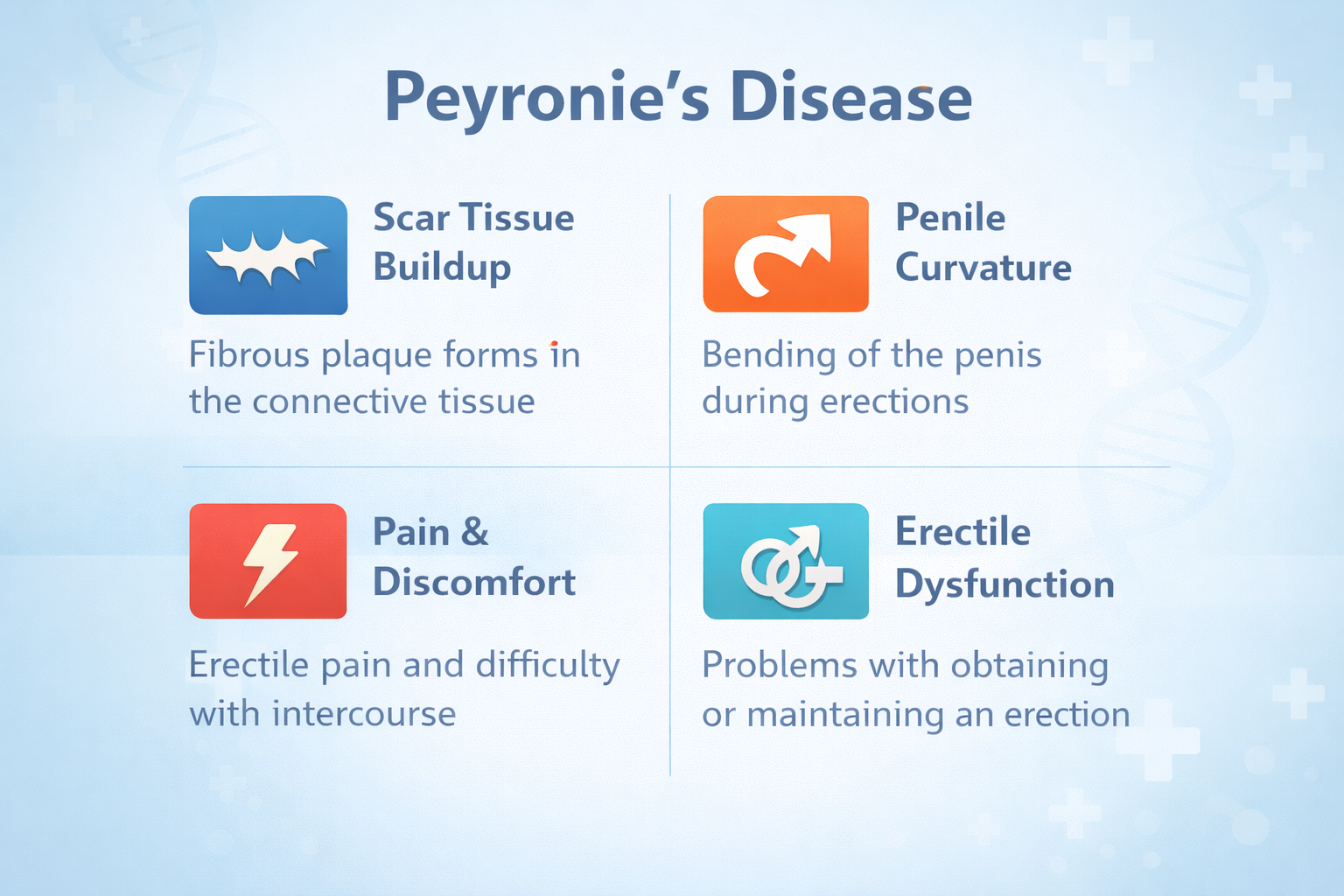
Peyronie’s disease may cause curvature, indentation, hourglass narrowing, hinge instability, shortening, pain or erectile dysfunction.
Explore Peyronie’s Disease →Organise erection quality, curvature, previous surgery and available investigations.
Case Navigator →Persistent deformity, implant problems or previous penile surgery may require a revision pathway.
Previous Treatment →Start with tablet response, injection suitability and the next reasonable treatment step.
ED Treatment Failure Pathway →Explore recovery after prostate cancer treatment, including the dedicated post-prostatectomy pathway.
Post-Prostate Treatment ED →See how erection quality, fibrosis and deformity can change clinical decisions.
Complex Case Atlas →Understanding why rigidity has changed comes first
Erectile dysfunction is not one single condition. Some men have difficulty becoming fully erect, while others achieve an erection but cannot maintain sufficient rigidity.
Assessment considers the pattern of erections, general health, medications, previous pelvic treatment, libido, penile conditions and response to previous treatment.
Cardiovascular disease, diabetes, medications, neurological conditions and selected hormonal factors may be relevant.
Vascular
Diabetes, cardiovascular risk factors and vascular disease can affect penile blood flow.
Neurological
Neurological conditions and previous pelvic treatment may affect the nerve pathways involved in erection.
Medication & Hormonal
Prescribed medicines and selected hormonal abnormalities may contribute in some men.
Penile Mechanics
Peyronie’s disease, fibrosis and previous penile surgery can alter erectile function.
Psychosexual
Anxiety, stress, mood and relationship factors may occur alone or alongside physical causes.
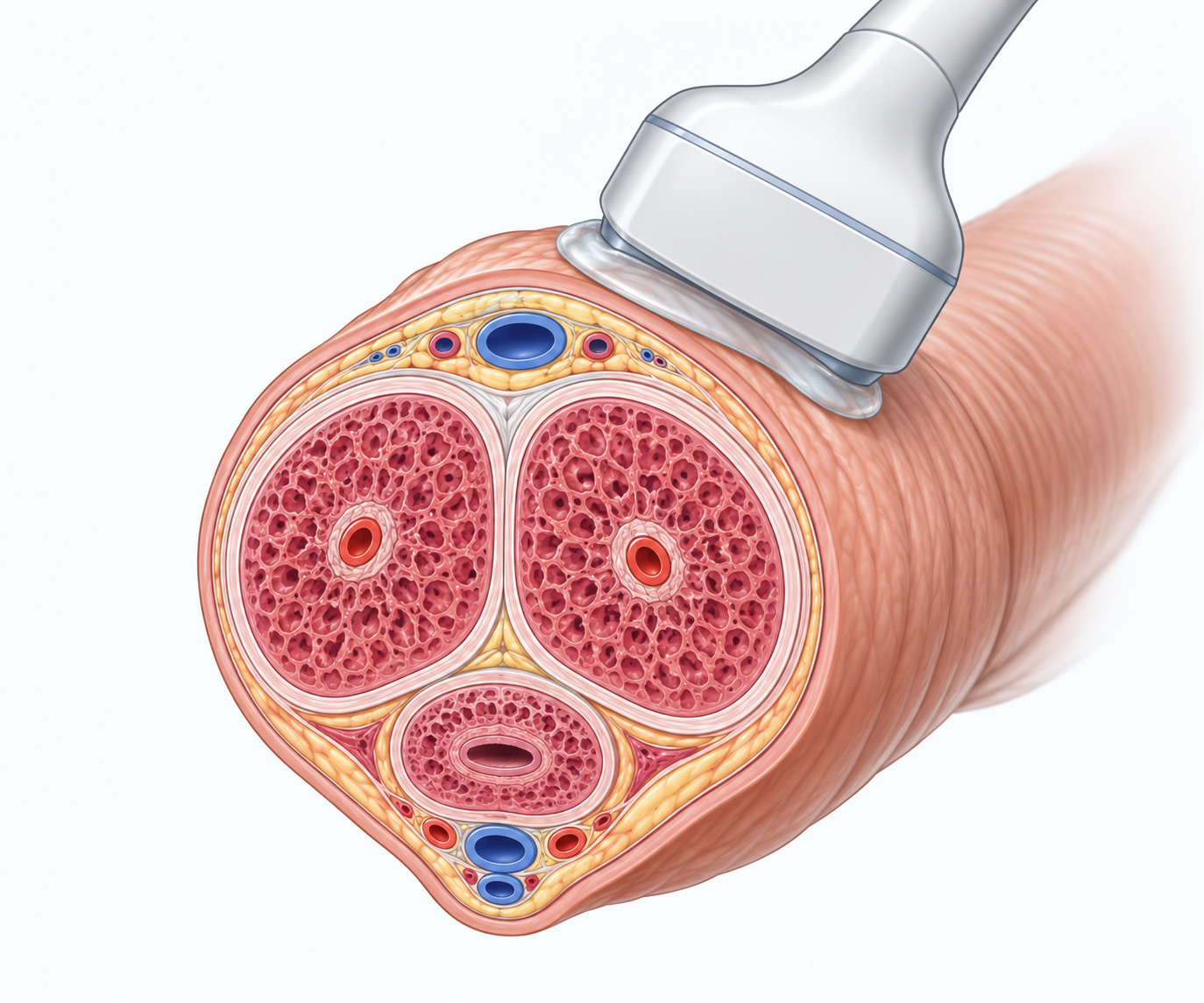
Penile ultrasound is used selectively — not routinely for every ED assessment
Most erectile dysfunction can be assessed from the history, examination and appropriate general investigations. Penile ultrasound or Doppler assessment may add useful information in selected situations where anatomy or penile haemodynamics could change the treatment discussion.
Explore erectile dysfunction assessment →What happens after tablets, injections or other ED treatment?
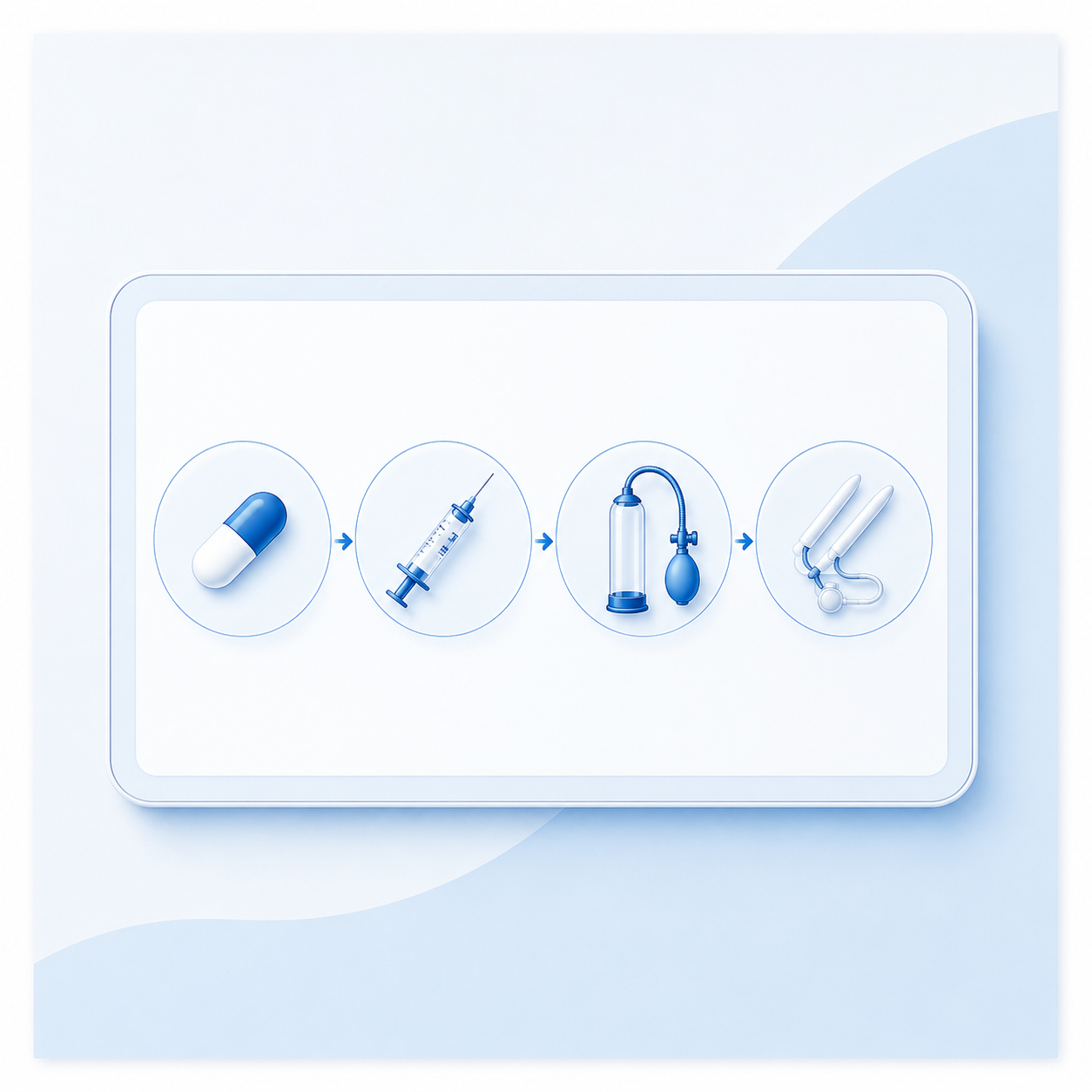
A poor response to one treatment does not automatically mean penile implant surgery is the next step. The useful question is whether treatment has been used appropriately, whether it is effective enough, whether it remains acceptable, and how much reliability and spontaneity matter to you.
Move through the decision points rather than repeating treatment that is not meeting your goals
These dedicated pages explain the common decision points between oral medication, penile injection therapy, treatment-resistant ED and a penile implant discussion. They are designed to complement the main Erectile Dysfunction page and ED Treatment Pathway.
ED Tablets Not Working — What Happens Next?
Review whether sildenafil, tadalafil or another PDE5 inhibitor has genuinely been unsuccessful and understand which non-tablet options may reasonably come next.
Explore Next Steps After ED Tablets →Penile Injections for ED — What If They Don’t Suit Me?
Understand alternatives when injections are ineffective, painful, difficult to use consistently, burdensome or simply not preferred.
Explore Alternatives to Penile Injections →Penile Implant vs Penile Injections
Compare reliability, spontaneity, ongoing treatment burden, invasiveness and the practical differences between injections and an implanted prosthesis.
Compare Implant and Injection Pathways →Severe / Treatment-Resistant Erectile Dysfunction
A dedicated pathway for men whose erectile dysfunction remains severe despite standard treatments, or where available options are unsuitable or unacceptable.
Explore Treatment-Resistant ED →When Should You Consider a Penile Implant?
Understand when penile prosthesis surgery may reasonably enter the discussion after inadequate, unsuitable or unwanted non-surgical ED treatment.
Explore When to Consider an Implant →Injection therapy acts directly within the erectile tissue
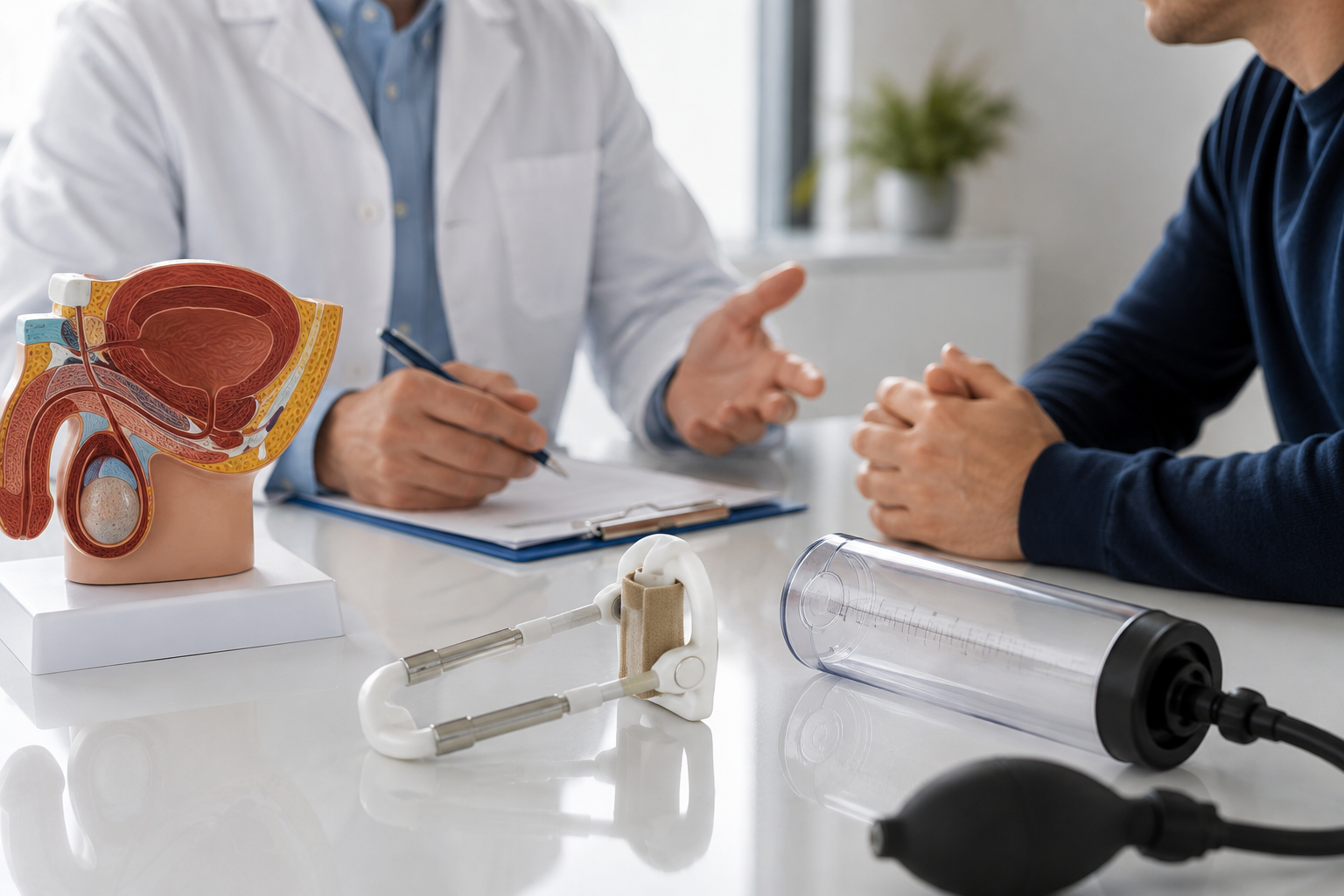
Intracavernosal injections can be considered when tablets are ineffective, unsuitable or unreliable. Technique, dose, response and safety need to be taught and reviewed individually rather than treated as a one-size-fits-all step.
Explore penile injections and alternatives →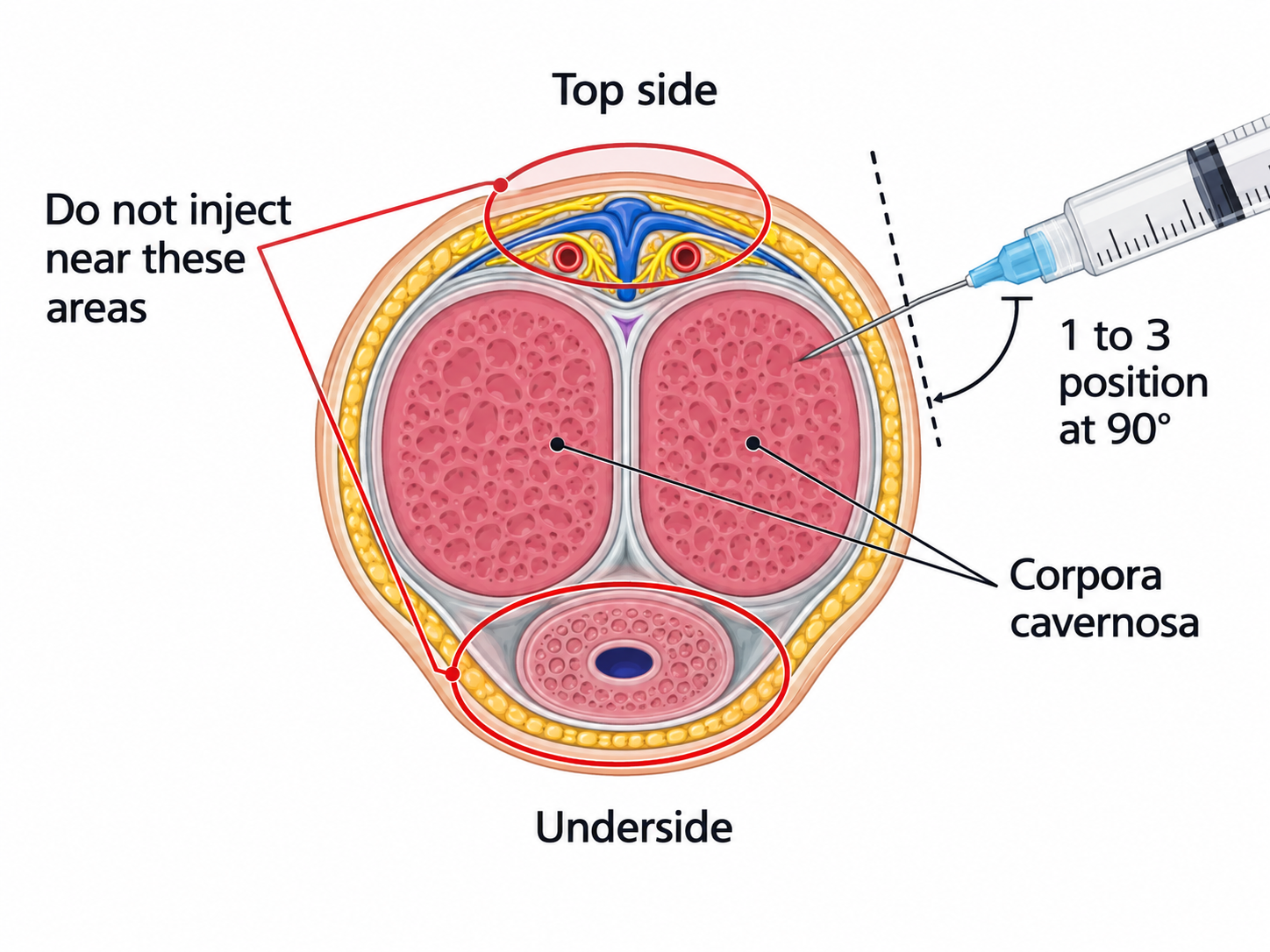
Prostate cancer treatment creates a distinct ED pathway
Erectile dysfunction after radical prostatectomy, radiotherapy or other prostate cancer treatment is not identical to general age-related ED. The type of cancer treatment, pre-treatment erections, nerve preservation, time since treatment, recovery trajectory and response to rehabilitation can all affect the next discussion.
Erectile Dysfunction After Prostate Cancer Treatment
An overview of why erectile function can change after prostate cancer treatment, what recovery may look like and when treatment escalation may be discussed.
Explore ED After Prostate Cancer Treatment →Erectile Dysfunction After Radical Prostatectomy
A focused pathway covering erectile recovery after prostate removal, penile rehabilitation, tablets, vacuum therapy, injections and the point at which escalation may be useful.
Explore ED After Radical Prostatectomy →Penile Implant After Prostatectomy
Dedicated information for men considering a penile prosthesis after radical prostatectomy, including timing, expectations and the importance of previous pelvic surgery in operative planning.
Explore Penile Implant After Prostatectomy →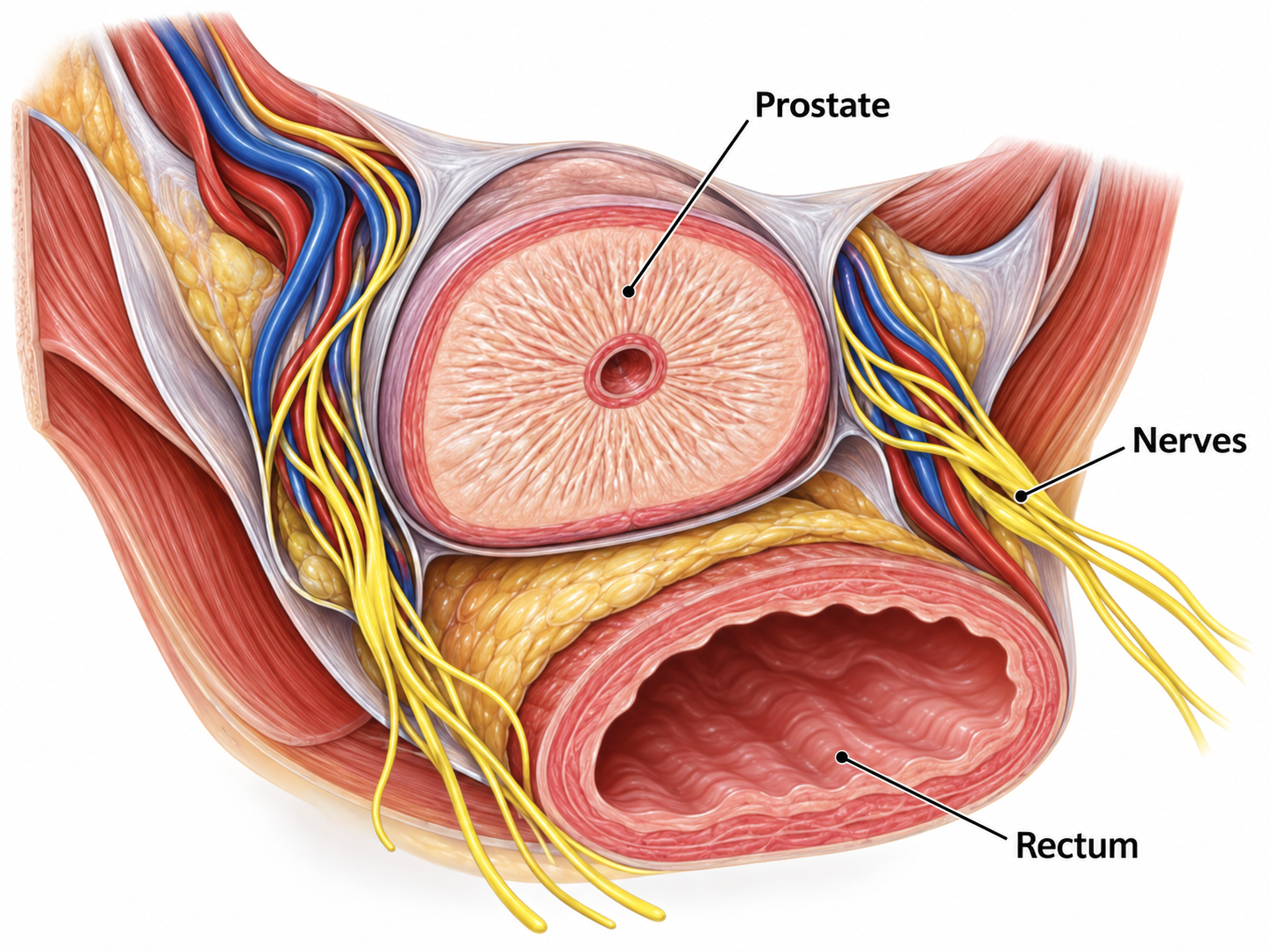
Previous prostate treatment changes the questions that matter
Baseline erections, nerve preservation, radiotherapy, time since treatment and response to rehabilitation can all influence the next discussion. The goal is to match treatment escalation to recovery trajectory and individual priorities.
Explore the post-prostatectomy ED pathway →Some men prioritise rehabilitation and natural recovery for longer, while others prioritise a reliable assisted erection or a definitive treatment discussion. These pages are educational and do not set a single mandatory treatment sequence.
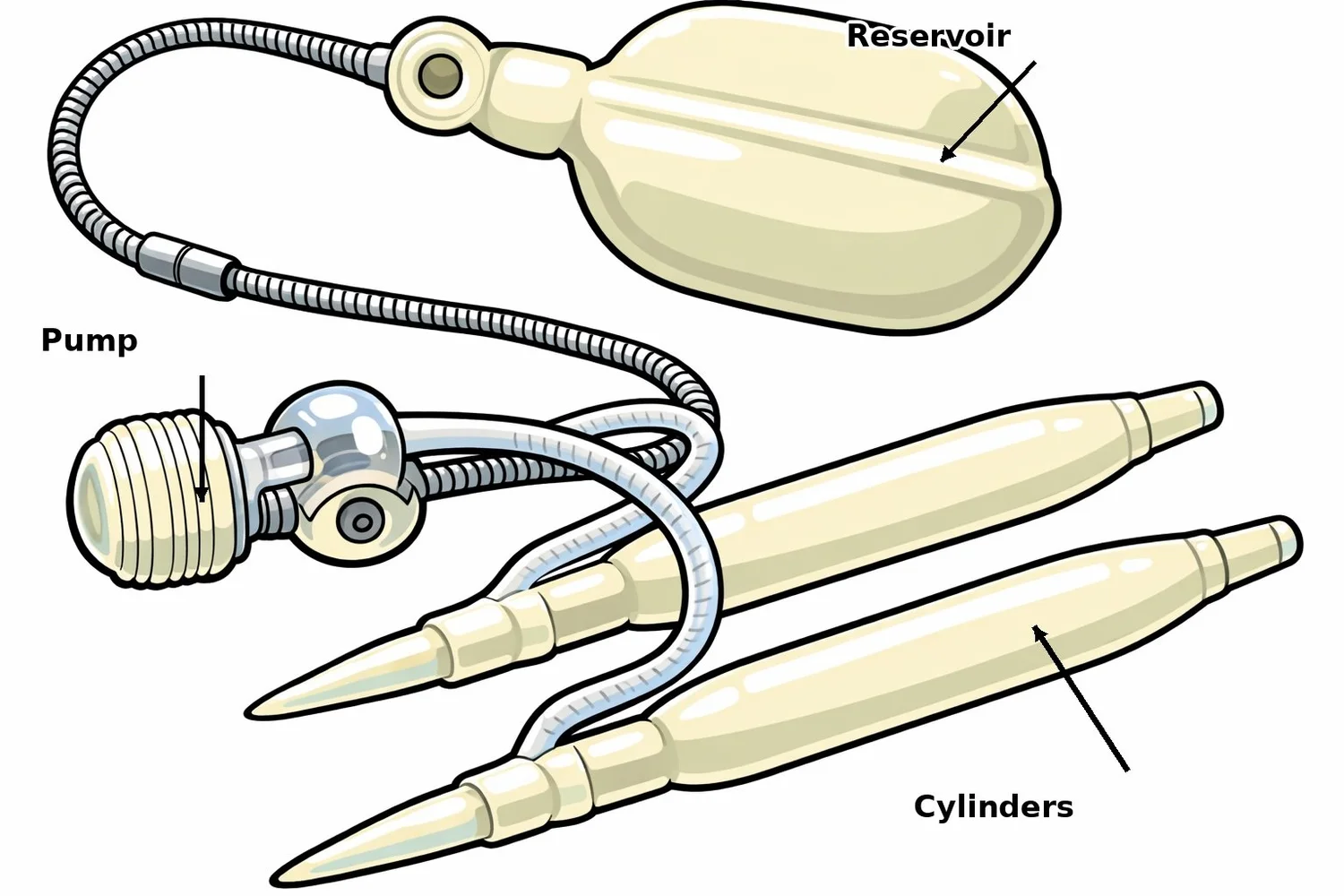
Mechanical rigidity when natural erectile function is inadequate
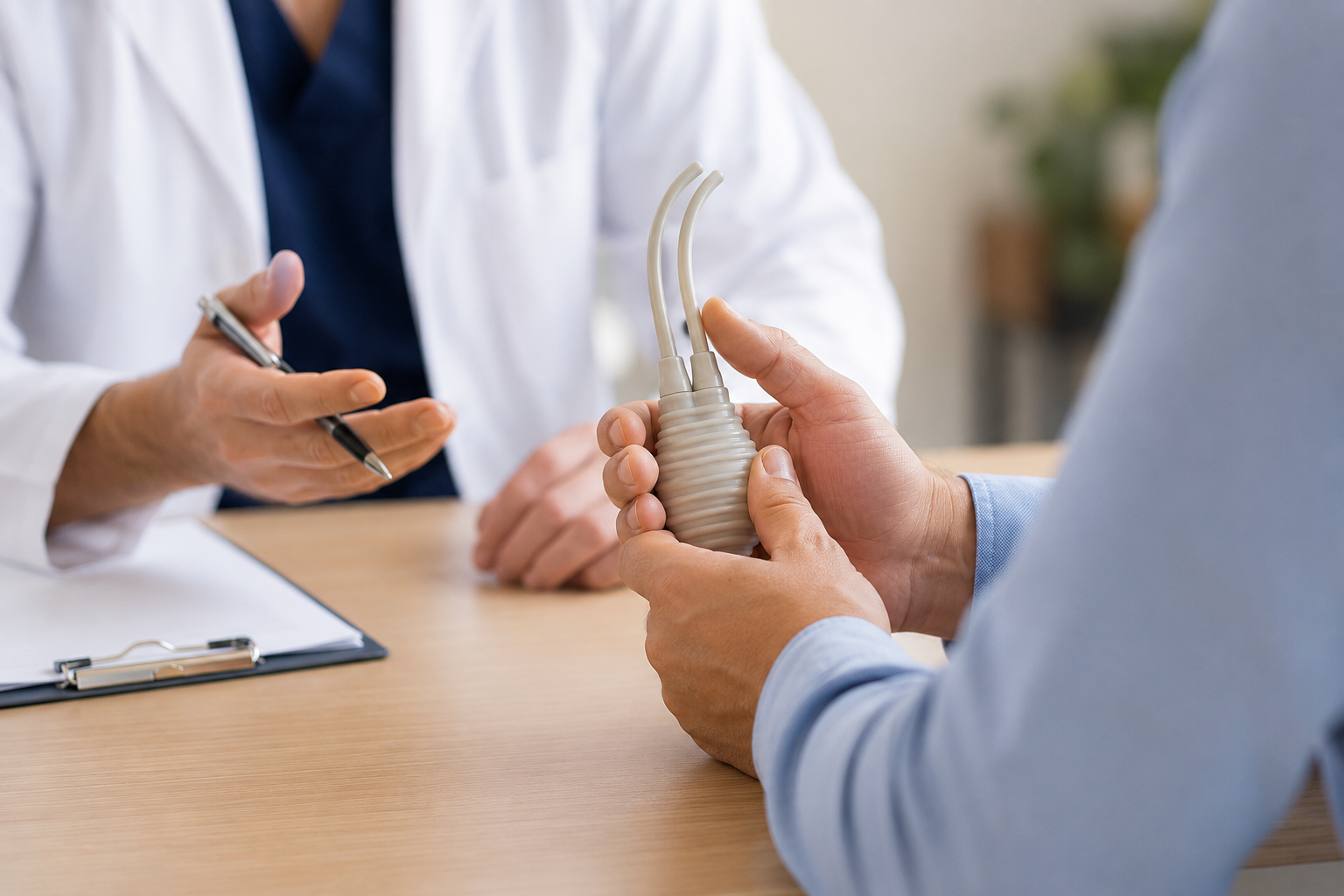
A penile implant is a surgically implanted medical device designed to provide penile rigidity when required.
Surgery may enter the discussion when significant erectile dysfunction remains problematic despite appropriate non-surgical options, when those treatments are unsuitable, or when an appropriately assessed patient prefers a surgical pathway.
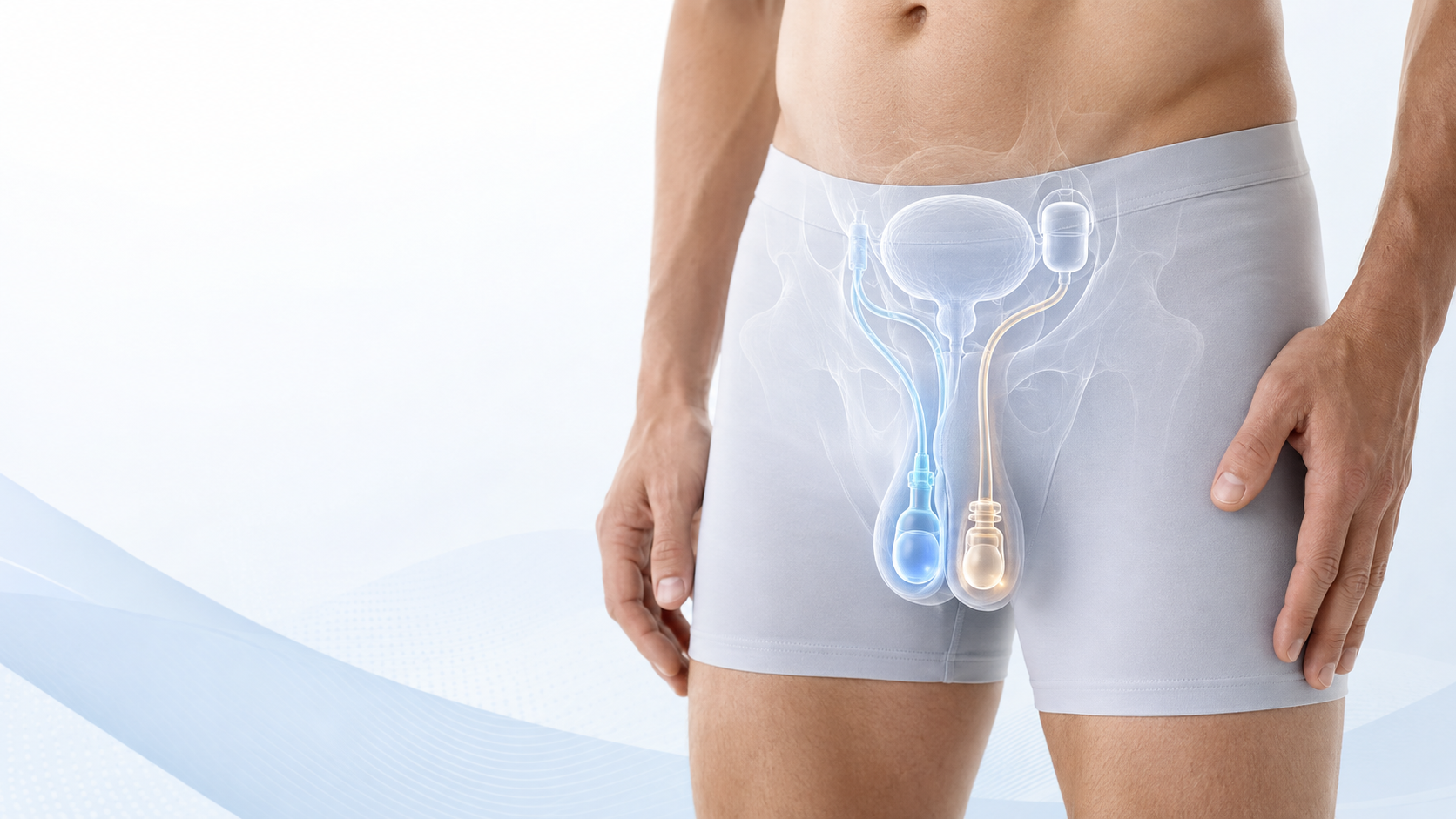
Implanted within the erectile chambers.
Positioned within the scrotum in an inflatable system.
Stores fluid within the pelvis or lower abdomen in a three-piece system.
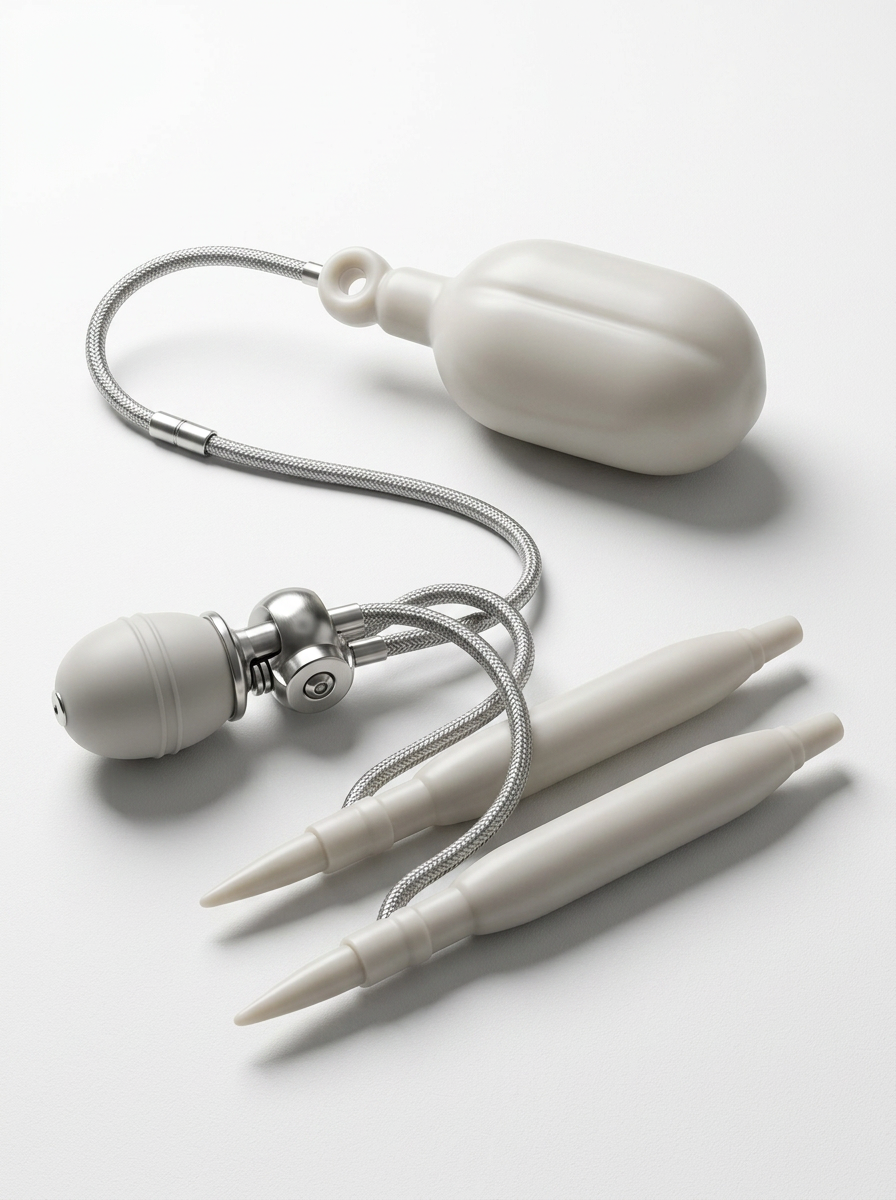
Three-Piece Inflatable Implant
Paired cylinders, a scrotal pump and fluid reservoir. The device can be inflated when rigidity is desired and deflated afterwards.
Malleable Penile Implant
Bendable implanted rods without a pump or fluid reservoir. The simpler mechanical design may be relevant in selected circumstances.
Device selection is not automatic
Anatomy, dexterity, previous pelvic surgery, penile fibrosis, prior infection and individual priorities all influence the discussion.
Inflatable and malleable systems use different mechanics
These are educational visuals already used within the penile implant information on this website. The purpose is to make the mechanical differences easier to understand before a detailed consultation about suitability, expectations and surgical planning.


Compare the decision, the alternatives and the post-prostatectomy pathway
These dedicated pages sit between general ED information and the main penile implant surgery page so patients can explore the specific decision point most relevant to them.
When non-surgical treatment has been inadequate, unsuitable or no longer fits your priorities.
Explore Implant Timing →Compare ongoing injection treatment with a surgically implanted option for rigidity.
Compare Options →Focused information for persistent erectile dysfunction after radical prostatectomy.
Explore Post-Prostatectomy Implant →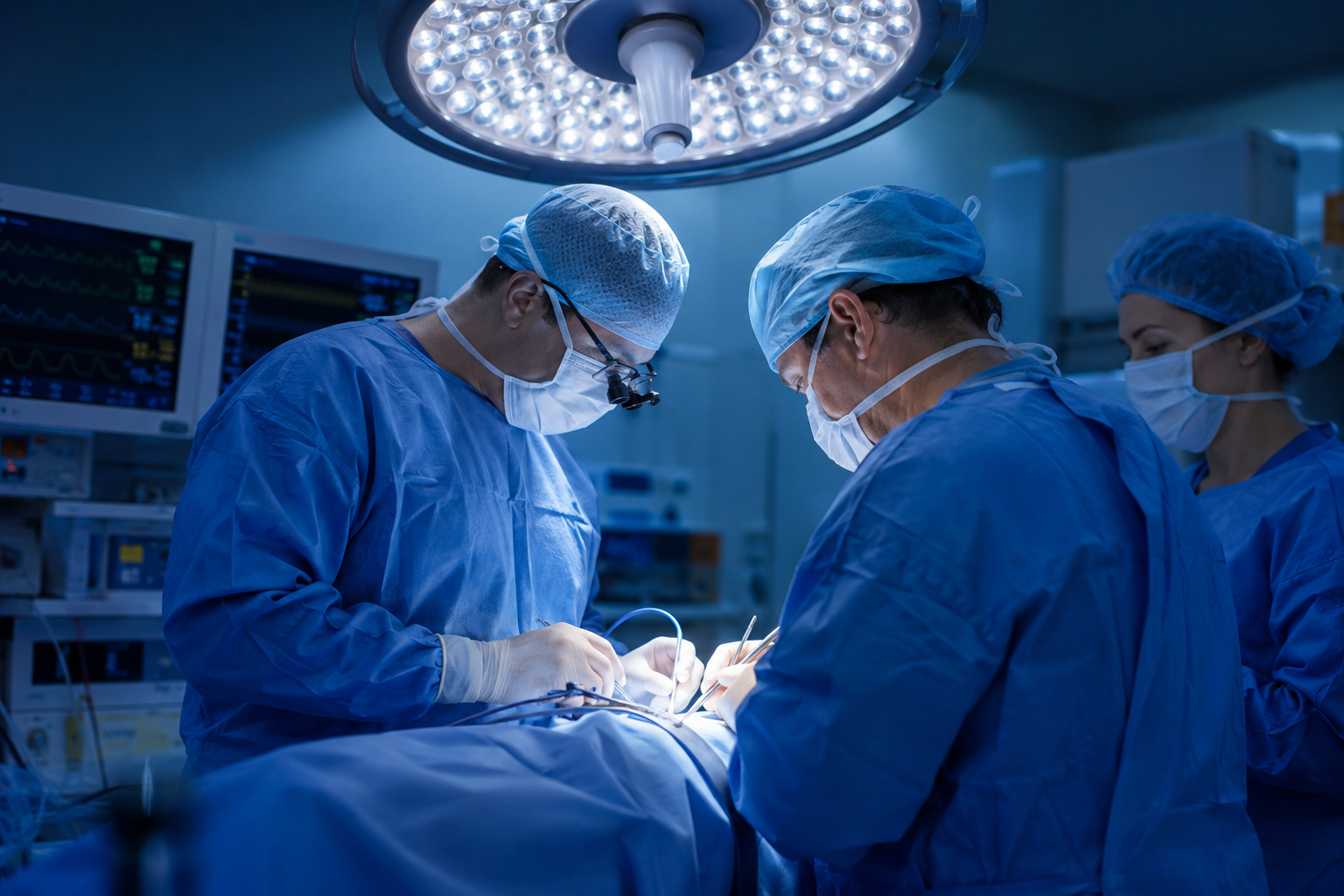
Previous surgery can make implant planning more complex
Scar tissue, altered anatomy, prior pelvic surgery, previous infection and earlier implant procedures may all influence operative planning.
Revision surgery therefore requires assessment of both the current device problem and the anatomy created by earlier surgery.
Explore Implant Revision →An existing implant problem requires a different assessment
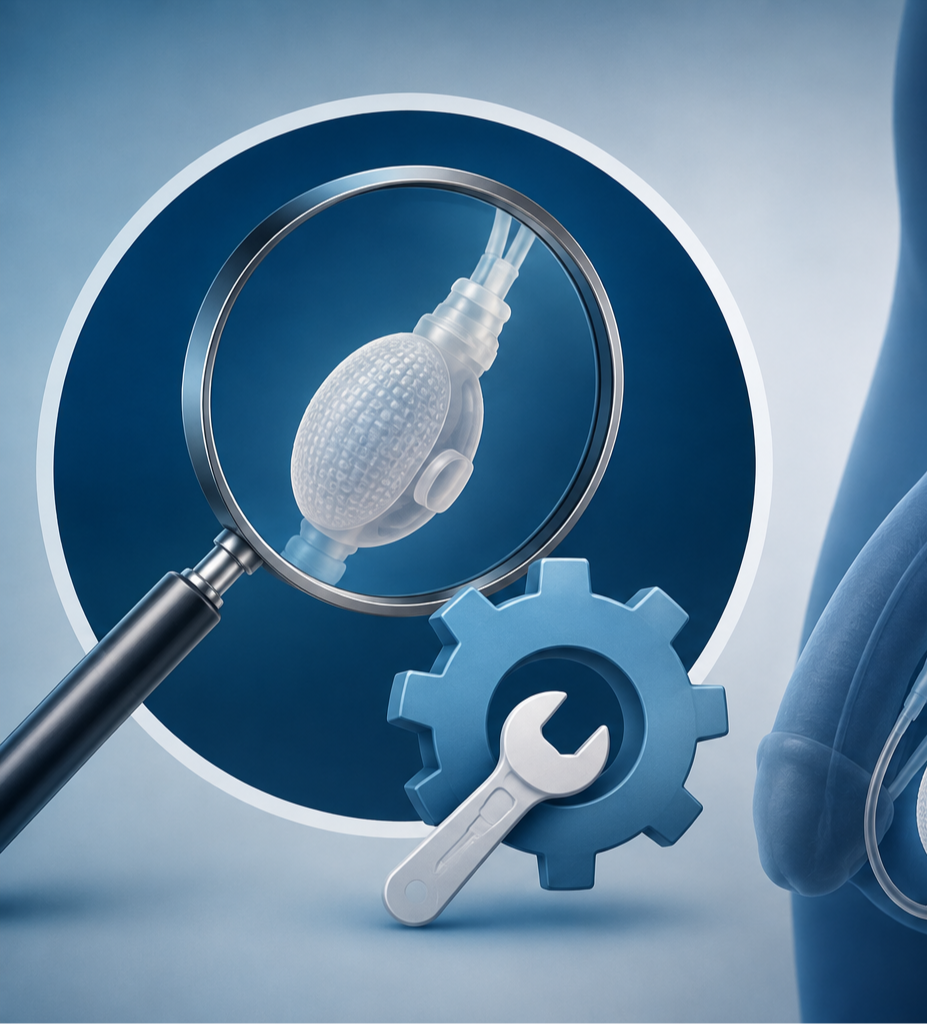
Penile implants can develop mechanical, positioning, wound, infection or tissue-related problems.
Previous infection, implant removal, multiple revisions and corporal fibrosis can make repeat surgery substantially more complex than primary implantation.
Curvature is only one component of the deformity
Peyronie’s disease involves abnormal scar tissue within the tunica albuginea, which can prevent one part of the penis from expanding normally during erection.
The clinical decision depends on disease stability, penile length, deformity complexity, erection quality and functional difficulty rather than curvature angle alone.
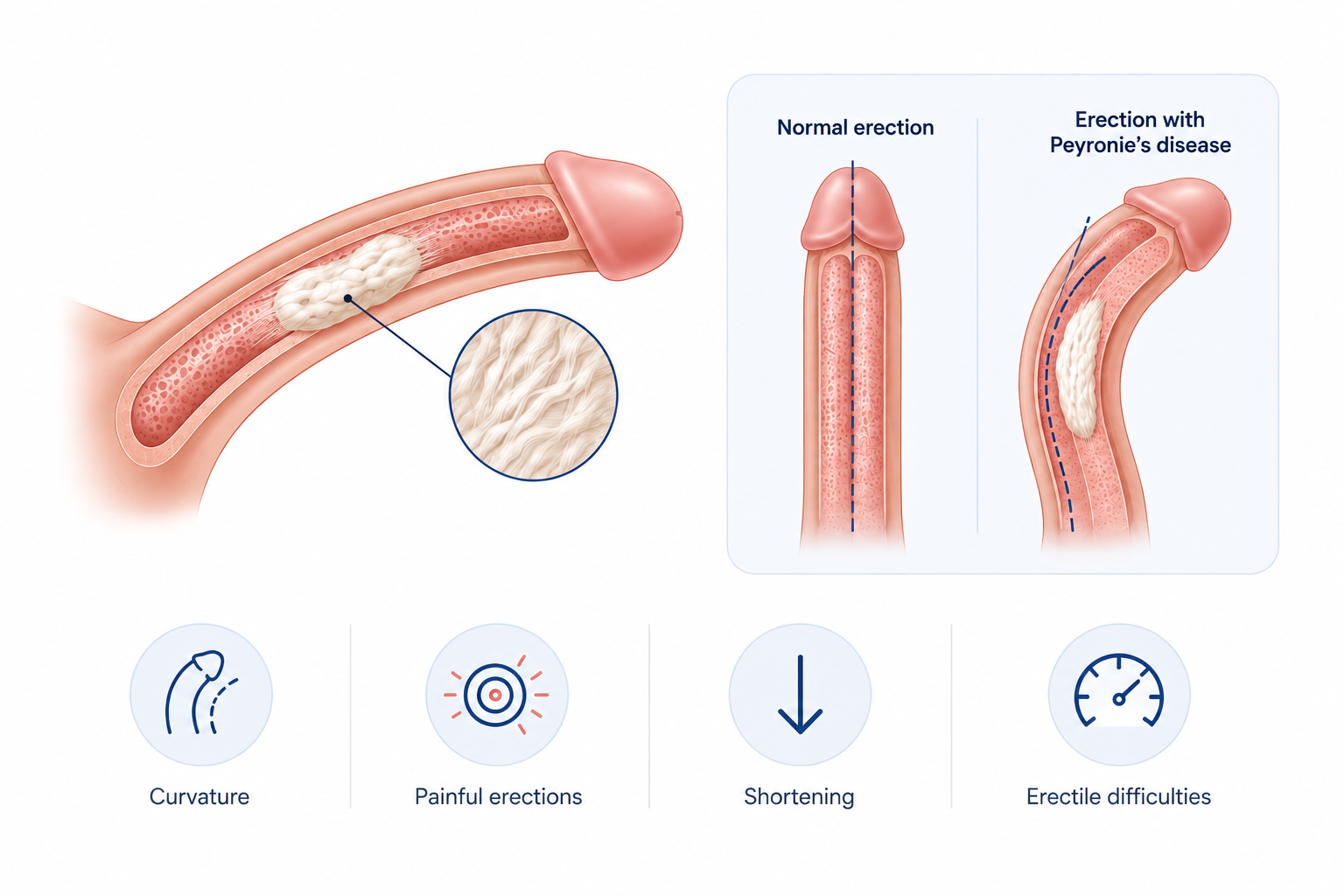
The operation depends on erection quality and deformity
Plication, grafting and penile implant surgery treat different mechanical problems and are not interchangeable operations.
Deformity-directed reconstruction
Where erectile function remains reliable, surgery may focus primarily on straightening the penis or correcting structural deformity.
Penile Plication
Straightens the penis by shortening the longer side. More applicable where erections remain reliable and major narrowing or hinge instability is absent.
Explore Plication →Plaque Incision & Grafting
Releases the shortened side and reconstructs the tunical defect. May be considered for selected severe or complex deformities.
Explore Grafting →Hourglass & Hinge Deformity
Significant narrowing can produce buckling despite relatively modest curvature. Correcting angle alone may not restore structural stability.
Explore Complex Deformity →Implant ± Straightening
When erectile rigidity remains inadequate, implant surgery may address rigidity while residual curvature or deformity is corrected where required.
Explore Implant Surgery →Different Peyronie’s problems lead to different treatment discussions
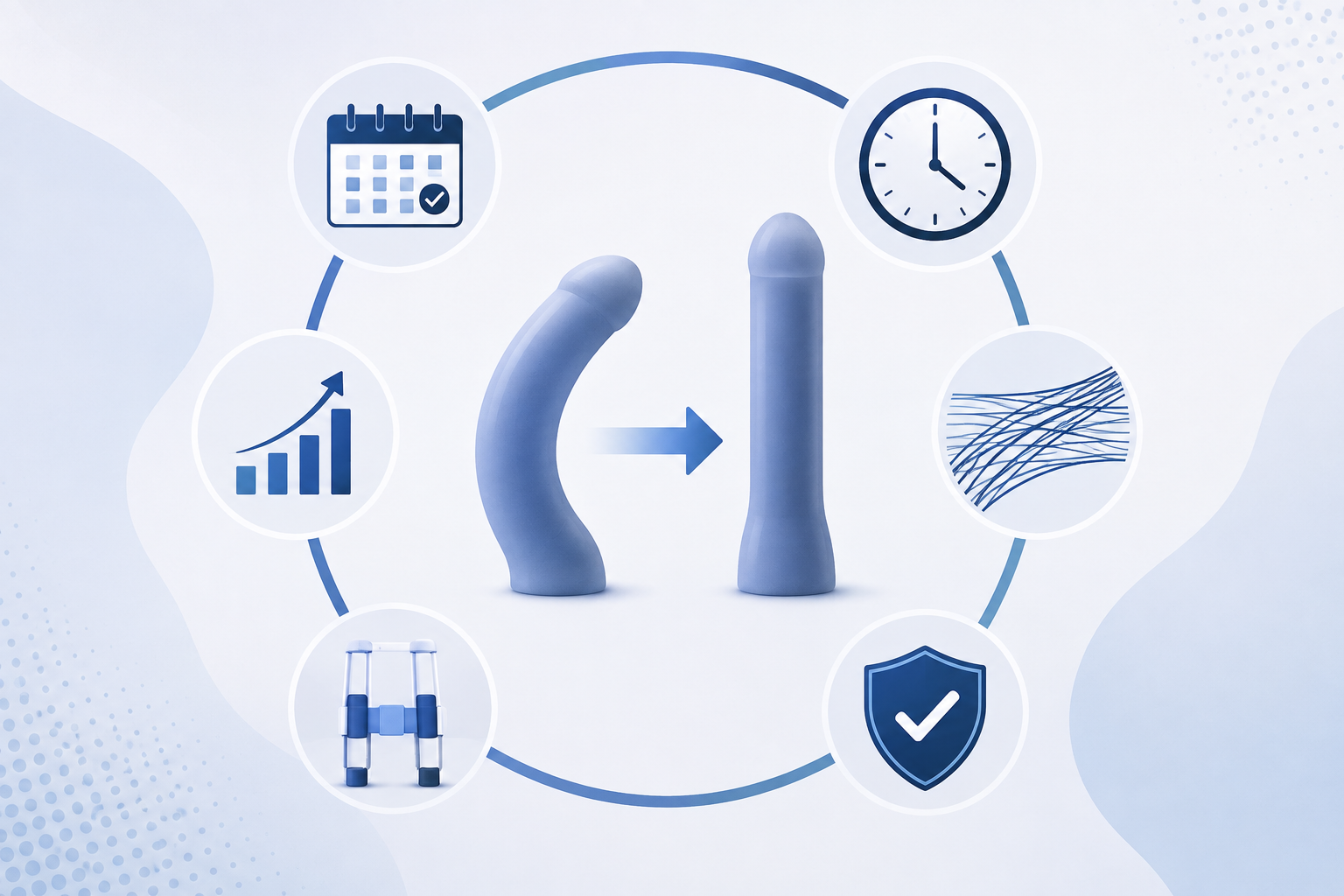
These site-hosted visuals help distinguish the deformity itself from conservative treatment, reconstructive surgery and the implant pathway when erectile dysfunction materially changes the operation.
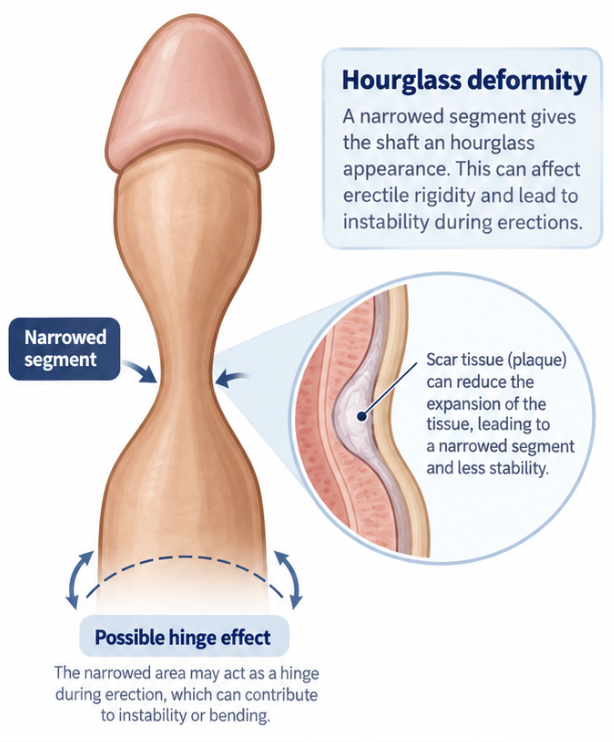
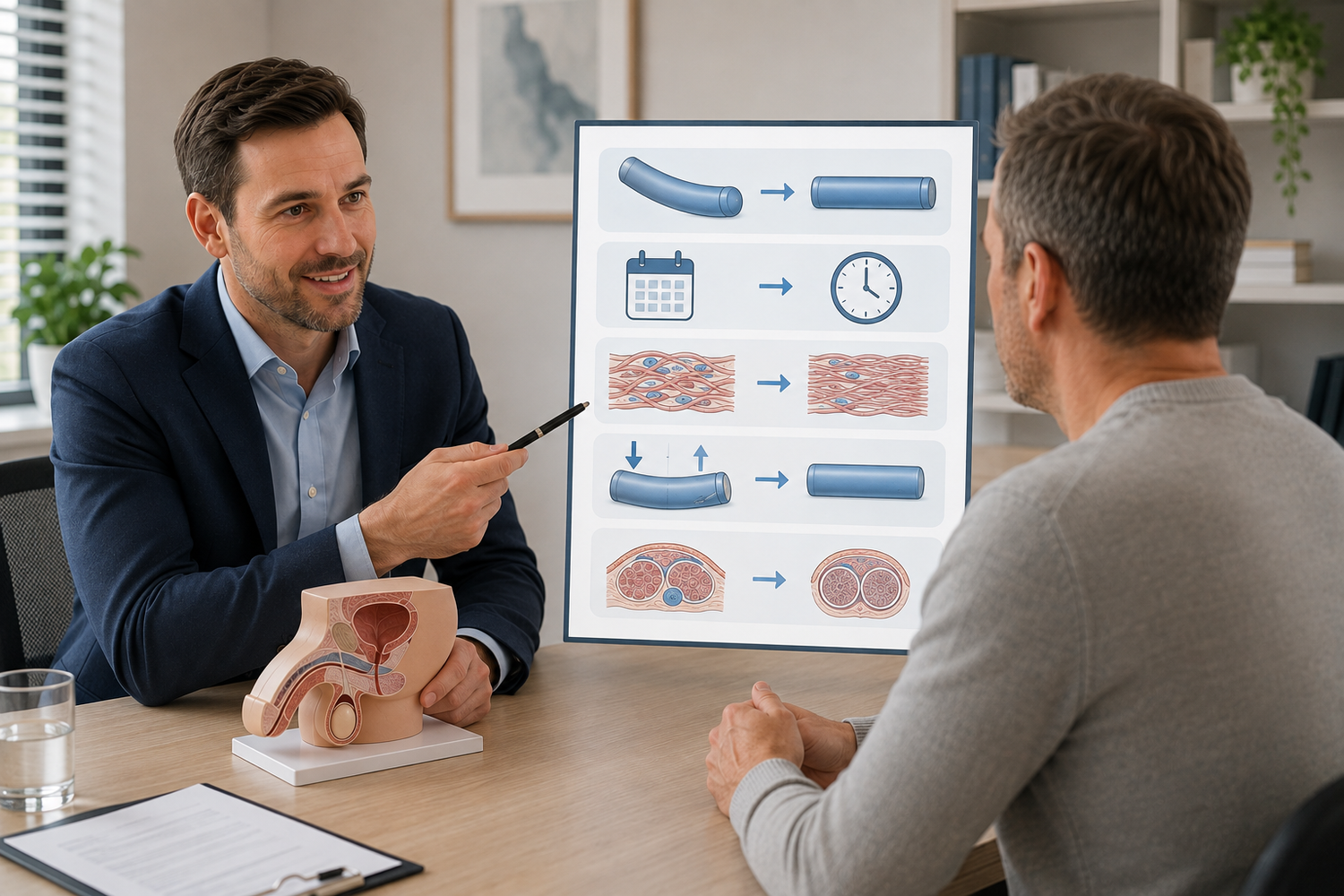
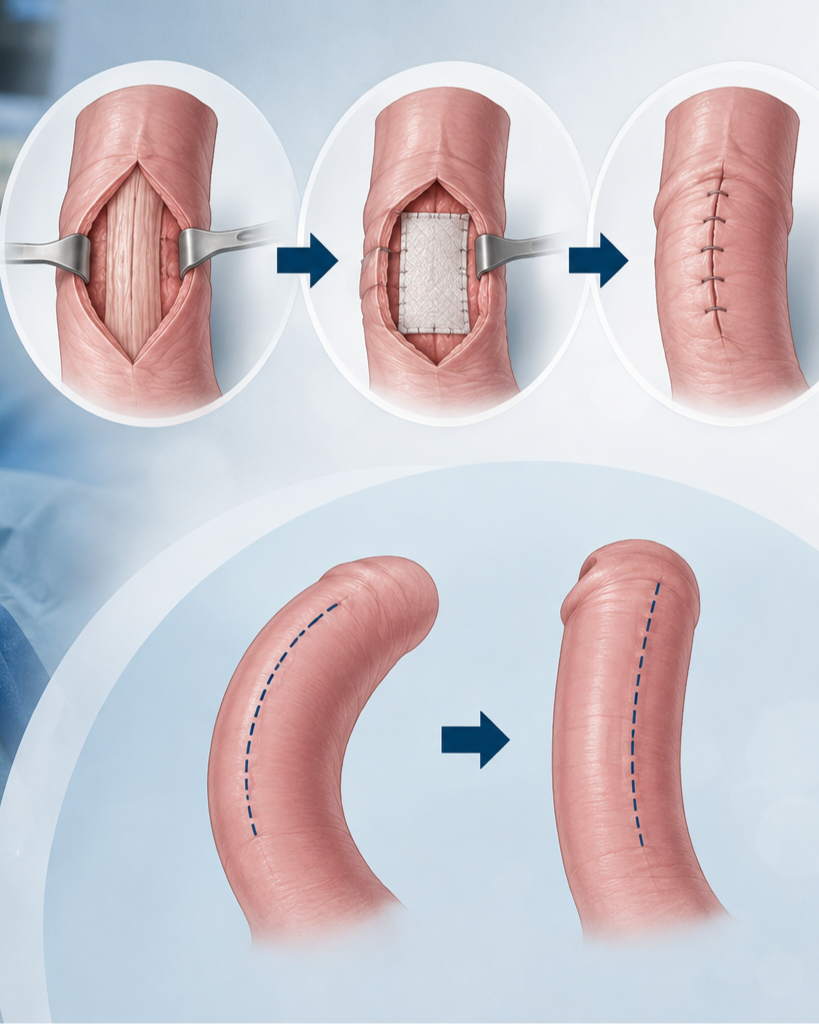
A straighter penis does not solve inadequate rigidity
Baseline erection quality is central to reconstructive planning because plication and grafting change penile shape but do not create stronger erections.
Treat the deformity
Surgical planning may focus primarily on curvature, length, narrowing and stability.
- Plication
- Grafting in selected anatomy
- Complex deformity reconstruction
Assess erectile reserve carefully
Baseline rigidity and treatment response deserve particular attention before more extensive reconstructive surgery.
- Document erection quality
- Review ED treatment response
- Consider selected investigation
Treat rigidity and deformity together
Penile implant surgery may provide the structural foundation while residual curvature is corrected as required.
- Mechanical rigidity
- Possible modelling
- Additional straightening where required
Previous treatment can change the anatomy
Previous injections, plication, grafting, implant surgery, infection, explantation or reconstructive procedures can change scar tissue, tissue quality and future surgical options.
See what actually changes the clinical decision
Explore composite scenarios involving deformity, poor erectile function, implant problems, fibrosis and previous surgery.
Explore Case Atlas →Patient Tools
Use these resources to organise symptoms and prepare questions. They do not diagnose a condition or automatically recommend treatment.
ED Treatment Pathway
Review factors that can influence erectile dysfunction assessment and treatment discussions.
Open Tool → 02 Peyronie’s diseasePeyronie’s Treatment Explorer
Organise curvature, narrowing, erection quality, stability and functional impact.
Open Tool → 03 Implant educationPenile Implant Discussion Guide
Understand general design differences and questions to discuss before implant surgery.
Open Guide → 04 Complex / overlapping problemsAndrology Case Navigator
Organise deformity, erectile function, previous treatment and existing records into one summary.
Open Navigator →
Specialist assessment before choosing the operation
Complex penile surgery depends on more than one diagnosis. Erectile function, penile dimensions, scar pattern, previous surgery, tissue quality and patient priorities often need to be considered together.
Dr Jack Crozier’s subspecialty practice includes erectile dysfunction, penile prosthetic surgery, Peyronie’s disease and reconstructive andrology.
Preparing for assessment from outside Brisbane
Existing information may be useful before travelling for complex penile or implant assessment.

Explore in more detail
Go directly to the most relevant condition, treatment-failure page, post-prostate pathway, procedure or reconstructive pathway.
Erectile Dysfunction
Causes, assessment and available treatment pathways.
ED Tablets Not Working
What to review when oral ED treatment has not produced a satisfactory response.
Penile Injections for ED
Alternatives when penile injections are ineffective, difficult, burdensome or unsuitable.
Severe / Treatment-Resistant ED
Persistent severe ED after standard treatments have been inadequate, unsuitable or unacceptable.
ED After Prostate Cancer Treatment
Sexual recovery and treatment options after prostate cancer surgery, radiotherapy or other treatment.
ED After Radical Prostatectomy
Focused post-prostatectomy recovery, rehabilitation and treatment escalation.
Penile Implant vs Penile Injections
Compare reliability, spontaneity, ongoing treatment burden and surgical considerations.
When to Consider a Penile Implant
When prosthesis surgery may reasonably enter the discussion after ED treatment.
Penile Implant After Prostatectomy
Implant considerations for persistent ED after radical prostatectomy.
Penile Implant Surgery
Inflatable and malleable prosthetic surgery.
Penile Implant Revision
Mechanical failure, positioning, infection and fibrosis.
Peyronie’s Disease
Curvature, narrowing, shortening and erection quality.
Hourglass & Hinge
Complex contour loss and mechanical instability.
Plaque Incision & Grafting
Tunical-lengthening reconstruction for selected deformity.
Penile Plication
Straightening surgery for selected stable curvature.
Penile Reconstruction
Complex reconstructive and revision urology.
ED, Penile Implant & Peyronie’s FAQs
If ED tablets have not worked, do I automatically need an implant?
No. Previous tablet response is only one part of assessment. Other treatment options may remain relevant depending on the underlying cause, severity, previous treatment and individual priorities.
What if penile injections work but I do not want to keep using them?
Treatment choice depends on more than whether an injection can produce an erection. Reliability, pain, preparation, spontaneity, ongoing treatment burden and personal preference can all be relevant when discussing alternatives.
How is erectile dysfunction after radical prostatectomy different from general ED?
Radical prostatectomy can affect the nerve and vascular pathways involved in erection. Baseline erectile function, nerve preservation, time since surgery and response to rehabilitation therefore become particularly relevant to treatment planning.
When is it reasonable to discuss a penile implant?
Implant discussion may become reasonable when erectile dysfunction remains significantly bothersome despite appropriate non-surgical treatment, when those treatments are unsuitable or unacceptable, or when an appropriately assessed patient wants to understand a definitive surgical option.
Is an inflatable or malleable penile implant better?
There is no single implant design that is best for every patient. Anatomy, manual dexterity, previous surgery, fibrosis, medical factors and individual priorities can all affect the discussion.
Can a penile implant require revision later?
Yes. Mechanical failure, positioning problems, infection, erosion or tissue-related problems may eventually require revision, replacement or removal.
Does curvature angle determine which Peyronie’s operation I need?
No. Erection quality, penile length, hourglass narrowing, hinge instability and deformity complexity can be just as important as curvature angle.
What is the difference between plication and grafting?
Plication straightens the penis by shortening the longer side. Grafting releases the shortened side and reconstructs the resulting tunical defect. They have different implications for penile length and erectile function.
What if I have Peyronie’s disease and poor erections?
Both problems should be considered together. If erectile rigidity remains inadequate despite appropriate treatment, straightening-only surgery may not address the main functional problem and penile implant surgery may enter the discussion.
What if previous surgery did not fix the problem?
Previous plication, grafting, implant surgery or reconstruction can alter anatomy and scar tissue. Operative reports and current functional concerns are particularly useful when reassessing these cases.
What records are useful if I already have an implant?
Implant identification information, previous operation reports, details of infection or revision and relevant imaging can all be helpful where available.
Define the problem before choosing the procedure
Specialist assessment can distinguish erectile dysfunction, penile deformity, implant-related problems and complex post-surgical anatomy before treatment is considered.
Medical information disclaimer: This page provides general educational information only and does not replace individual medical advice, diagnosis or informed consent. Erectile dysfunction, Peyronie’s disease and penile implant problems vary substantially between patients. Medical devices and surgical procedures have potential risks, contraindications, limitations and alternatives that require individual clinical discussion. Outcomes cannot be guaranteed.
Explore More About Erectile Dysfunction, Penile Implants & Peyronie’s