

Penile Implant vs Penile Injections
Penile injections and penile implant surgery can both provide erections when tablets are no longer effective enough. The main difference is how the erection is produced, how much preparation is required each time, and whether you want an on-demand treatment or a surgical long-term option.
For some men, injections remain effective and convenient for many years. For others, injections become painful, unreliable, inconvenient or simply no longer provide the rigidity they need.

When might each treatment make sense?
Penile injections may remain a good option if they reliably produce an erection, you are comfortable injecting before sexual activity and avoiding surgery remains important to you.
A penile implant may be worth discussing when injections are no longer sufficiently reliable, cause pain or anxiety, interfere with intimacy, or you want to understand a more predictable surgical option for severe erectile dysfunction.
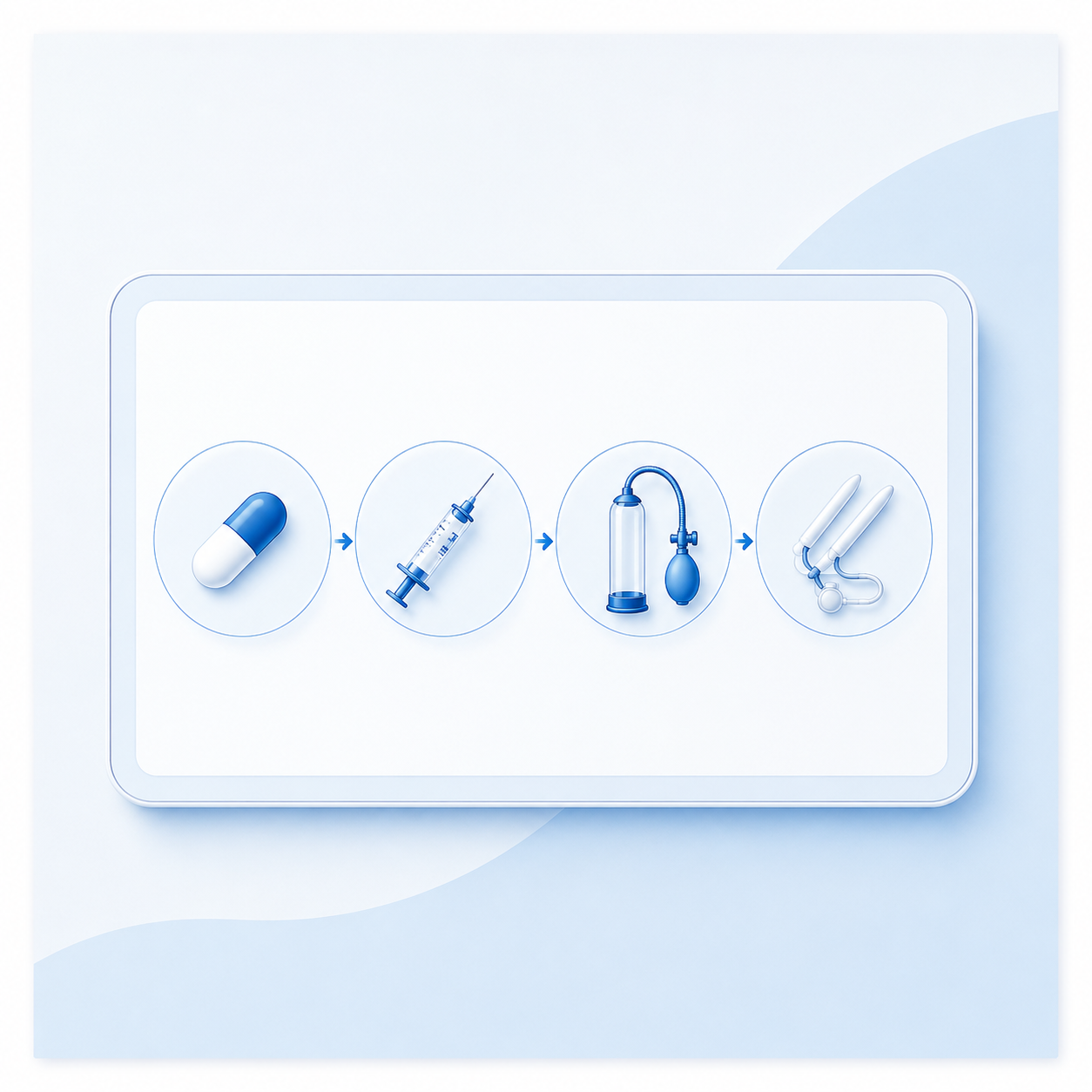
ED treatment is usually a pathway rather than a single decision
Treatment commonly begins with assessment of the underlying cause and consideration of less-invasive options where appropriate.
Tablets, vacuum devices and penile injections rely on different mechanisms. A penile implant is different because it provides mechanical rigidity from a device implanted inside the body.
Moving from injections to an implant is therefore not simply changing medication. It means changing from an on-demand non-surgical treatment to an implanted surgical treatment.
Penile injections vs penile implant
Both can provide sufficient rigidity for intercourse, but the experience of using them is quite different.
| Question | Penile injections | Penile implant |
|---|---|---|
| How is rigidity produced? | Medication is injected directly into the erectile tissue before sexual activity. | An implanted device mechanically produces penile rigidity. |
| Is treatment required before sex? | Yes. The medication and injection need to be prepared and administered before intercourse. | No injection or ED medication is required to create the main rigidity. An inflatable implant is activated when required. |
| Is surgery required? | No. | Yes. Implantation requires an operation and anaesthesia. |
| Predictability | Many men achieve good erections, although response may vary with dose, technique and progression of erectile dysfunction. | Designed to provide predictable mechanical rigidity after recovery when the device is functioning normally. |
| Can I simply stop? | Yes. Injections can be stopped and other ED options can subsequently be considered. | Implantation permanently changes the erectile tissues and future rigidity generally becomes dependent on the implant. |
| Important risks | Pain, bleeding, bruising, prolonged erection, priapism and penile scar tissue. | Infection, bleeding, pain, erosion, device problems, dissatisfaction and possible future revision surgery. |
| When is it often discussed? | When tablets are ineffective or unsuitable but a man wants to continue with non-surgical treatment. | When significant ED persists despite other treatments, alternatives are unsuitable, or an appropriately assessed patient wishes to consider a surgical option. |
Individual suitability depends on medical history, previous prostate or pelvic treatment, penile anatomy, hand function, medications and personal priorities.
Penile injections
Penile injection therapy is also called intracavernosal injection therapy or ICI.
Medication is injected directly into the erectile tissue. It acts locally to relax smooth muscle and increase penile blood flow, allowing an erection to develop.
Injections can remain effective even when tablets such as sildenafil or tadalafil have not produced sufficient rigidity.
Why some men prefer injections
- No operation is required.
- They can work when ED tablets have not worked sufficiently.
- Treatment is used only when required.
- The dose can be adjusted according to response.
- Treatment can be stopped without surgery.
Why some men eventually move away from injections
- The injection process may interfere with spontaneity.
- Penile discomfort can occur.
- Rigidity may become inconsistent.
- Some men become increasingly uncomfortable using needles.
- Repeated injections may contribute to scar tissue.
- There remains a risk of an erection lasting too long.
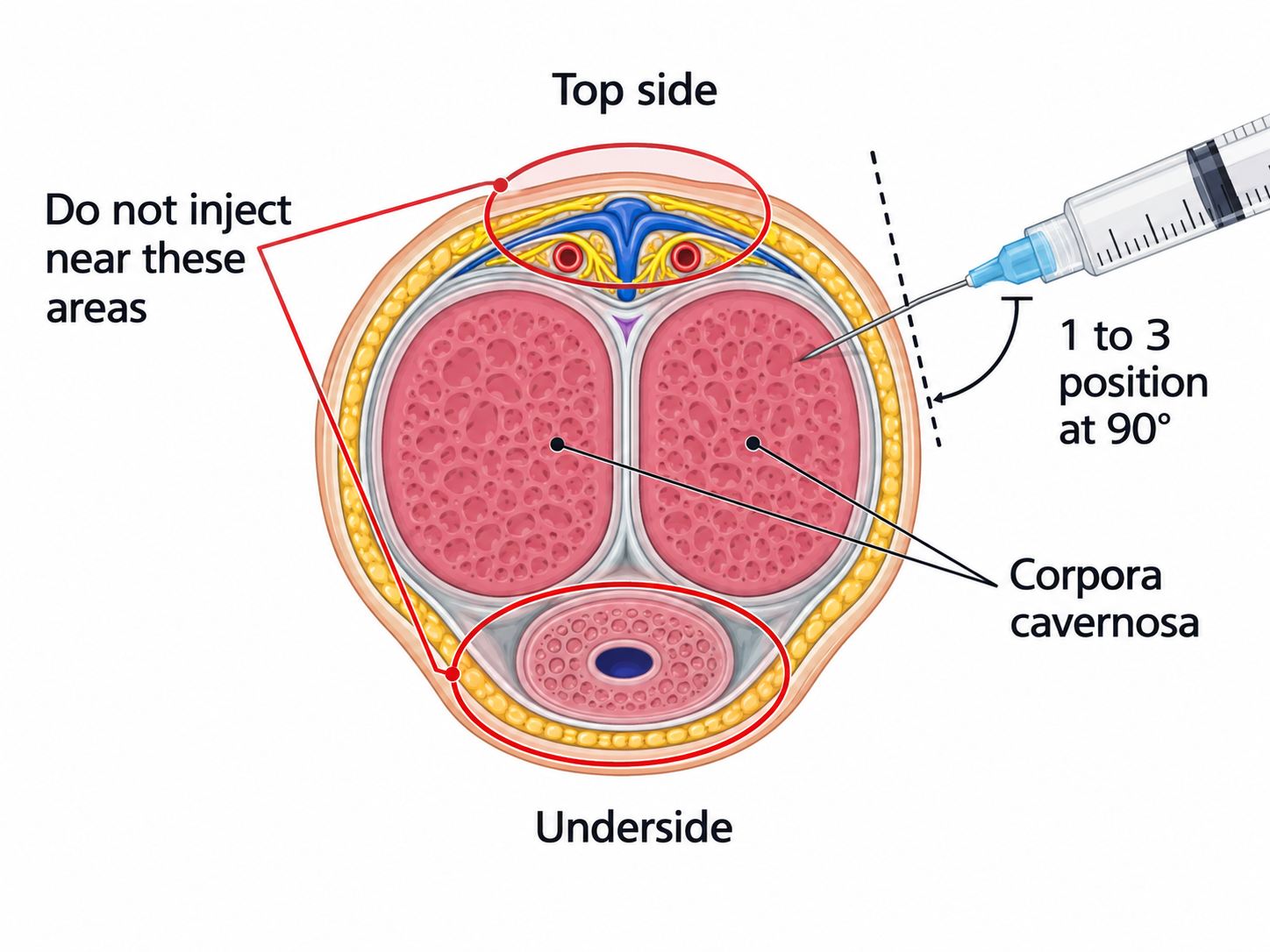
Every erection requires another treatment episode
Have the prescribed medication and injection equipment available.
Administer the prescribed dose using the technique you have been taught.
The erection develops as the medication acts on the erectile tissue.
A prolonged erection requires urgent attention.
An erection lasting around 4 hours requires urgent assessment
Penile injections can occasionally cause a prolonged erection. An erection approaching or lasting 4 hours, particularly when painful or not resolving, requires urgent medical assessment because prolonged priapism can damage the erectile tissue.
Penile implant surgery
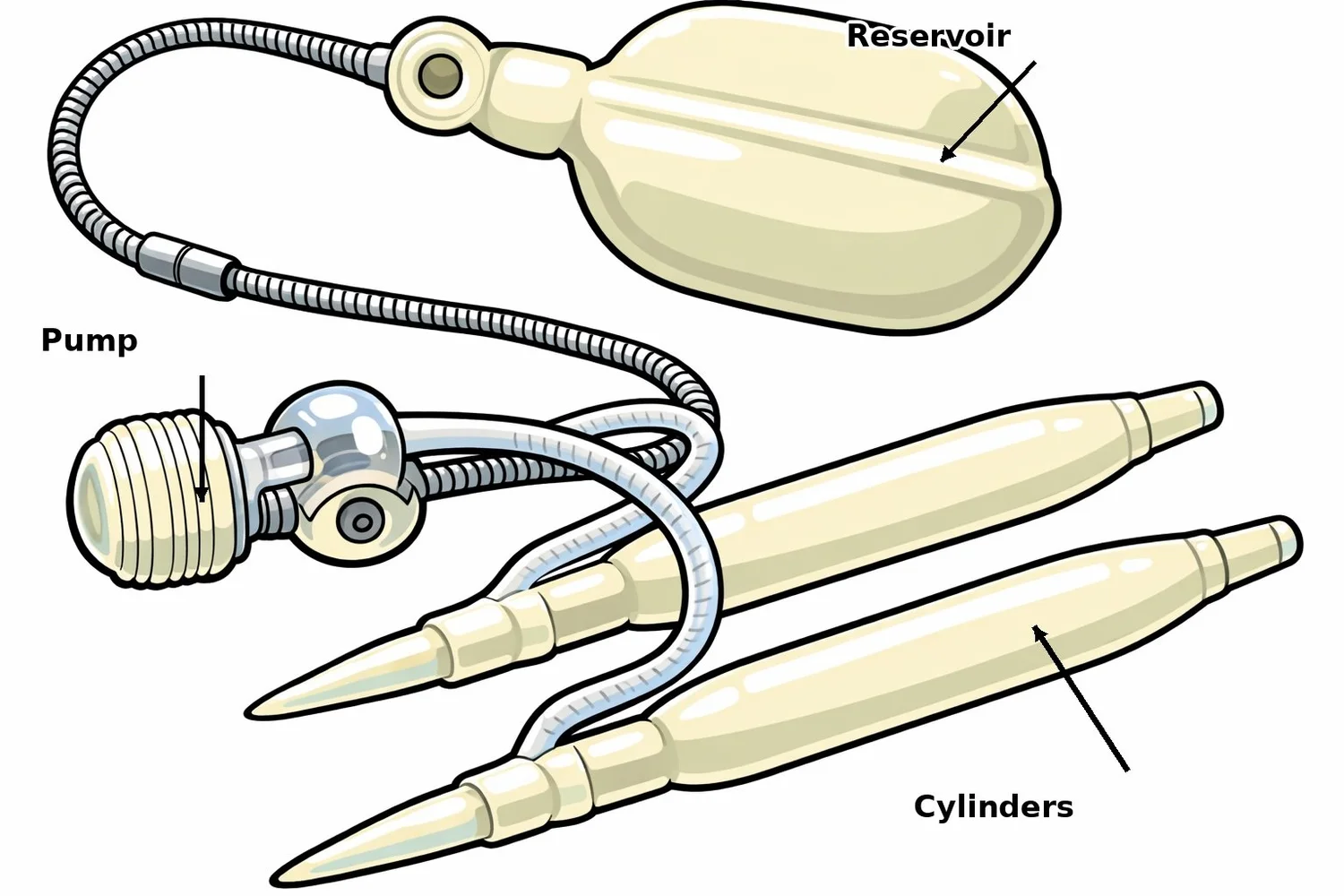
A penile implant — also called a penile prosthesis — is a device placed completely inside the body to provide penile rigidity.
Unlike injections, the implant does not depend on medication creating increased blood flow each time an erection is wanted. Rigidity is instead created mechanically.
A three-piece inflatable system generally contains paired cylinders, a scrotal pump and a fluid reservoir.
Why men may consider an implant
- ED tablets have not provided sufficient rigidity.
- Penile injections are ineffective or increasingly unreliable.
- Injection pain or anxiety has become unacceptable.
- Preparation before intercourse interferes with intimacy.
- Severe ED persists after prostate or pelvic treatment.
- ED occurs together with significant Peyronie's disease.
- A more predictable long-term surgical treatment is preferred.
“My injections still work. Is it too early to consider an implant?”
Not necessarily — but working injections also do not mean you need an implant.
The decision is not based solely on whether an injection is capable of producing an erection.
A man may still obtain reasonable rigidity but find that the preparation, needles, discomfort, timing or unpredictability have changed the sexual experience enough that he wants to understand another option.
Conversely, if injections provide reliable erections and you are comfortable using them, there may be no reason to proceed to surgery.
The more useful question is often not simply “Do injections work?” but “Does this treatment still fit how I want to manage my erections?”
Which situation sounds closer to yours?
Continuing injections may make sense if…
- They reliably produce the erection you need.
- You remain comfortable injecting.
- Planning treatment before sex is not troublesome.
- Pain or scar tissue is not causing concern.
- Avoiding surgery remains a strong priority.
An implant discussion may be worthwhile if…
- Injections frequently provide inadequate rigidity.
- You no longer want to inject before intercourse.
- Injection pain or anxiety is limiting treatment.
- Predictability has become increasingly important.
- Severe ED persists despite other reasonable treatments.
- You are comfortable discussing a surgical option.

The decision is about more than which treatment produces an erection
Different men place different value on avoiding surgery, spontaneity, reliability, treatment preparation and the possibility of future revision surgery.
Partner expectations can also matter. For some couples, injections remain an acceptable part of sexual activity. Others find that repeated preparation has become disruptive.
A useful consultation should therefore identify what is actually unsatisfactory about the current treatment before deciding whether another option would genuinely improve function or quality of life.
What matters most to you?
This does not diagnose ED or recommend a treatment. It simply highlights issues that may be useful to discuss during a consultation.
1. How are injections currently working?
2. How do you feel about continuing injections?
3. Which priority is most important?
Select one answer for each question
A discussion summary will appear here.
What does a penile implant actually change?
Rigidity
The principal purpose of an implant is to provide sufficient mechanical penile rigidity for sexual activity.
Sexual desire
An implant does not create libido. Sexual desire remains influenced by hormones, health, medications and relationships.
Penile size
Penile implant surgery is not penile enlargement surgery. The aim is functional rigidity within the existing anatomy.
Orgasm
Orgasm is a separate neurological function. The implant provides rigidity rather than producing orgasm itself.
An implant is a substantially bigger decision than changing medication
A penile implant can provide a highly predictable method of producing rigidity for appropriately selected men, but it remains an operation involving an implanted medical device.
Important considerations include infection, bleeding, wound healing, device position, recovery, learning to operate the implant and the possibility that another operation may eventually be required.
Expectations around penile length, glans fullness, sensation, appearance and device use should also be discussed before surgery.
Penile Implant Surgery Guide
Some situations require a more individualised discussion
Severe erectile dysfunction
The severity and underlying cause of ED influence whether injections are likely to remain useful.
Explore Erectile Dysfunction → 02ED after prostate or pelvic treatment
Previous pelvic surgery or radiotherapy can alter both erectile function and future implant planning.
Explore Implant Surgery → 03Peyronie's disease with poor erections
Penile curvature, narrowing, instability and erectile rigidity need to be considered together.
Explore Peyronie's Disease → 04Previous ED treatment has not worked
Reassessment can establish whether the main issue is treatment failure, progression of ED or another functional problem.
Explore Previous Treatment →Assessment with Dr Jack Crozier
Dr Jack Crozier is a Brisbane urologist and fellowship-trained andrologist whose subspecialty practice includes erectile dysfunction, penile implant surgery, Peyronie's disease and reconstructive andrology.
Assessment can review previous ED treatment, erection quality, penile anatomy, previous prostate or pelvic treatment and the practical issues influencing whether continued injection therapy or discussion of implant surgery is reasonable.
Penile implant vs injections FAQs
Do I have to try penile injections before having an implant?
Not every patient's pathway is identical. Less-invasive ED treatments are commonly considered before surgery, but treatment depends on the cause and severity of ED, previous treatment, medical factors and patient preference.
If injections are ineffective, unsuitable, poorly tolerated or no longer acceptable, it is reasonable to discuss whether implant surgery should enter the treatment conversation.
Are penile injections safer than an implant?
The risks are different. Injections avoid surgery but can cause pain, bruising, bleeding, scar tissue and prolonged erections including priapism.
Implant surgery introduces surgical and device-related risks, including infection, bleeding, erosion, mechanical problems and possible future revision surgery.
Which treatment provides the harder erection?
Correctly dosed penile injections can provide very good rigidity in many men. However, response can vary between treatment episodes.
A penile implant creates rigidity mechanically and is often discussed when sufficient erections cannot be obtained reliably with tablets, injections or other appropriate treatments.
Can penile injections stop working?
They can become less effective if the underlying erectile dysfunction progresses. Changes in vascular function, neurological function or penile fibrosis can influence response.
In other men, the injection may still technically work but treatment becomes increasingly inconvenient or uncomfortable.
Can I still orgasm with a penile implant?
Many men can continue to experience orgasm after penile implant surgery. The implant principally provides rigidity and does not directly create libido, sensation or orgasm.
Does a penile implant increase penis size?
No. Penile implant surgery is not a penile enlargement operation. Its principal purpose is to provide functional rigidity within the patient's existing penile anatomy.
What if I have Peyronie's disease as well as erectile dysfunction?
When significant penile deformity occurs together with erectile dysfunction, erection quality and deformity should be considered together.
In selected men with treatment-resistant ED, penile implant surgery may form part of a pathway addressing both rigidity and deformity.
When should I think about moving on from injections?
There is no single threshold.
It may be worthwhile discussing alternatives when injections become unreliable, painful, anxiety-provoking, inconvenient, associated with scar tissue or simply no longer suit how you want to manage your sexual function.
You do not need to decide between injections and an implant on your own.
Specialist assessment can review why your current ED treatment is not meeting your needs and whether continuing injections, modifying treatment or discussing penile implant surgery is reasonable.
Medical information: This page provides general educational information only and does not provide individual medical advice, diagnosis or a treatment recommendation. Erectile dysfunction treatment and penile implant surgery have potential benefits, limitations and risks. Individual assessment and informed consent are required before treatment decisions are made.