Peyronie’s Disease Treatment Brisbane
Specialist assessment of penile curvature, shortening, indentation, hourglass deformity, hinge instability and erectile dysfunction associated with Peyronie’s disease.
Treatment depends on more than the number of degrees of curvature. Disease stability, penile shape, erection quality, penile dimensions and the functional effect of the deformity all influence which treatment pathways are reasonable to consider.

What is Peyronie’s disease?
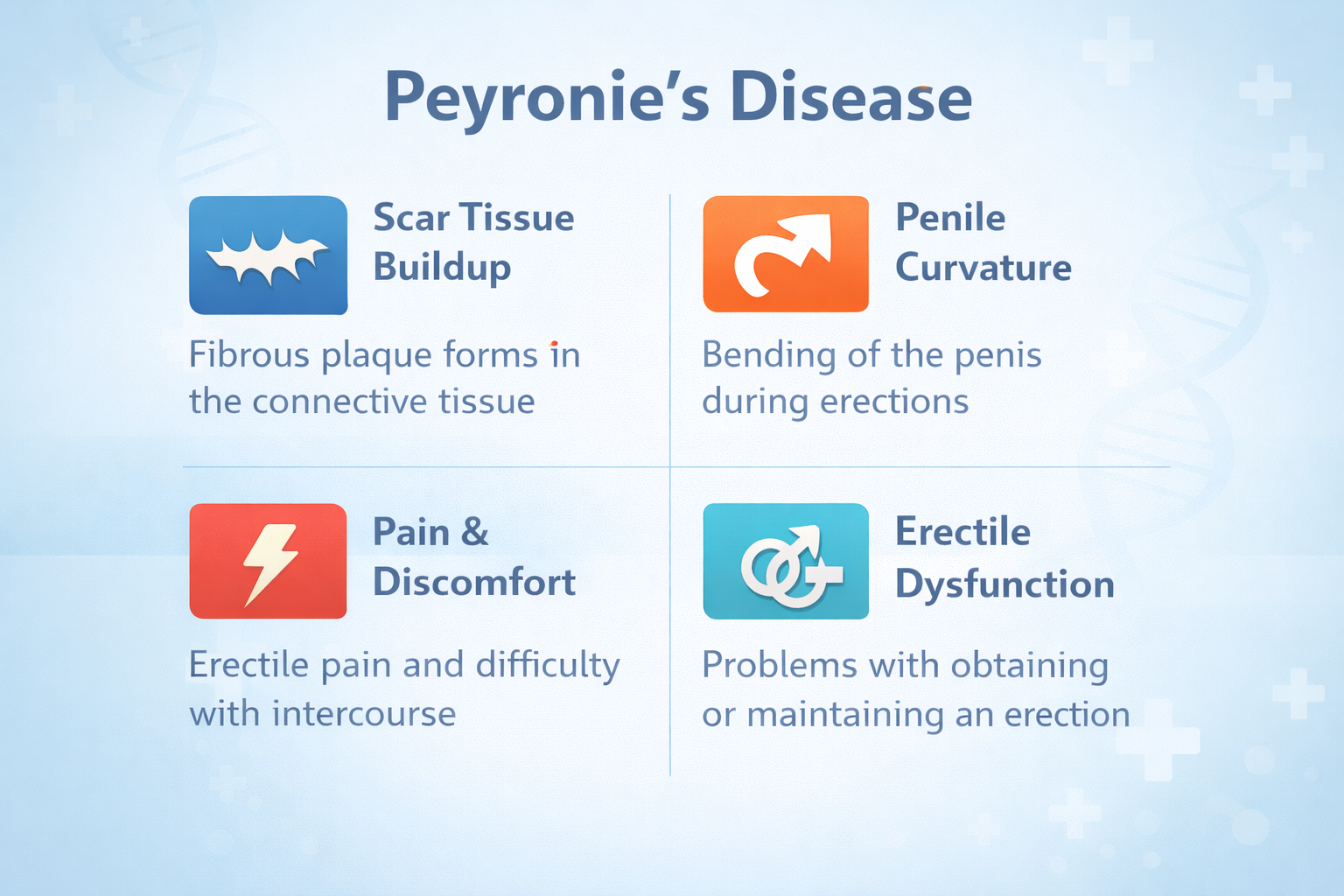
Peyronie’s disease occurs when abnormal scar tissue, often called a plaque, develops within the tunica albuginea — the strong covering surrounding the erectile tissue.
During erection, an affected area may not expand in the same way as the surrounding tissue. This can produce curvature, shortening, indentation, narrowing or an unstable segment.
Some men develop a relatively simple bend. Others develop a complex three-dimensional deformity involving loss of girth, an hourglass appearance or a hinge effect.
Peyronie’s disease is not a cancer or sexually transmitted infection. The important issue is how the scar affects penile shape, erection quality and sexual function.
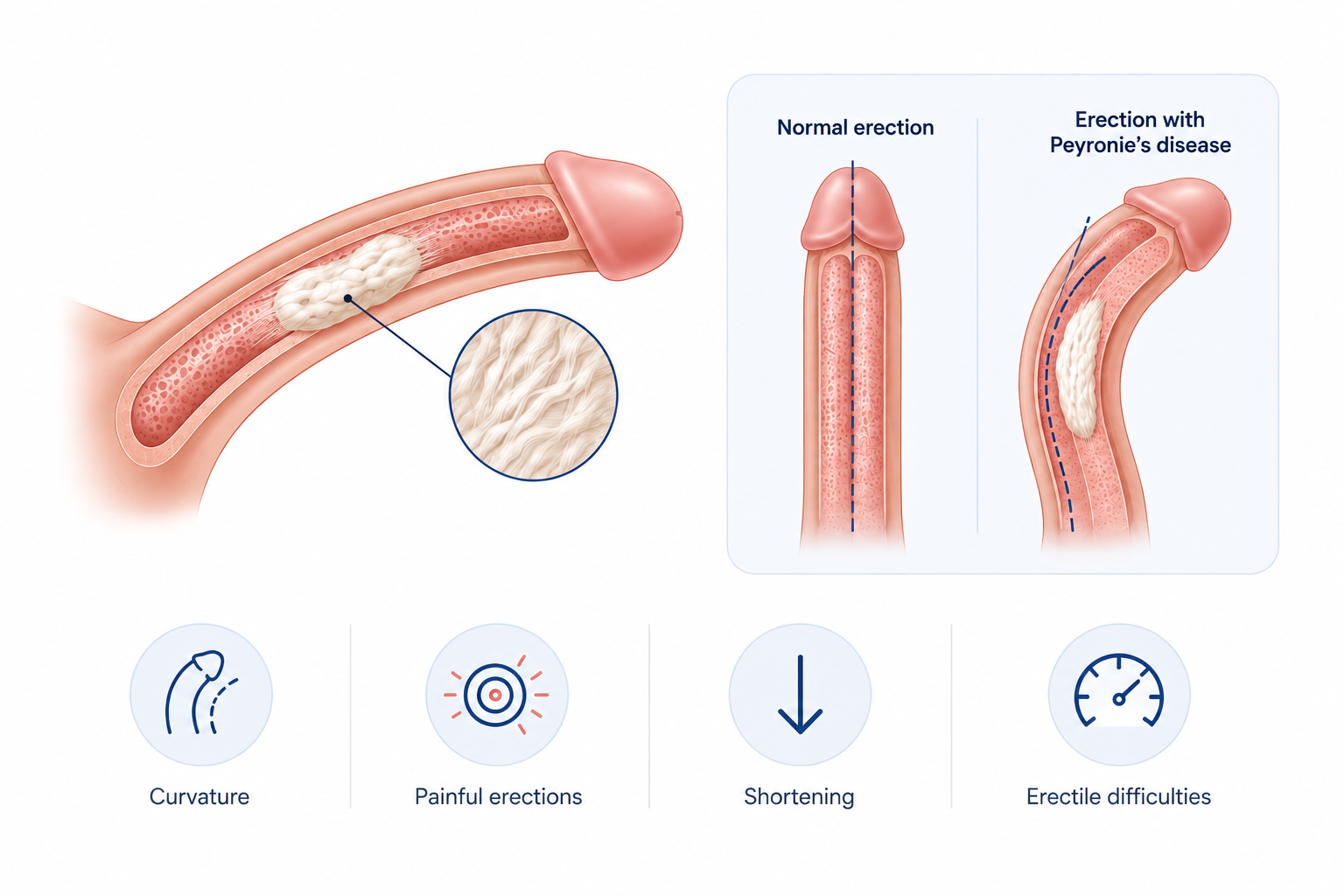
How can Peyronie’s disease affect the penis?
Two men with a similar curvature angle can have very different functional problems. Assessment therefore needs to consider the complete penile deformity.
Curvature
The erect penis may curve upwards, downwards or to either side and may sometimes curve in more than one plane.
Indentation
A focal area may appear indented or narrowed because that part of the tunica does not expand normally.
Hourglass deformity
Circumferential or substantial narrowing can create an hourglass-like shape during erection.
Hinge instability
A narrowed portion of the penis may buckle during sexual activity despite otherwise reasonable erection rigidity.
Shortening
Scar contraction and altered penile geometry can produce perceived or measurable loss of penile length.
Erectile dysfunction
Reduced rigidity may occur alongside the deformity and can substantially change which treatment pathway is appropriate.
Is the condition still changing?
One of the first questions is whether the Peyronie’s disease is still active or whether the deformity has become stable.
Still changing
The condition may still be evolving. Features can include:
- recent onset
- changing curvature
- changing indentation or narrowing
- ongoing penile or erection pain
- progressive perception of shortening
Management during this stage usually focuses on assessment, maintaining erection quality, symptom management and conservative strategies where appropriate.
What should I do in the first 6 months? →The deformity has settled
Stability generally means penile shape is no longer progressively changing and the painful phase has usually improved.
- curvature no longer progressing
- penile shape reasonably consistent
- pain usually resolved or substantially reduced
- remaining functional problem can be assessed
When a stable deformity makes sexual activity difficult, corrective surgery may be discussed according to erection quality, penile length and the type of deformity present.
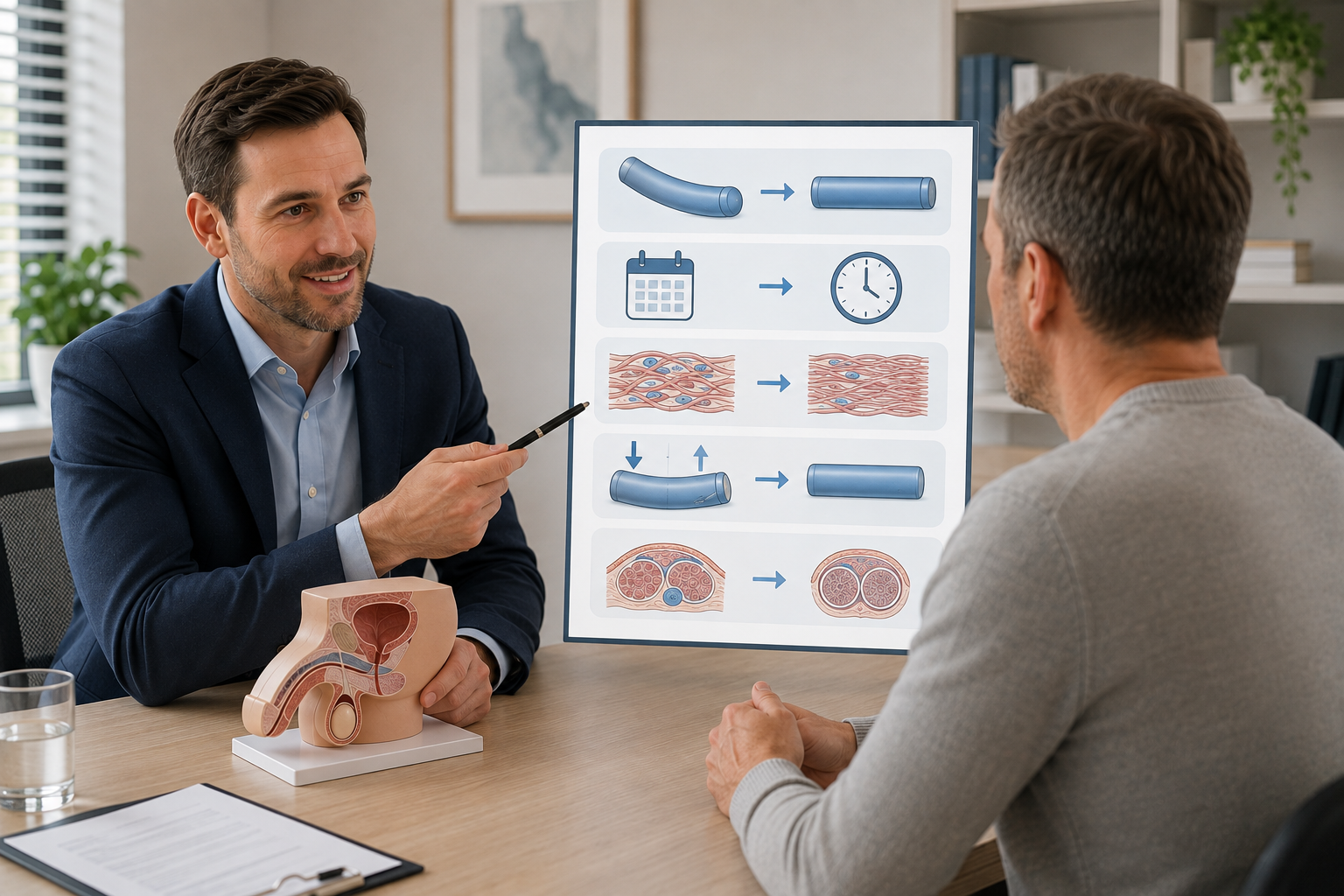
How is Peyronie’s disease assessed?
Curvature angle alone does not determine treatment. Penile shape, length, stability and erection quality need to be considered together.
When the problem began, whether it is changing, pain, shortening and functional impact are discussed.
Examination assesses plaque, penile length, skin and other anatomical findings relevant to treatment.
Photographs can demonstrate curvature, indentation, narrowing and hinge instability.
Natural erection rigidity and response to previous ED treatment help determine the appropriate pathway.
Not every patient requires ultrasound. It may be useful in selected circumstances when plaque calcification, erectile haemodynamics or another feature is likely to influence treatment planning.
Not everyone with Peyronie’s disease needs surgery
Conservative management may be reasonable when disease is evolving, the deformity remains functionally manageable or a patient does not wish to pursue surgical correction.
Observation
Mild or stable curvature that does not significantly interfere with sexual activity may not require procedural treatment.
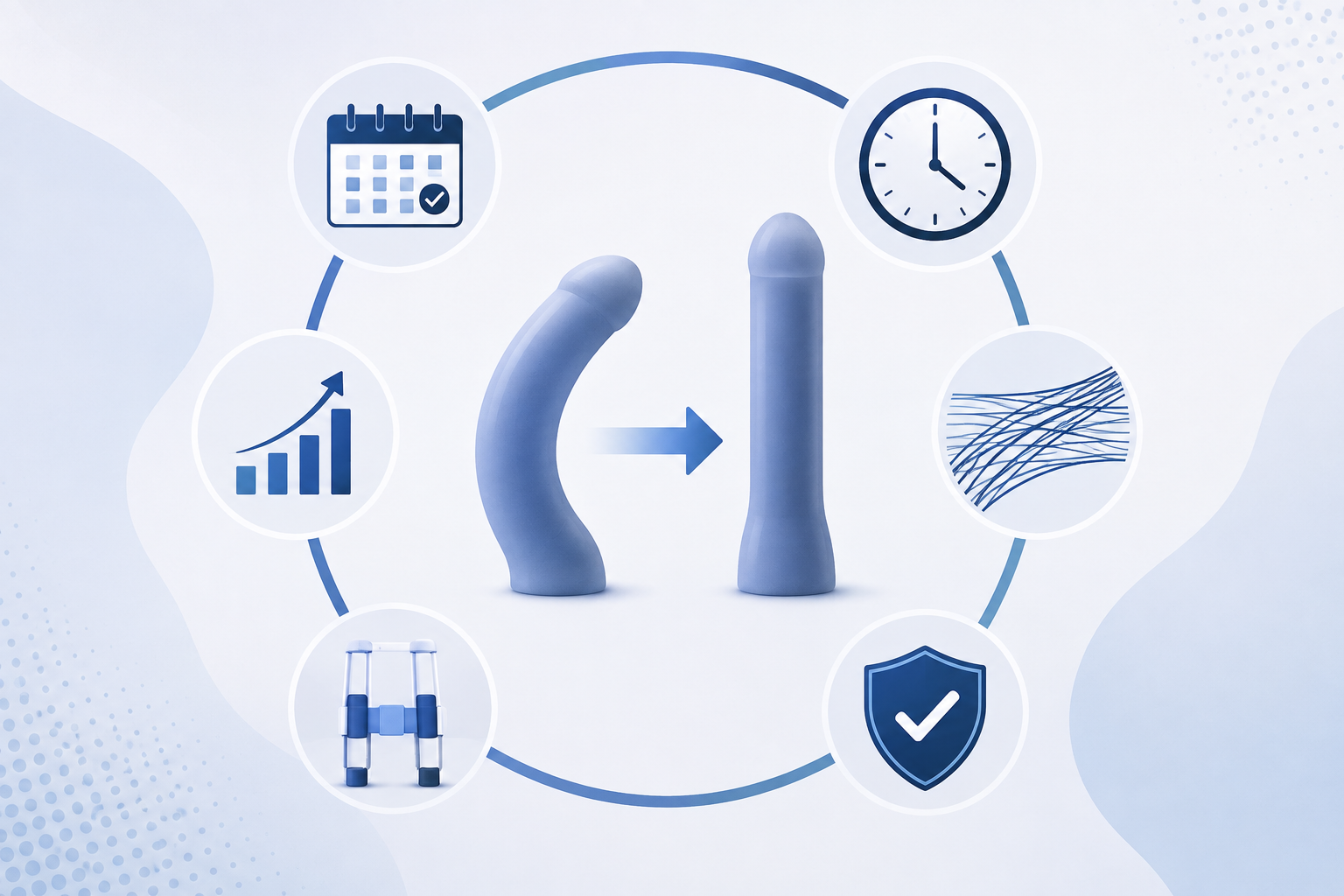
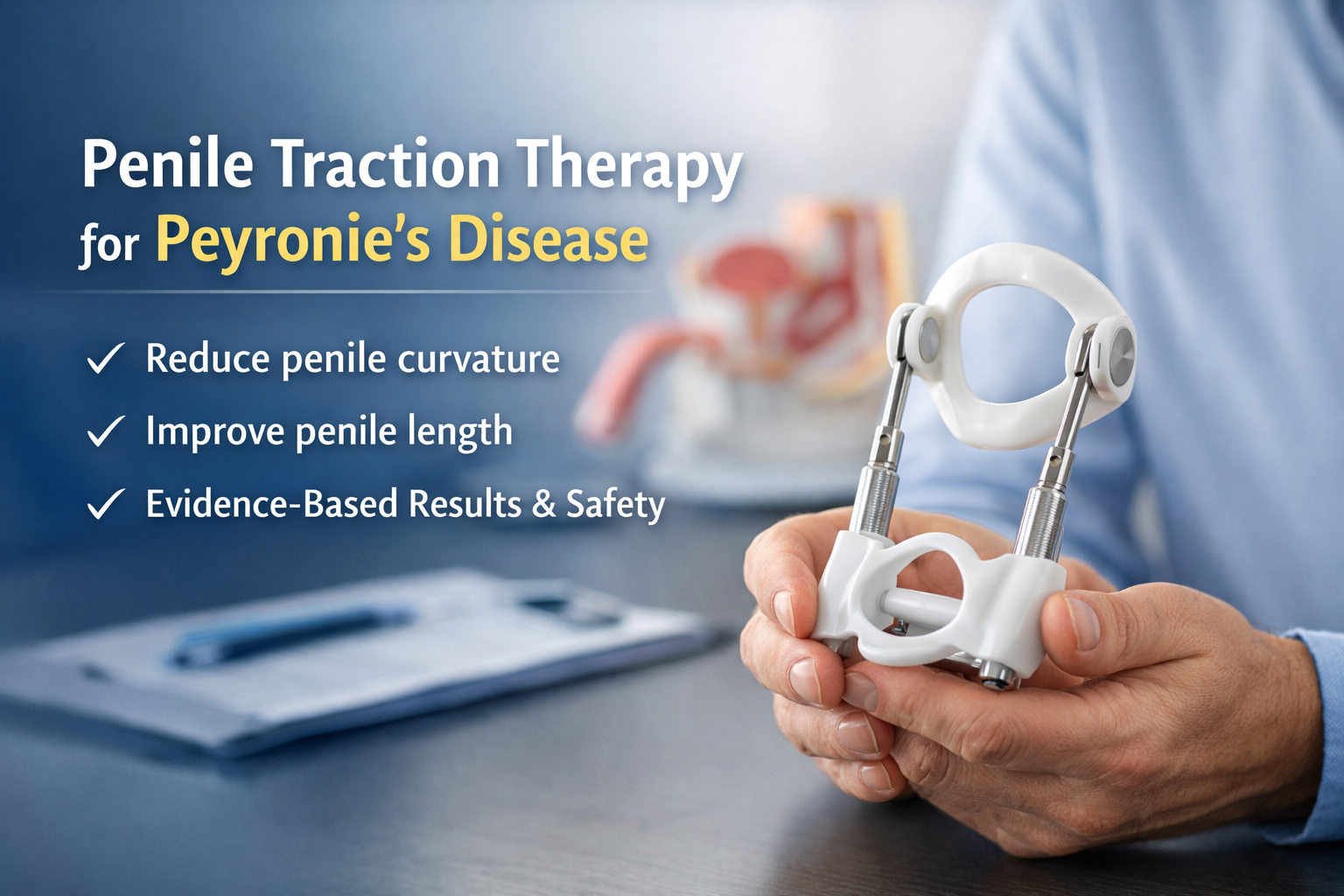
Penile traction
Traction may be considered in selected men, particularly where preservation or recovery of penile length is a treatment priority.
Erectile function treatment
Improving rigidity can improve sexual function even when the plaque or structural deformity itself remains present.
Which Peyronie’s operation may be appropriate?
There is no single operation that is best for every Peyronie’s deformity. The decision depends particularly on erection rigidity, penile length, curvature complexity, narrowing and instability.
Penile Plication
Plication corrects curvature by shortening the longer side of the penis. It may be considered when erections are reliable, penile length is adequate and major hourglass or hinge deformity is absent.
Plaque Incision & Grafting
Grafting releases the shortened side of the tunica and reconstructs the resulting defect. It may be considered for selected severe, complex or length-limiting deformities.
Penile Implant ± Straightening
When erectile dysfunction remains significant despite appropriate non-surgical treatment, an implant can address rigidity while additional straightening may be performed where required.

The operation should match the deformity
Straightening surgery is not simply selected from the curvature angle. The surgical plan needs to balance straightness, penile stability, erection quality, existing penile length and the risks associated with each reconstructive approach.
Complex deformities can sometimes require more than one corrective manoeuvre, depending on the findings during assessment and surgery.
Hourglass and hinge deformity deserve separate assessment
A penis can be relatively straight and still be mechanically difficult to use because of narrowing or instability.
An hourglass deformity describes substantial narrowing around part of the shaft. A hinge effect occurs when a weakened narrowed segment bends or buckles under load despite an otherwise rigid erection.
Why does this change treatment?
Simply correcting a curvature angle does not necessarily restore the mechanical stability of a narrowed portion of the penis.
Depending on erection quality and anatomy, options may include observation, traction, plication in selected circumstances, grafting or other reconstructive techniques, or penile implant surgery when significant erectile dysfunction is also present.
Hourglass & Hinge Deformity GuideA straightening operation cannot compensate for poor rigidity
Erectile function should be considered before selecting a Peyronie’s operation.
Some men have reliable erections but mechanical difficulty because of curvature. Others have significant erectile dysfunction as well as the penile deformity.
If erections remain inadequate despite appropriate ED treatment, plication or grafting alone could create a straighter penis without solving the underlying rigidity problem.
In appropriately selected men, penile implant surgery may therefore address both erectile rigidity and the Peyronie’s deformity within the same surgical pathway.

What is Peyronie’s treatment trying to achieve?
The objective is usually a penis that is sufficiently straight, stable and rigid for comfortable functional sexual activity while preserving penile dimensions and erectile function where reasonably possible.
Functional straightness
Treatment aims for useful functional correction rather than promising perfect geometric straightness.
Preserve erection quality
The potential effect on erections differs between plication, grafting and penile implant pathways.
Restore stability
Significant hourglass or hinge deformity requires attention to mechanical stability rather than curvature alone.
Consider penile length
Peyronie’s itself can cause shortening, and each treatment has different implications for penile dimensions.
Improve sexual function
Comfortable and mechanically possible sexual activity is generally more meaningful than curvature angle alone.
Set realistic expectations
Residual curvature, shortening, sensory change or erectile difficulty can occur depending on treatment.
Peyronie’s Treatment Explorer
Organise information about disease stability, curvature, erection quality, penile length, narrowing and functional impact before your consultation. The tool provides educational information and does not diagnose Peyronie’s disease or select treatment for you.
Common questions about Peyronie’s disease
What should I do in the first 6 months?
Understand changing curvature, pain and why early management differs from stable disease.
Read article → Non-surgical treatmentDoes penile traction therapy work?
Review the role of traction in selected men with Peyronie’s disease and penile shortening.
Read article → Penile lengthCan penile length be recovered?
Learn why Peyronie’s can cause shortening and what treatment can realistically achieve.
Read article → Everyday questionsCan sex or masturbation make it worse?
Practical information about sexual activity, penile injury and protecting an unstable or painful erection.
Read article →
Dr Jack Crozier
Dr Jack Crozier is a Brisbane urologist and fellowship-trained andrologist whose practice includes Peyronie’s disease, erectile dysfunction, penile implant surgery and reconstructive andrology.
His advanced andrology fellowship experience at University College London Hospitals included assessment and surgery for penile curvature, complex penile deformity and penile prosthetic surgery.

Travelling to Brisbane for Peyronie’s assessment?
Existing investigations and documentation can help provide useful information before travel where clinically appropriate.
Useful information can include:
- when the curvature began
- whether shape is still changing
- previous Peyronie’s treatments
- erection quality
- previous ED treatment
- previous penile surgery
- penile ultrasound reports
- erection photographs
Explore Peyronie’s treatment in more detail
Penile Plication
Straightening surgery for selected stable curvature with adequate penile length and good erection quality.
Plication surgery →Plaque Incision & Grafting
Tunical-lengthening reconstruction for selected severe or complex deformity with sufficiently good erectile function.
Grafting surgery →Hourglass & Hinge Deformity
Dedicated information about narrowing, indentation and mechanical instability.
Complex deformity →Penile Implant Surgery
Surgical rigidity treatment when significant erectile dysfunction accompanies Peyronie’s disease.
Penile implants →Erectile Dysfunction
Assessment of erection problems occurring with or independently of Peyronie’s disease.
ED information →ED, Implants & Peyronie’s
Return to the broader penile function and reconstructive andrology treatment hub.
Main treatment hub →Peyronie’s disease FAQs
Does every penile curve mean Peyronie’s disease?
Does Peyronie’s disease always get worse?
When is Peyronie’s disease considered stable?
Do I need surgery?
What is penile plication?
Explore penile plication →
What is plaque incision and grafting?
Explore plaque incision & grafting →
What is an hourglass deformity?
Explore hourglass & hinge deformity →
Can Peyronie’s disease cause erectile dysfunction?
When is a penile implant used for Peyronie’s disease?
Explore penile implant surgery →
Can traction straighten Peyronie’s disease?
Will surgery restore my original penile length?
Will surgery make the penis completely straight?
What photographs should I bring to my appointment?
Do I need a penile ultrasound?
Can I seek assessment if I live interstate or overseas?
Not sure whether your deformity needs observation, plication, grafting or another pathway?
Specialist assessment can help establish whether the condition is still active, document the deformity, assess erection quality and clarify which treatment options are reasonable to consider.
Explore More About Peyronie’s Disease