


Penile Plication Surgery for Peyronie’s Disease
Penile plication is a surgical technique used to straighten a stable penile curvature by shortening the longer side of the penis opposite the Peyronie’s plaque.
It is generally considered for men who have good erectile function, adequate penile length and a curvature that interferes with sexual activity without a major hourglass or hinge deformity.
What is penile plication?
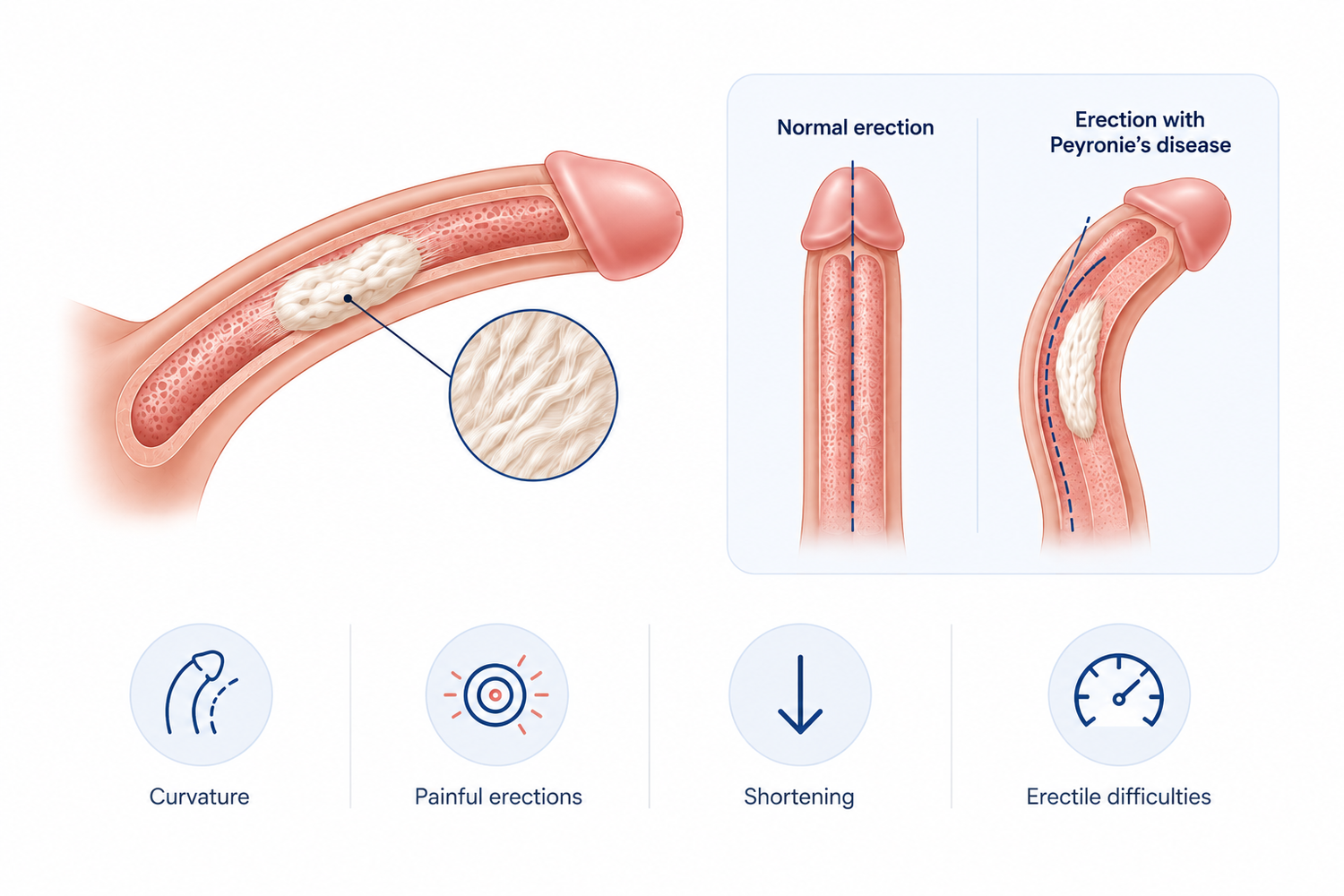
Peyronie’s disease causes scar tissue within the tunica albuginea — the strong outer covering of the erectile tissue. The scarred side does not stretch normally during erection, creating curvature or other changes in penile shape.
Plication corrects curvature from the opposite, longer side of the penis. Sutures are used to shorten that side until the two sides are more similar in length and the erection becomes functionally straighter.
The Peyronie’s plaque itself does not usually need to be removed during a standard plication procedure.
The goal of surgery is usually to make sexual activity comfortable and mechanically possible while balancing straightness, penile length, erection quality and surgical risk.
Who may be suited to penile plication?
Plication is most useful when the main problem is curvature rather than significant erectile dysfunction or major loss of penile girth and stability.
A typical plication candidate may have:
- Peyronie’s disease that is stable rather than actively changing
- curvature that makes penetration difficult or uncomfortable
- reliable erections that are adequate for intercourse
- adequate penile length
- a relatively simple curvature pattern
- little or no major hourglass narrowing
- no significant hinge instability
- realistic expectations about possible shortening
Plication may be less suitable when there is:
- significant erectile dysfunction not responding adequately to non-surgical treatment
- substantial pre-existing penile shortening
- severe or complex curvature
- significant hourglass deformity
- a hinge or unstable segment
- marked narrowing or loss of girth
- priorities that make further shortening particularly unacceptable
Straightening a penis does not treat significant erectile dysfunction. If erections are not sufficiently reliable for intercourse despite appropriate treatment, a penile implant pathway may be more appropriate than straightening-only surgery.

When is Peyronie’s surgery considered?
Definitive corrective surgery is generally reserved for stable Peyronie’s disease.
Stability means the penile deformity is no longer progressively changing. Clinical guidelines commonly refer to curvature remaining stable for approximately three to six months, usually after the condition has been present for around nine to twelve months or longer.
Surgery may be considered when the stable deformity causes meaningful functional difficulty — particularly when penetration is difficult or impossible.
Why not operate while the curve is still changing?
Surgery corrects the deformity that exists at the time of the operation. If the disease remains biologically active and the scar continues to change afterwards, the final shape may also change.
What needs to be assessed before plication?
The degree of curvature alone does not determine the best operation. Penile shape, length and erectile function need to be considered together.
Curvature
Direction, severity and location of the bend are documented, usually using erection photographs or an induced erection when required for surgical planning.
Penile shape
Indentation, narrowing, hourglass deformity and hinge instability can influence whether plication alone will adequately correct the functional problem.
Erection quality
Natural erection rigidity and response to erectile dysfunction treatment are important because plication does not restore erectile rigidity.
Penile length
Current stretched penile length and the patient's perception of existing shortening should be discussed before selecting a shortening procedure.
How does penile plication straighten the penis?
In Peyronie’s disease, the scarred side of the penis is effectively shorter because it cannot expand normally.
Plication does not lengthen this scarred side. Instead, it shortens the opposite — convex — side so that the two sides become more similar in length during erection.
Recreate the curvature
During surgery, an artificial erection can be produced so the direction and point of maximum curvature can be assessed.
Shorten the longer side
Sutures or another tunical-shortening technique are placed opposite the Peyronie’s plaque to correct the bend.
Reassess straightness
The erection is reassessed and further correction can be made where required to achieve a functional result.

Will plication make my penis shorter?
Some degree of additional shortening is an inherent possibility because plication corrects the bend by shortening the longer side of the penis.
Some men have lost length before surgery because the scarred side no longer stretches normally.
It depends partly on the degree and direction of curvature, current penile dimensions and the amount of correction required.
Men may notice change differently depending on their baseline length and expectations.
Penile length should be discussed before surgery
Plication is generally most attractive when the penis has adequate length and the patient accepts that additional shortening can occur in exchange for improving curvature.
When there is already substantial shortening, very severe curvature or a complex deformity, a tunical lengthening or grafting approach may sometimes be discussed instead — provided erectile function is good enough.
Grafting avoids deliberately shortening the opposite side, but it is a more complex operation and generally carries greater concern regarding postoperative erectile dysfunction.
Plication, grafting or penile implant?
There is no single best Peyronie’s operation. The appropriate procedure depends on penile length, erection quality, severity and complexity of the deformity, and the patient's priorities.
Penile Plication
Often considered when erections are reliable and the deformity is primarily curvature.
- good erectile function
- adequate penile length
- less-complex curvature
- minimal hourglass or hinge deformity
- lower concern for new erectile dysfunction than grafting
- additional shortening can occur
Plaque Incision & Grafting
May be considered when erections are good but the deformity is more severe or complex.
- good natural erections
- severe curvature in selected men
- significant pre-existing shortening
- complex contour deformity
- does not deliberately shorten the opposite side
- greater erectile-function considerations
Penile Implant
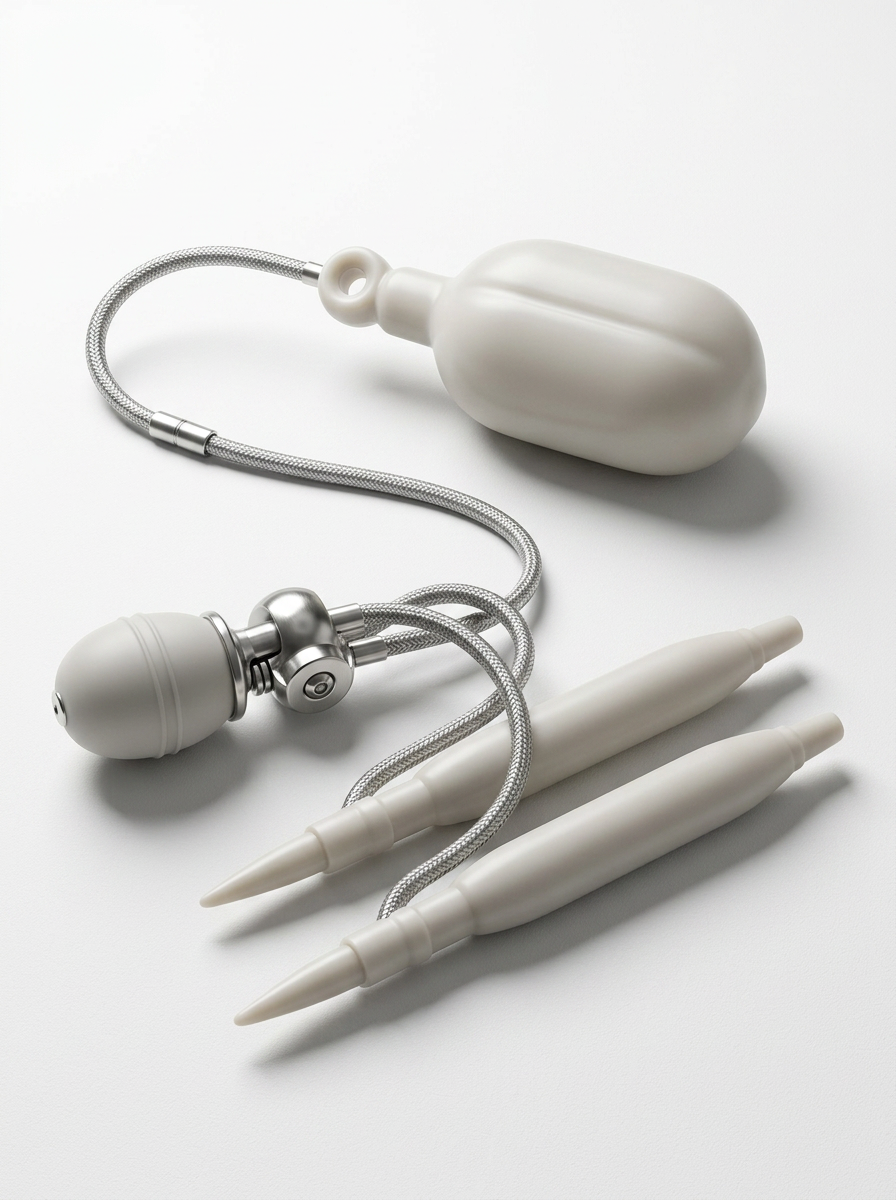
Often the preferred surgical pathway when Peyronie’s disease occurs with significant treatment-resistant erectile dysfunction.
- treats erectile rigidity
- implant itself may improve some curvature
- modelling or additional straightening may be required
- appropriate when straightening alone would not solve the ED
What if my erections are not reliable enough for plication?
Plication changes penile shape but does not create a stronger erection.
If erectile dysfunction is significant and does not respond adequately to tablets, injections or other appropriate treatment, a straight penis may still not be rigid enough for satisfactory sexual activity.
In this situation, penile implant surgery can address erectile rigidity and the Peyronie’s deformity together.
Depending on the residual curvature after the implant cylinders are placed, additional straightening manoeuvres may sometimes be required.
What if I have an hourglass or hinge deformity?
Curvature is only one aspect of Peyronie’s disease. Some men have localised narrowing that creates an hourglass shape or a segment that bends or buckles during intercourse.
Curvature without instability
When the main functional problem is a relatively simple bend and erections are reliable, plication may be sufficient.
Significant hourglass narrowing
Plication can straighten a bend but does not restore lost girth at a narrowed segment. A different reconstructive strategy may therefore be required.
Hinge instability
If the penis buckles at an unstable narrowed segment, simply correcting the angle of curvature may not solve the mechanical problem.
Hourglass deformity, indentation and hinge instability should be specifically assessed before choosing plication because the straightest operation is not necessarily the operation that produces the most stable or functional penis.
What result should I expect?
Published series generally report high rates of meaningful penile straightening after tunical-shortening procedures, but study techniques and definitions of success vary.
Surgery cannot guarantee a perfectly straight penis, preservation of exact preoperative length or complete absence of recurrence.
Functional straightness
The practical goal is usually a penis sufficiently straight and stable for comfortable sexual activity.
Small degrees of residual curvature do not necessarily represent treatment failure if intercourse is comfortable and mechanically possible.
Preoperative counselling should specifically address:
- expected straightness
- possible shortening
- palpable plication sutures
- erection quality
- sensation
- recurrence or residual curvature
- recovery and sexual abstinence
Recovery after penile plication
Recovery varies between patients and according to the exact plication technique, anaesthetic and any additional procedures.
Early recovery
Swelling, bruising, penile discomfort and tenderness around the incision are expected to some degree during the early postoperative period.
Erections
Spontaneous or nocturnal erections may initially feel uncomfortable as the tissues heal. This generally improves with recovery.
Sexual activity
Penetrative sexual activity and masturbation are avoided during the initial healing period. The appropriate time to restart depends on healing and postoperative review.
Work
Return to work depends on discomfort, the physical demands of the occupation and individual recovery.
Exercise
Heavy lifting, vigorous exercise and activities that place pressure on the genital region are restricted during early healing.
Follow-up
Healing, curvature, penile sensation and erectile function can be reviewed after surgery before unrestricted sexual activity resumes.
Do I need to be circumcised for plication surgery?
Not every plication operation automatically requires circumcision.
The incision and surgical exposure can vary according to the direction of curvature, plication technique, foreskin condition and whether another reconstructive procedure is required.
In some operations a circumferential incision and degloving may be used, while other techniques can be performed through alternative incisions.
If the foreskin is healthy and can safely be preserved, this can be discussed during surgical planning. Circumcision may still be appropriate in selected situations.
Possible risks and limitations
Penile plication is established reconstructive surgery, but no operation is risk-free and individual risk varies.
Procedure-related risks
- pain and swelling
- bruising or bleeding
- infection
- wound problems
- temporary or persistent sensory change
- palpable or uncomfortable sutures
- anaesthetic complications
Functional limitations
- penile shortening
- residual curvature
- recurrent curvature
- contour irregularity
- new or worsened erectile dysfunction
- need for further treatment or surgery
- result not meeting cosmetic expectations
From Peyronie’s assessment to plication surgery
Confirm the diagnosis and disease phase
The history is reviewed to determine whether the deformity remains active or has become stable.
Document the deformity
Curvature photographs, penile measurements and assessment of indentation or hourglass deformity help define the surgical problem.
Assess erectile function
Erection quality is reviewed because significant treatment-resistant erectile dysfunction can change the preferred surgical pathway.
Compare surgical options
Plication, grafting and penile implant surgery are compared where relevant, including expected effects on length, straightness and erectile function.
Surgery
An artificial erection allows the deformity to be assessed and the appropriate tunical-shortening correction performed.
Recovery and follow-up
Wound healing, straightness, sensation and erection quality are reviewed before return to unrestricted sexual activity.

What should I bring to a Peyronie’s consultation?
Accurate documentation of the erect deformity can make surgical assessment substantially more useful.
If you are comfortable doing so, bring photographs of a full erection stored on your own phone.
Useful views include:
- looking down from above
- a side view
- an additional angle if there is significant lateral curvature
Also bring relevant medication information, previous penile ultrasound results, previous treatment records and operative reports if you have undergone earlier penile surgery.

Dr Jack Crozier
Dr Jack Crozier is a Brisbane urologist and fellowship-trained andrologist with a subspecialty practice in Peyronie’s disease, penile reconstruction, erectile dysfunction and penile implant surgery.
His advanced andrology fellowship at University College London Hospitals included Peyronie’s disease surgery, penile prosthetic surgery, male reproductive surgery and reconstructive andrology.
Travelling for Peyronie’s surgery assessment?
Patients with complex penile curvature, hourglass deformity, erectile dysfunction or previous penile surgery may seek specialist assessment from elsewhere in Queensland, interstate or overseas.
Where clinically appropriate, existing photographs, ultrasound results, previous operation reports and treatment records can be reviewed as part of planning before major travel arrangements are made.
A physical examination or additional assessment may still be required before a definitive surgical recommendation can be made.
Explore related treatment pathways
Peyronie’s Disease
Understand the condition, active and stable phases, assessment and the broader range of treatment options.
Peyronie’s Treatment Explorer
Organise information about curvature, deformity, disease stability and erection quality before specialist review.
Penile Implant Surgery
Learn about the surgical pathway when Peyronie’s disease is associated with significant erectile dysfunction.
Peyronie’s & Penile Length
Understand why shortening occurs and how plication, grafting and implant surgery affect length differently.
Early-Stage Peyronie’s Disease
Learn why surgery is generally delayed while penile curvature and symptoms are still changing.
Penile & Sexual Health
Explore Peyronie’s disease, erectile dysfunction and penile implant treatment pathways.
Penile plication FAQs
What does penile plication actually do?
Plication straightens the erect penis by shortening the longer side opposite the Peyronie’s plaque. This balances the difference in length between the two sides and reduces curvature. The plaque itself does not usually need to be removed.
Who is a good candidate for penile plication?
Plication is most commonly considered in men with stable Peyronie’s disease, erections that are sufficiently rigid for intercourse, adequate penile length and a curvature that causes functional difficulty without major hourglass narrowing or hinge instability.
How curved does the penis need to be before surgery?
There is no single curvature measurement that automatically means surgery is required. Functional impact is more important than a number alone. Surgery is usually considered when stable deformity meaningfully compromises sexual intercourse or causes substantial functional difficulty.
Will penile plication shorten my penis?
Additional shortening is possible because the operation straightens the penis by shortening the longer side. The amount varies according to baseline penile length, direction and severity of curvature and the amount of correction required. Peyronie’s disease itself may already have caused shortening before surgery.
How much length will I lose?
It is not possible to accurately guarantee a particular measurement before surgery. Greater curvature generally requires more shortening to achieve correction, but perceived length change varies considerably between men. Baseline penile length and expectations should be discussed before selecting plication.
Does plication remove the Peyronie’s plaque?
Usually not. Standard plication corrects the curvature from the side opposite the plaque rather than excising the plaque itself. This is one reason it is considered a tunical-shortening procedure.
Is plication the same as the Nesbit procedure?
They belong to the same broader group of tunical-shortening operations but are not identical. Traditional Nesbit surgery removes small ellipses of tunica on the longer side, while pure plication techniques use sutures to shorten the tunica without excising it. Several modifications are used in modern practice.
What is 16-dot plication?
The 16-dot technique is one described method of penile plication in which strategically placed sutures shorten the convex side of the penis. It is one of several plication techniques. No single plication method has been proven superior for all patients.
Will I be able to feel the plication stitches?
Some men can feel firmness or small knots beneath the skin where plication sutures are located. This may become less noticeable with time, but palpable or occasionally uncomfortable sutures are a recognised consideration that should be discussed before surgery.
Can plication cause erectile dysfunction?
New erectile dysfunction is possible after any penile reconstructive operation, although the risk is generally considered lower with tunical-shortening surgery than with plaque incision and grafting. Preoperative erectile function is an important part of surgical selection.
Is plication better than grafting?
Neither is better for every patient. Plication is usually more attractive for men with reliable erections, adequate length and less-complex curvature. Grafting may be discussed for selected men with good erections but severe curvature, substantial shortening or a complex deformity where further shortening is undesirable.
Can plication fix an hourglass deformity?
Plication can correct associated curvature but does not restore lost girth at the narrowed hourglass segment. If the narrowing creates hinge instability or significant loss of support, another reconstructive technique may be more appropriate.
What if I have Peyronie’s disease and erectile dysfunction?
The severity and treatability of the erectile dysfunction matter. If erections are sufficiently reliable with or without appropriate non-surgical treatment, plication may still be considered. When significant erectile dysfunction does not respond adequately to other therapy, penile implant surgery may provide a better surgical pathway because it addresses rigidity as well as curvature.
Does the penis need to be completely straight after surgery?
Not necessarily. The main objective is usually functional straightness — a stable erection that allows comfortable sexual activity. A small residual bend can be compatible with an excellent functional result.
Can the curvature return after plication?
Residual or recurrent curvature can occur. This may relate to healing, suture-related factors or future change in Peyronie’s disease. This is one reason definitive surgery is generally delayed until the disease appears stable.
Do I need to be circumcised for plication surgery?
Not necessarily. Whether circumcision is required depends on the surgical approach, foreskin condition, direction of curvature and any additional procedure required. Foreskin preservation can be discussed during operative planning when appropriate.
How long before I can have sex after plication surgery?
Sexual activity is restricted while the incision and deeper tissues heal. The exact timing varies according to the operation and individual recovery. You should wait until your surgeon confirms that healing is sufficient before restarting intercourse or masturbation.
Should I use traction after plication surgery?
Postoperative traction or stretching is not automatically required for every patient. Some penile rehabilitation strategies have been described after Peyronie’s surgery, but they should only begin after adequate wound healing and according to specific postoperative advice.
Can plication be repeated if curvature returns?
Further surgery can sometimes be considered for significant recurrent or residual curvature, but the preferred approach depends on the remaining penile length, deformity, erectile function and previous operative technique.
Can I have an assessment if I live interstate or overseas?
Potentially. Erection photographs, previous penile ultrasound results, treatment records and previous operative reports may be useful during initial planning. Physical examination or further assessment may still be required before a definitive surgical recommendation is made.

Is penile plication the right operation for your curvature?
If Peyronie’s disease has stabilised and penile curvature is interfering with sexual activity, specialist assessment can help determine whether plication, grafting, penile implant surgery or another management pathway best matches your penile anatomy, erection quality and priorities.
Medical information disclaimer: This page provides general educational information and does not replace individual medical advice, diagnosis or informed consent. Peyronie’s disease varies considerably between patients. The appropriate treatment depends on disease stability, penile curvature, length, hourglass or hinge deformity, erectile function, previous treatment, medical history and individual priorities. Published surgical outcomes describe groups of patients and cannot predict an individual's result. Penile plication, grafting and penile implant surgery all have potential risks and limitations. Surgical straightening, preservation of penile length, erectile function and patient satisfaction cannot be guaranteed.