


Plaque Incision & Grafting for Peyronie’s Disease
Plaque incision and grafting is a reconstructive operation used in selected men with stable Peyronie’s disease when curvature, shortening or complex penile deformity makes a simple plication procedure less suitable.
Unlike plication, grafting works from the shortened side of the penis — releasing the restriction and covering the resulting tunical defect with graft material.
What is plaque incision and grafting?
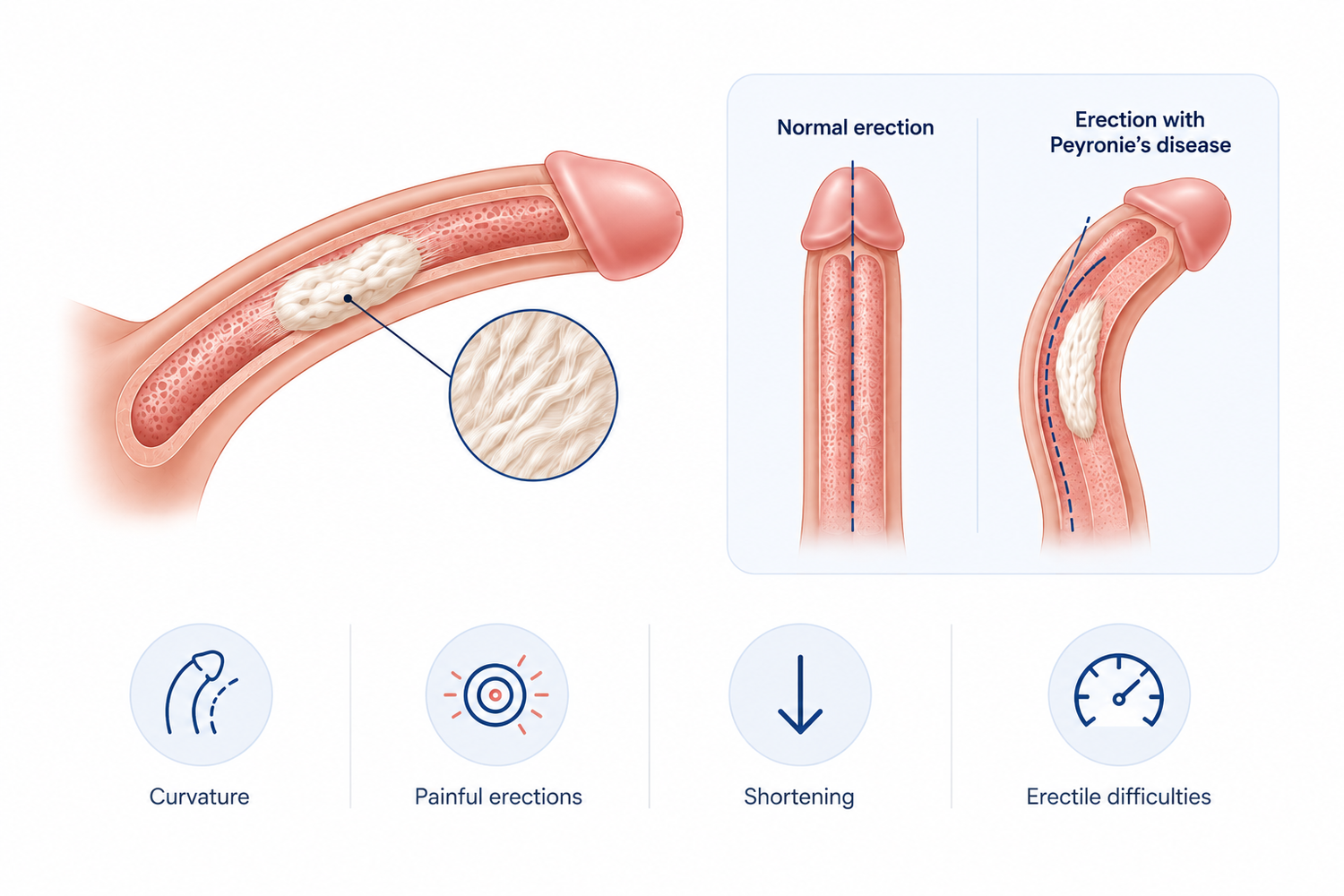
Peyronie’s disease creates scar tissue within the tunica albuginea — the strong outer covering of the erectile tissue. Because the scarred side cannot expand normally, the penis may bend, shorten, narrow or become unstable during erection.
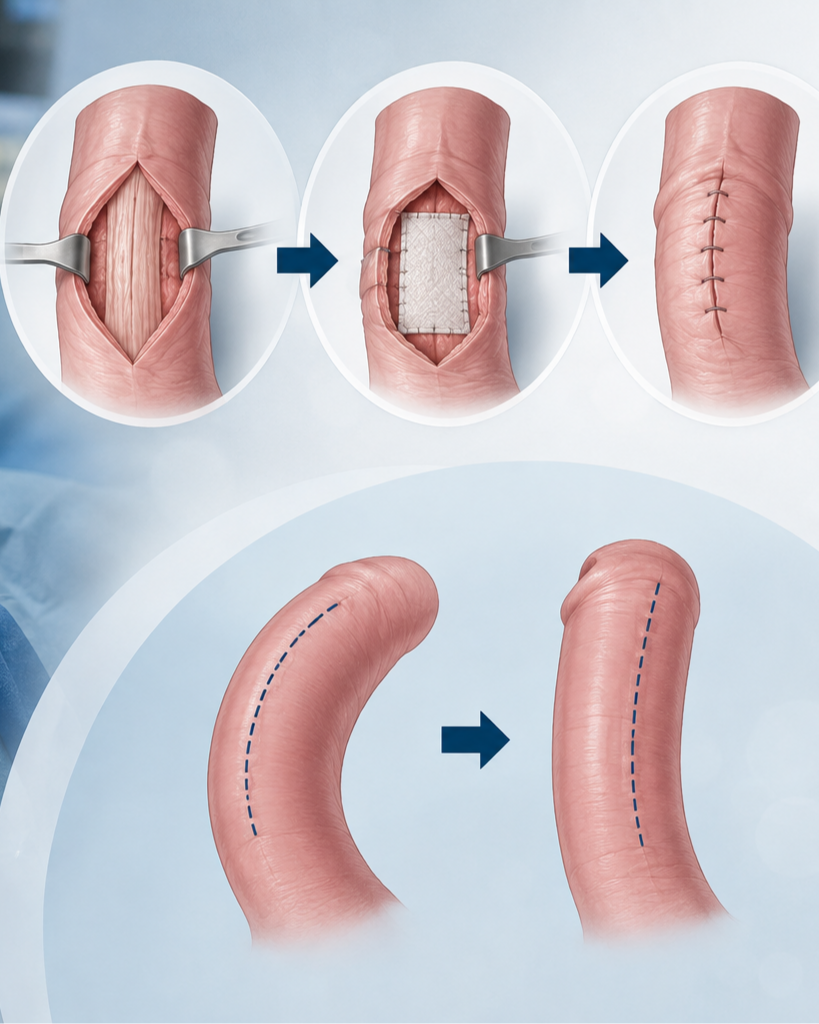
During plaque incision and grafting, the surgeon releases the shortened side at the point of greatest deformity.
This creates a controlled opening in the tunica. A graft is then used to cover that defect so the shortened side can expand further during erection.
Complete plaque excision is usually avoided because removing more tunica can increase the size of the defect and may increase the risk of postoperative erectile problems.
Who may be suited to plaque incision and grafting?
Grafting is not simply a more extensive version of plication. It is generally reserved for selected men whose anatomy and priorities make a tunical-lengthening approach more appropriate.
Typical features can include:
- stable Peyronie’s disease
- reliable natural erections
- severe curvature in an appropriately selected patient
- significant pre-existing penile shortening
- complex or multiplanar curvature
- selected hourglass or hinge deformities
- adequate penile rigidity without an implant
- a strong wish to avoid further shortening from plication
Grafting may be less suitable when there is:
- significant erectile dysfunction
- poor response to erectile dysfunction treatment
- ongoing change in curvature or deformity
- adequate penile length with relatively simple curvature
- a deformity that can be corrected satisfactorily by plication
- medical or surgical factors that make reconstructive surgery less appropriate
Plaque incision and grafting does not treat erectile dysfunction and can itself affect erectile function. Significant pre-existing erectile dysfunction therefore changes the surgical discussion.

The deformity and erection quality both need to be documented
Peyronie’s surgery is generally considered once the condition has become stable and the deformity meaningfully interferes with sexual activity.
Before selecting grafting, assessment usually considers:
- direction and degree of curvature
- stretched penile length
- hourglass deformity or indentation
- hinge or buckling instability
- single-plane versus multiplanar deformity
- erection rigidity
- response to erectile dysfunction medication if relevant
- previous Peyronie’s or penile surgery
How does plaque incision and grafting work?
The exact operation is tailored to the deformity. The basic principle is to release the shortened concave side rather than shortening the opposite side.
Recreate the erection
An artificial erection allows the curvature, narrowing and point of maximum deformity to be assessed during surgery.
Access the shortened side
Depending on plaque position, surrounding structures may need to be carefully mobilised to reach the tunica safely.
Incise the tunica
One or more controlled incisions release the area responsible for tethering and allow the shortened side to expand.
Cover the defect
Graft material is secured over the tunical defect before straightness and stability are reassessed.
Why is a graft required?
Once the shortened tunica is released, the resulting opening cannot simply be left uncovered when the defect is significant.
The graft provides a patch over the tunical defect while allowing the released side to remain expanded.
This is why grafting is commonly described as a tunical-lengthening procedure.
Does grafting restore penile length?
Grafting aims to reduce the additional shortening that would occur if the opposite side were shortened with plication.
The concave side is allowed to expand rather than shortening the longer side.
Grafting cannot reliably restore every millimetre lost since Peyronie’s disease began.
Residual curvature can occasionally require additional shortening manoeuvres even during a grafting operation.
Why grafting is considered when length matters
Men with severe curvature may require substantial shortening if correction is performed entirely with plication.
Grafting can therefore be considered in appropriately selected men with significant shortening or severe deformity who have good erectile function.
However, long-term penile length gain is not guaranteed. The realistic objective is usually to correct the deformity while avoiding deliberate shortening of the opposite side.
Why is erectile function so important before grafting?
Postoperative erectile dysfunction is one of the most important considerations when discussing tunical-lengthening surgery.
Grafting can require mobilisation of penile structures and changes the mechanics of the tunica. Erectile function can therefore worsen after surgery in some men.
Published studies report widely varying erectile outcomes, reflecting differences in patient selection, surgical techniques, graft materials and definitions of erectile dysfunction.
For this reason, grafting is generally reserved for men with good baseline erectile rigidity.
Plication, grafting or penile implant?
The operation is selected according to penile length, erection quality, curvature severity, complex deformity and individual priorities rather than curvature angle alone.
Penile Plication
Often considered when erections are good and the deformity is relatively straightforward.
- reliable erections
- adequate penile length
- less-complex curvature
- little major hourglass or hinge deformity
- additional shortening can occur
Plaque Incision & Grafting
May be considered for selected complex or severe deformity when natural erections remain reliable.
- good baseline erections
- significant shortening
- severe or complex curvature
- selected hourglass or hinge deformity
- greater concern regarding postoperative ED
Penile Implant
Generally preferred when significant erectile dysfunction does not respond adequately to non-surgical treatment.
- addresses erectile rigidity
- may improve curvature with cylinder placement
- additional straightening can be performed if required
- avoids relying on impaired natural erectile function
What about hourglass or hinge deformity?
Some men have a localised area of narrowing rather than a simple bend. This can create an hourglass shape or a segment that buckles during intercourse.
Hourglass narrowing
Circumferential or localised loss of girth can create a narrowed segment that may be visually or functionally significant.
Hinge effect
A narrowed segment may lack sufficient support and bend or buckle during penetration even when the penis is otherwise reasonably straight.
Different reconstructive options
Depending on the anatomy, management may involve tunical grafting, extra-tunical grafting, plication, implant surgery or a combination of techniques.
This is why hourglass narrowing and hinge deformity need to be assessed separately from curvature angle when planning surgery.
What graft material is used?
A variety of graft materials have been used in Peyronie’s reconstruction. No single graft has been proven superior for every patient.
Autologous grafts
Tissue can be harvested from elsewhere in the patient's body. This avoids donor material but creates a second surgical site.
Allografts
Processed human tissue can be used without requiring a separate harvesting incision from the patient.
Xenografts
Processed biological graft materials derived from non-human tissue have also been used in penile reconstruction.
Synthetic grafts
Synthetic materials have historically been used, although material selection needs to consider tissue integration, infection and long-term mechanical behaviour.

Grafting may be combined with other straightening techniques
Complex Peyronie’s deformities do not always fit into one simple category.
Once the shortened side has been released, some residual curvature may remain.
Additional plication, further tunical incision or another reconstructive manoeuvre may sometimes be required to produce a sufficiently straight and stable erection.
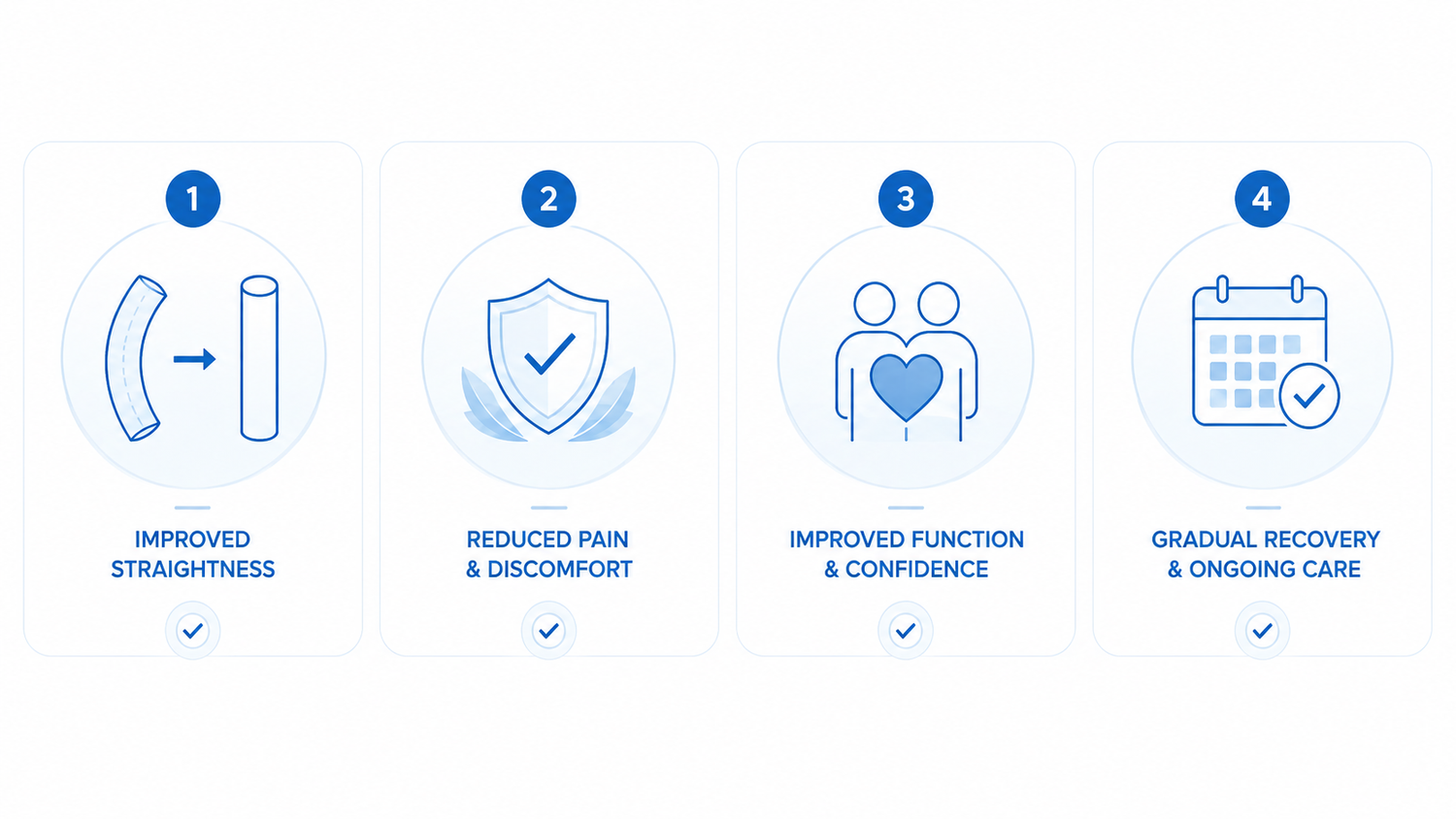
Recovery after plaque incision and grafting
Recovery is generally more involved than after a simple plication because grafting requires more extensive penile dissection and reconstruction.
Swelling and bruising
Penile swelling, bruising, tenderness and wound discomfort are expected during the early recovery period.
Erections during healing
Spontaneous erections can initially be uncomfortable while the tunica, graft and surrounding tissues heal.
Sexual activity
Intercourse and masturbation are avoided during the early postoperative period until healing is sufficient.
Work
Return to work depends on discomfort, healing and the physical demands of the patient's occupation.
Exercise
Heavy lifting, vigorous exercise and pressure on the genital region are restricted during early recovery.
Rehabilitation
Selected men may be advised to use a traction or other penile-rehabilitation strategy after adequate wound healing. This should follow individual postoperative instructions.
Possible risks and limitations
General and surgical risks
- pain
- swelling and bruising
- bleeding or haematoma
- infection
- wound healing problems
- anaesthetic complications
- need for further surgery
Penile and functional risks
- new or worsened erectile dysfunction
- temporary or persistent penile numbness
- residual curvature
- recurrent curvature
- graft contraction or contour irregularity
- persistent hourglass or hinge deformity
- penile shortening
- result not meeting expectations
Published erectile dysfunction rates after lengthening procedures vary considerably. The risk depends strongly on baseline erectile function, patient selection, deformity, surgical technique and other factors.
From Peyronie’s assessment to grafting surgery
Confirm stable Peyronie’s disease
The history is reviewed to determine whether curvature, pain and penile shape have stopped meaningfully changing.
Document the deformity
Erection photographs and penile measurements help define curvature, shortening, narrowing, hourglass deformity and hinge instability.
Assess erectile function
Baseline rigidity and response to erectile dysfunction treatment are reviewed because grafting relies on sufficiently good natural erections.
Compare the operations
Plication, grafting and penile implant surgery are compared, including their different effects on length, erectile function and complex deformity.
Reconstructive surgery
The shortened side is released and the tunical defect reconstructed with graft material according to the deformity identified.
Recovery and functional follow-up
Healing, straightness, sensation and erectile function are reviewed before return to unrestricted sexual activity.

Dr Jack Crozier
Dr Jack Crozier is a Brisbane urologist and fellowship-trained andrologist with a subspecialty practice in Peyronie’s disease, penile reconstruction, erectile dysfunction and penile implant surgery.
His advanced andrology fellowship at University College London Hospitals included Peyronie’s disease surgery, reconstructive andrology and penile prosthetic surgery.
Travelling for complex Peyronie’s surgery assessment?
Patients with severe penile curvature, shortening, hourglass deformity, hinge instability or previous penile surgery may seek specialist assessment from elsewhere in Queensland, interstate or overseas.
Where clinically appropriate, erection photographs, ultrasound results, previous operative reports and treatment records can be reviewed as part of preliminary planning.
Physical examination or additional erectile assessment may still be required before a definitive surgical recommendation is made.
Explore related information
Peyronie’s Disease
Understand the condition, disease phases and the broader range of non-surgical and surgical treatment pathways.
Penile Plication Surgery
Learn about tunical-shortening surgery for men with reliable erections and less-complex penile curvature.
Penile Implant Surgery
Explore the surgical pathway when Peyronie’s disease occurs with significant erectile dysfunction.
Peyronie’s & Penile Length
Understand why shortening occurs and what plication, grafting and implants can realistically achieve.
Peyronie’s Treatment Explorer
Organise information about curvature, deformity, disease stability and erectile function before consultation.
Erectile Dysfunction, Implants & Peyronie’s
Return to the main penile and sexual-health treatment hub.
Plaque incision and grafting FAQs
What is plaque incision and grafting?
It is a reconstructive operation in which the shortened side of the tunica albuginea is incised to release the Peyronie’s deformity. The resulting defect is then covered with graft material.
Is the Peyronie’s plaque removed?
Usually not completely. Modern grafting surgery generally uses incision or partial release rather than complete plaque excision. Complete excision creates a larger tunical defect and may increase the risk of postoperative erectile dysfunction.
Who is a good candidate for grafting surgery?
Grafting is generally considered in selected men with stable Peyronie’s disease, good natural erectile function and severe curvature, significant shortening or complex deformity where plication may be less suitable.
Why do erections need to be good before grafting?
Grafting does not treat erectile dysfunction and carries a meaningful risk of postoperative erectile deterioration. Good baseline rigidity therefore makes a man more suitable for a reconstruction that continues to rely on his natural erectile function.
Can grafting cause erectile dysfunction?
Yes. New or worsened erectile dysfunction is an important recognised risk. Reported rates vary widely between studies because patient selection, surgical techniques, graft materials and definitions of erectile dysfunction differ.
Is grafting better than plication?
Neither operation is better for every patient. Plication generally suits men with good erections, adequate length and less-complex curvature. Grafting may be considered when erections are good but severe curvature, substantial shortening or complex deformity makes further shortening less desirable.
Does grafting make the penis longer?
Grafting releases the shortened side and avoids intentionally shortening the opposite side. It may preserve more functional length than plication in selected cases, but it does not reliably restore the penis to its pre-Peyronie’s length or guarantee a long-term length gain.
Can grafting fix an hourglass deformity?
Selected hourglass or hinge deformities may be treated with a grafting-based reconstructive technique, but not every hourglass deformity requires incision of the tunica. Extra-tunical grafting and other reconstructive options may be appropriate depending on penile stability and erectile function.
What graft material is best?
No graft material has been proven superior for every patient. Several biological and synthetic materials have been used. Choice depends on the operative technique, surgeon experience, tissue requirements and individual circumstances.
Can the graft shrink or contract?
Graft contraction and scar remodelling are recognised possibilities and can contribute to recurrent curvature or contour change. The likelihood varies according to healing, graft characteristics and the underlying disease.
Will the penis be completely straight after grafting?
Perfect straightness cannot be guaranteed. The practical goal is generally a penis sufficiently straight and stable for comfortable sexual activity. Small residual curvature may still be compatible with a good functional result.
Can curvature come back?
Residual or recurrent curvature can occur following any Peyronie’s reconstruction. This may relate to healing, graft contraction, scar remodelling or further disease change.
What if I already have erectile dysfunction?
Mild erectile dysfunction that responds reliably to treatment may not necessarily exclude grafting. Significant erectile dysfunction that does not respond adequately to medication generally shifts the surgical discussion toward penile implant surgery.
Is plaque incision and grafting more complex than plication?
Generally yes. Grafting involves release of the shortened tunica, creation of a tunical defect and graft reconstruction. Depending on plaque location, additional mobilisation of penile structures may also be required.
Can grafting affect penile sensation?
Temporary penile numbness can occur, particularly when the neurovascular bundle requires mobilisation. Persistent sensory change is less common but remains a recognised surgical risk.
Do I need circumcision with grafting surgery?
Not every patient automatically requires circumcision. The need depends on the surgical exposure, foreskin condition, plaque location and additional procedures required. This should be discussed before surgery.
How long before I can have sex after grafting?
Sexual activity is avoided during initial wound and graft healing. The exact period depends on the operation and individual recovery. Intercourse and masturbation should only resume after postoperative review confirms adequate healing.
Will I need penile traction after surgery?
Traction or another penile rehabilitation strategy may be recommended in selected patients after adequate healing, but it is not appropriate to start independently soon after surgery. Postoperative rehabilitation should follow individual surgical instructions.
Can I be assessed if I live interstate or overseas?
Potentially. Erection photographs, previous penile ultrasound, treatment records and operative reports may help with preliminary assessment. Physical examination or additional testing may still be required before a definitive surgical plan is made.
Is grafting the right reconstructive option for your deformity?
If stable Peyronie’s disease has caused severe curvature, shortening, hourglass narrowing or another complex deformity, specialist assessment can help determine whether plication, plaque incision and grafting, penile implant surgery or another reconstructive pathway best matches your anatomy, erectile function and priorities.
Medical information disclaimer: This page provides general educational information and does not replace individual medical advice, diagnosis or informed consent. Peyronie’s disease varies considerably between patients. The appropriate surgical treatment depends on disease stability, penile length, curvature, hourglass or hinge deformity, erectile function, previous treatment, medical history and individual priorities. Plaque incision and grafting can cause complications including erectile dysfunction, altered penile sensation, recurrent or residual curvature, graft-related changes and shortening. Surgical straightening, preservation or restoration of penile length, erectile function and satisfaction cannot be guaranteed.