


Asymptomatic Kidney Stones: Surveillance or Treatment?
A kidney stone found unexpectedly on a scan does not automatically need surgery. Selected non-obstructing stones can sometimes be monitored, while others may be better treated because of stone growth, obstruction, infection risk or individual circumstances.
Fever, chills, significant illness, severe worsening pain, persistent vomiting or concern about urinary obstruction requires prompt medical assessment rather than routine surveillance.
Does an asymptomatic kidney stone need treatment?
Not necessarily. A stone that is sitting within the kidney, is not obstructing urine drainage and is not causing symptoms or infection may sometimes be suitable for active surveillance rather than immediate removal.
Surveillance does not mean ignoring the stone. It means making a deliberate decision to monitor it, watching for changes that could alter the balance between observation and treatment.
Stone size matters, but the decision is not based on diameter alone. Location, number of stones, growth, kidney anatomy, infection, kidney function and your own circumstances can all influence the plan.

When might monitoring be reasonable?
Surveillance is most relevant when the stone is currently causing little or no clinical problem and there is a reliable pathway for follow-up.
No significant symptoms
The stone was discovered incidentally and is not causing recurrent renal colic or persistent stone-related pain.
No concerning obstruction
Imaging does not show clinically significant obstruction or another concern threatening drainage from the kidney.
No associated infection
There is no recurrent stone-associated urinary infection or infected obstruction requiring a different management strategy.
Kidney function is preserved
Kidney function and the overall clinical picture do not suggest that leaving the stone in place is putting renal function at unacceptable risk.
Stone behaviour is acceptable
Previous imaging may show that the stone is stable rather than demonstrating progressive growth or increasing stone burden.
Follow-up is practical
Surveillance is more useful when future imaging and medical review can be arranged and new symptoms can be assessed if they occur.
What does active surveillance actually involve?
The objective is to understand how the stone behaves over time and identify meaningful change before it creates a larger problem.
Establish the baseline
Review the stone's size, location, number, overall burden and whether obstruction is present.
Plan follow-up
Decide what form of imaging and clinical review is appropriate for the particular stone and patient.
Look for change
Compare future imaging for growth, stone movement, new stones or evidence of urinary obstruction.
Reassess the decision
Continue surveillance if appropriate or reconsider treatment when the risk-benefit balance changes.
Do I need repeated CT scans?
Not necessarily. The appropriate imaging strategy depends on the type of stone, whether it can be followed accurately using ultrasound or plain imaging, previous investigations and whether treatment is being considered.
Ultrasound may be useful for monitoring selected stones and assessing whether urinary dilatation is present.
Plain X-ray imaging can sometimes help follow stones that are visible on X-ray.
Low-dose non-contrast CT provides more detailed information when the exact stone burden or anatomy needs clarification.
What can make treatment more appropriate?
Surveillance is a continuing decision. A stone that was reasonable to observe previously may become more appropriate to treat if its behaviour or clinical impact changes.
Stone growth
Progressive enlargement on serial imaging can shift the balance toward active removal.
New obstruction
A stone causing new impairment of urine drainage requires reassessment even when pain is limited.
Pain or renal colic
A previously silent renal stone may move or become symptomatic, changing the reason for continued observation.
Urinary infection
Recurrent infection associated with a stone or infection behind an obstruction can alter the urgency and treatment strategy.
Increasing stone burden
Formation of additional stones or increasing total stone burden may warrant reconsideration of surveillance alone.
Individual circumstances
Occupation, travel, access to emergency care, medical conditions and patient preference may affect the threshold for treatment.
Surveillance versus proactive treatment
In some patients both strategies are medically reasonable. The decision then becomes a balance between the future risk posed by the stone and the risks, recovery and potential benefits of removing it now.
Surveillance may favour
- No current stone symptoms
- No concerning urinary obstruction
- No stone-associated infection
- Stable or acceptable stone burden
- Reliable access to follow-up
- Preference to avoid an unnecessary procedure
Treatment may favour
- Progressive stone growth
- New or persistent obstruction
- Recurrent pain or renal colic
- Stone-associated urinary infection
- Increasing or substantial stone burden
- Specific occupational, travel or personal priorities
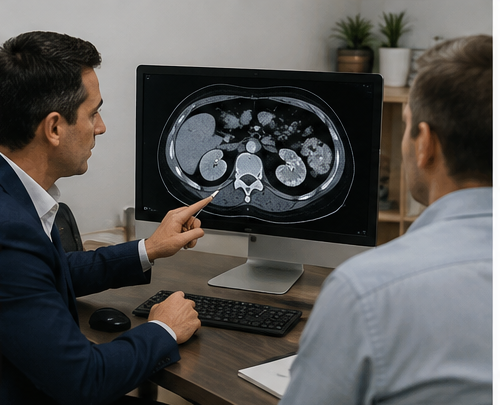
Your circumstances also matter
Two people with apparently similar stones may reasonably make different treatment decisions.
The scan provides important information, but it does not capture the entire clinical situation. The consequences of a future stone episode may be very different for someone who lives close to emergency care compared with someone travelling remotely or working in an occupation where an unpredictable renal colic episode could have major consequences.
How can a kidney stone be treated?
Deciding to treat a stone is separate from deciding which procedure to use. Treatment is selected according to stone size, location, density, kidney anatomy and other individual factors.
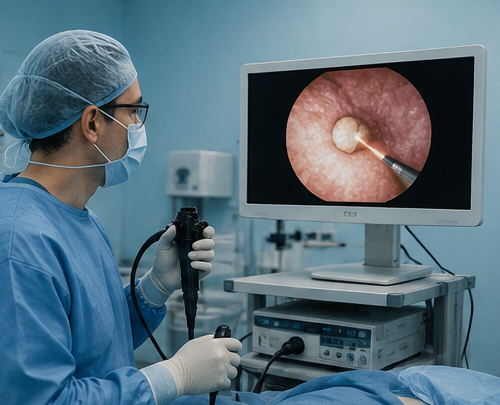
Ureteroscopy, Flexible Pyeloscopy & Laser
Fine instruments can be passed through the natural urinary tract to reach selected stones within the ureter or kidney. Laser energy can then be used to fragment the stone where appropriate.
Shock Wave Lithotripsy
Shock waves generated outside the body can fragment suitable renal stones. Suitability depends on stone size, location, density and patient anatomy.
PCNL
Percutaneous nephrolithotomy provides direct keyhole access to the kidney and is an important treatment pathway for selected larger or complex renal stones.
Large or Multiple Stones
Multiple stones, large renal stone burdens, unusual anatomy and staghorn stones may require a more detailed or staged treatment strategy.
Surveillance should not ignore future stone risk
Monitoring the stone already present is only one part of kidney stone management. Some people continue to form new stones even while an existing stone remains unchanged.
Patients with recurrent stones, multiple stones or other features suggesting increased recurrence risk may benefit from additional investigation aimed at understanding why stones are forming.
Already had a CT or ultrasound?
Existing imaging is particularly useful when deciding whether a stone can be observed. Whenever possible, the actual images are more useful than relying only on a written radiology report.
Helpful information to bring
- CT, ultrasound or other kidney imaging
- Previous radiology reports
- Earlier imaging for comparison
- Recent kidney function blood tests
- Urine test or culture results
- Previous stone analysis if available
- Previous stone procedure details
What can be reviewed?
- Exact stone size and location
- Number and overall stone burden
- Whether obstruction is present
- Evidence of interval stone growth
- Kidney anatomy
- Previous stone history
- Surveillance versus treatment options
Asymptomatic kidney stone FAQs
Does every asymptomatic kidney stone need to be removed?
No. Selected non-obstructing kidney stones that are not causing symptoms, infection or other clinical concerns may sometimes be managed with active surveillance rather than immediate surgery.
Is surveillance safe?
Surveillance can be an appropriate strategy for selected patients when the potential future risks of the stone have been considered and follow-up is available. The decision should be reviewed if the stone grows, symptoms develop, obstruction appears or infection becomes a concern.
What size asymptomatic kidney stone can be observed?
There is no single stone diameter that determines the decision in every patient. Smaller, stable non-obstructing stones are commonly considered for surveillance, but stone location, growth, overall burden, kidney anatomy and individual circumstances also matter.
Can an asymptomatic kidney stone suddenly cause pain?
Yes. A stone that has previously remained within the kidney may move into the ureter and cause renal colic. This possibility is one of the factors considered when discussing surveillance versus proactive treatment.
Can a kidney stone cause obstruction without severe pain?
Urinary obstruction does not always produce severe symptoms. This is one reason why planned follow-up imaging can be useful in selected patients undergoing active surveillance.
How often should an asymptomatic kidney stone be scanned?
Follow-up should be individualised. The appropriate interval and imaging method depend on stone size and location, previous growth, recurrence risk, stone visibility on different imaging methods and the patient's circumstances.
Do I need a CT scan every year?
Not necessarily. Ultrasound or plain imaging may be suitable for surveillance in selected circumstances. CT provides greater anatomical detail but exposes the patient to radiation, so its use can be tailored to the clinical question.
What happens if my kidney stone grows?
Documented stone growth can change the balance between continued surveillance and active treatment. Updated imaging can be reviewed together with stone location, overall stone burden and individual clinical factors.
Can I choose to have an asymptomatic stone removed?
Patient preference can form part of shared decision-making. Occupation, travel, previous painful stone episodes, access to emergency care and personal priorities may all be relevant when both surveillance and treatment are reasonable options.
Which operation is used if I decide to treat the stone?
The procedure depends on the stone rather than simply on the decision to treat. Options for selected stones can include shock wave lithotripsy, flexible ureteroscopy and laser treatment, or PCNL for larger or more complex stone burdens.
When is a kidney stone an emergency?
Urinary obstruction together with infection can require urgent treatment. Fever, chills, significant illness, worsening severe pain, persistent vomiting or inability to pass urine should prompt urgent medical assessment rather than waiting for a routine outpatient appointment.
Have you been told there is a kidney stone on your scan?
Existing imaging can be reviewed to establish where the stone is, whether it is causing obstruction, whether it has changed over time and whether surveillance or active treatment is the more appropriate pathway.
This information is general educational information and does not replace individual medical advice. Whether an asymptomatic kidney stone should be monitored or treated depends on factors including stone size and location, stone growth, symptoms, urinary obstruction, infection, kidney function, urinary anatomy, previous stone history, medical conditions and individual circumstances. Seek urgent medical assessment for fever, chills or significant illness associated with suspected urinary obstruction.