Varicocele & Male Fertility
A varicocele is an enlargement of veins around the testicle. Many varicoceles cause no fertility problem, but in selected men they can be associated with impaired sperm production and difficulty conceiving.
The important question is not simply whether a varicocele exists — it is whether treating it is likely to improve your reproductive pathway.
What is a varicocele?
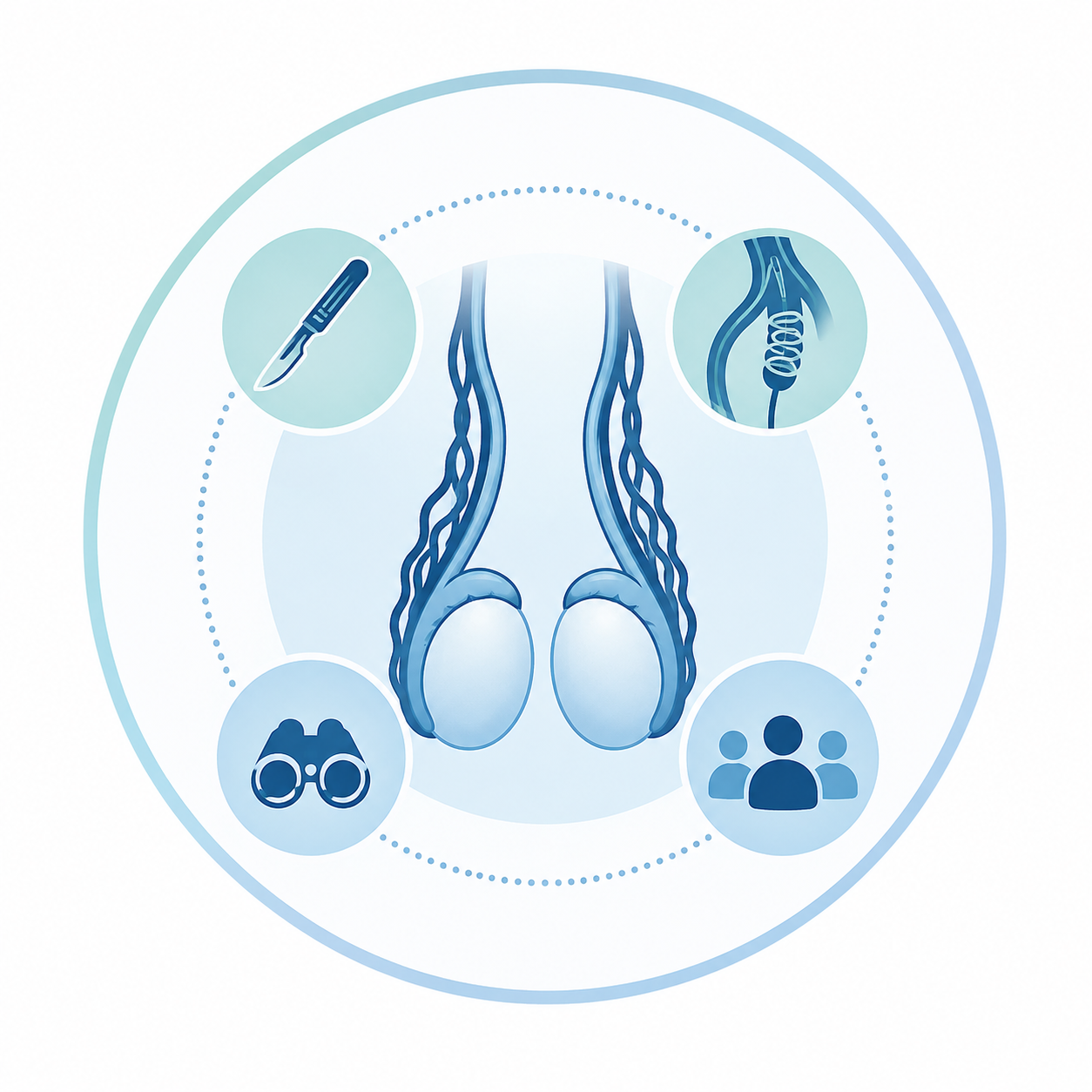
A varicocele is a group of enlarged veins within the spermatic cord above and around the testicle.
It develops when venous drainage from the testicle becomes inefficient and blood refluxes or pools within the veins. Varicoceles are more commonly detected on the left side, although they can occur on both sides.
Importantly, a varicocele is common and many men who have one remain completely fertile.
Finding a varicocele therefore does not prove that it is responsible for an abnormal semen analysis or a couple's difficulty conceiving.


How can a varicocele affect fertility?
The exact relationship is complex. Varicoceles may alter the environment required for normal sperm production.
Proposed mechanisms include increased testicular temperature, oxidative stress and altered testicular function.
In affected men, a varicocele may be associated with changes in sperm concentration, motility and other aspects of semen quality.
Concentration
Some men have a lower concentration or reduced total sperm number.
Motility
Sperm movement may be impaired in some men with a clinically significant varicocele.
DNA integrity
Varicocele has been associated with increased sperm DNA fragmentation in selected fertility populations.
Testicular function
A significant varicocele can occasionally be associated with reduced testicular size or function.
Does your varicocele actually need treatment?
Treatment makes the most sense when there is a reasonable connection between the varicocele and a problem that matters to you — rather than treating the scan itself.
Is it clinically significant?
A varicocele that can be detected on physical examination generally has greater clinical relevance than a small varicocele seen only on ultrasound.
Is there a fertility abnormality?
Semen results, reproductive history and other potential male-factor causes should be considered before attributing infertility to the varicocele.
Will treatment change the couple's pathway?
Even when repair might improve sperm production, the time required for improvement should be weighed against the reproductive circumstances of the person providing the eggs.
When is treatment more — or less — likely to be useful?
Treatment may be worth considering
- A clinically palpable varicocele
- Difficulty conceiving as a couple
- Relevant abnormal semen parameters
- No more important untreated explanation for the male factor
- Persistent typical varicocele-related ache or heaviness
- Selected recurrent or persistent varicocele after previous treatment
- A fertility timeframe that allows time to assess response
The benefit may be less clear
- A small varicocele detected only by ultrasound
- Repeatedly normal semen parameters
- No pain or testicular-function concern
- Another major cause of infertility is present
- The couple needs to proceed urgently with assisted reproduction
- The symptoms do not sound typical for varicocele pain
- Treatment would be unlikely to change the reproductive plan
Important: a larger varicocele or an abnormal ultrasound does not by itself prove that treatment will improve fertility. The treatment decision is based on the whole reproductive picture.
Observation, microsurgery or embolisation?
There is no single correct treatment for every varicocele. Some men need no procedure at all.
Observation
No procedure is required when the varicocele is unlikely to be clinically important or when the expected benefit of treatment is small.
Follow-up can include symptoms, examination, semen testing or fertility reassessment depending on the situation.
When is observation reasonable? ↓Microsurgical Varicocele Repair
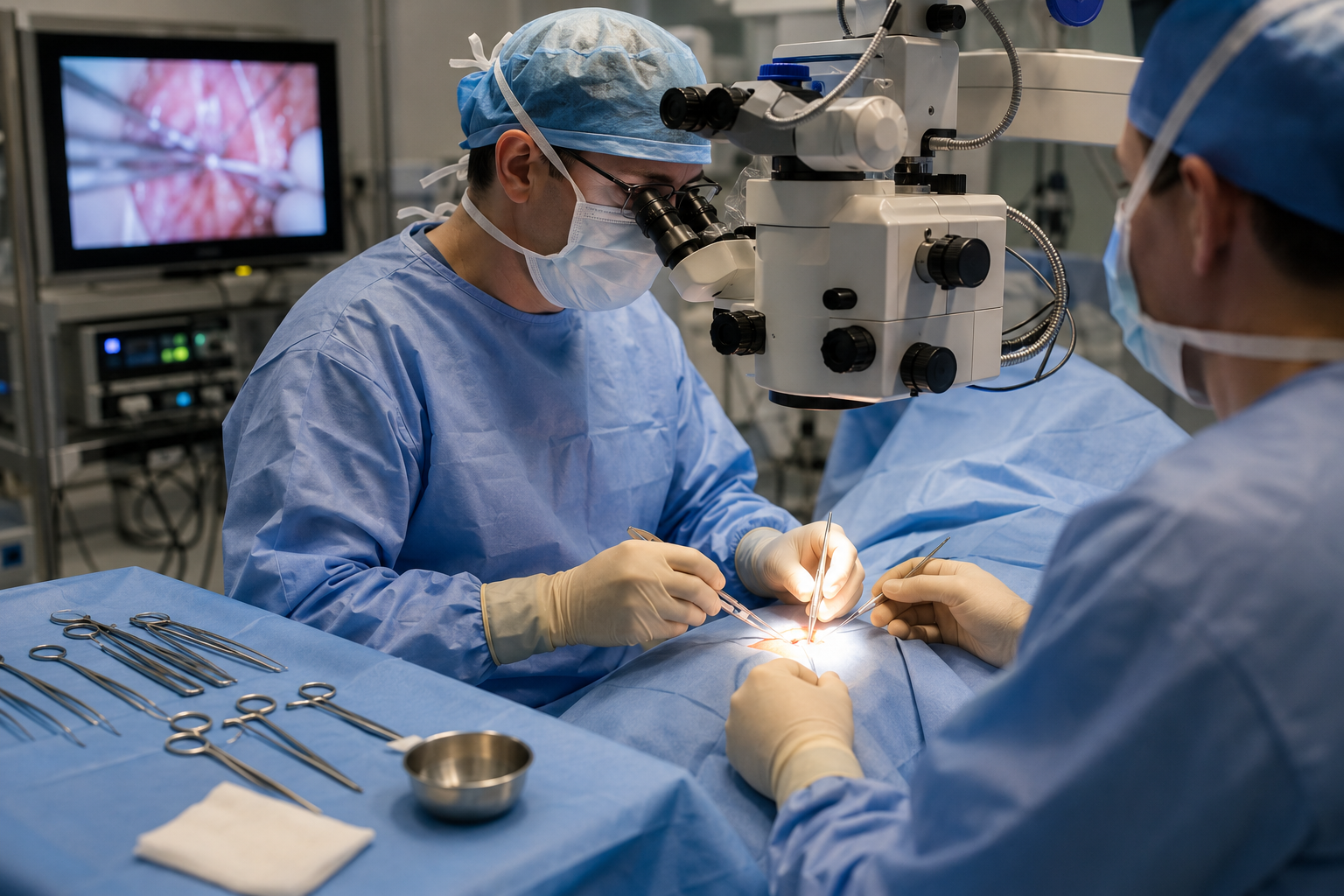
A small lower-groin incision allows abnormal veins to be identified under an operating microscope while preserving the testicular artery and lymphatic vessels.
This is commonly used when fertility improvement is the principal treatment goal.
Explore Microsurgery ↓Varicocele Embolisation
An interventional radiologist treats the abnormal venous drainage from inside the vascular system using image-guided catheter techniques.
It is a minimally invasive alternative that may be particularly useful in selected patients.
Complete Embolisation Guide →Microsurgical varicocele repair
Microsurgical varicocelectomy is performed through a small incision in the lower groin, usually using a subinguinal or inguinal approach.
An operating microscope provides magnification of the structures within the spermatic cord.
Enlarged veins responsible for the varicocele are divided while important structures are preserved.
What about varicocele embolisation?
Varicocele embolisation treats the abnormal testicular venous drainage from inside the vascular system rather than through a groin incision.
A catheter is advanced under image guidance into the abnormal vein, which is then occluded using an appropriate embolisation technique.
The procedure itself is performed by an interventional radiologist. Male fertility assessment can help establish whether treating the varicocele is appropriate before deciding between embolisation and surgery.
Why might embolisation be considered?
Microsurgery vs embolisation
Both approaches aim to stop abnormal venous reflux, but they reach the abnormal veins in different ways.
| Feature | Microsurgical Repair | Varicocele Embolisation |
|---|---|---|
| Specialist | Urological surgeon / reproductive microsurgeon | Interventional radiologist |
| Approach | Small lower-groin incision | Small venous puncture |
| Visualisation | Direct operating-microscope magnification | X-ray venography and image guidance |
| Anaesthesia | Commonly general anaesthesia | Commonly local anaesthetic with or without sedation |
| Testicular artery | Identified and preserved under magnification | Not directly dissected |
| Lymphatics | Identified and preserved | Not surgically disrupted |
| Radiation | No procedural X-ray radiation | Fluoroscopy is used |
| Contrast | Not generally required | Venographic contrast is commonly required |
| Recurrent varicocele | Repeat microsurgery can be considered | Can be particularly useful after previous surgery |
| Recovery | Temporary limitation of strenuous activity after surgery | Initial recovery is often relatively rapid |
| Fertility follow-up | Repeat semen analysis after sufficient time for spermatogenesis | Same principle — response is assessed over months |
The most important decision comes first: is treatment likely to improve your fertility or symptoms? Once treatment is justified, microsurgery and embolisation can be compared according to anatomy, fertility priorities, previous procedures and individual preference.
When might sperm improve?
Changes in fertility are not immediate. New sperm production takes time, so follow-up is usually planned over several months.
Establish a baseline semen pattern and clarify the couple's fertility strategy.
The initial focus is wound or access-site recovery rather than semen improvement.
A repeat semen analysis is commonly the first meaningful assessment of a fertility response.
Further testing and natural conception, IUI, IVF or ICSI planning depend on the response and the couple's circumstances.
Repair the varicocele first — or proceed to IVF/ICSI?
This can be one of the most important decisions for couples where a varicocele and abnormal semen analysis are found.
Treating the varicocele first may make sense when…
There is a clinically significant varicocele, relevant semen impairment and sufficient reproductive time to wait for possible sperm improvement.
A meaningful improvement can sometimes change the reproductive options available, although this cannot be predicted or guaranteed.
Proceeding directly to ART may make sense when…
The reproductive timeframe is limited, another major fertility factor exists, IVF is already required for other reasons, or waiting several months is unlikely to improve the overall chance of achieving the couple's goals.
The decision should be based on both partners rather than the semen analysis alone.
A useful question is: “If my semen parameters improve after treatment, will that realistically change what we do next?”
What if the sperm count is extremely low?
A very low sperm concentration does not automatically mean that a varicocele should—or should not—be repaired.
The key question is whether the varicocele is likely to be an important contributor and whether an improvement could meaningfully alter the fertility pathway.
Severe oligozoospermia also warrants consideration of other possible causes of impaired sperm production rather than automatically attributing the entire result to a varicocele.
Possible limitations of varicocele treatment
Successful closure of abnormal veins does not guarantee improvement in sperm quality, pregnancy or pain.
Semen may not improve
Some men show little or no meaningful change in semen parameters after successful treatment.
Pregnancy is not guaranteed
Fertility depends on both partners and on reproductive factors beyond the varicocele.
Varicocele can recur
Persistence or recurrence is possible following any treatment technique.
Pain can persist
Scrotal discomfort may continue even when the varicocele has been technically treated.
Treatment has procedural risks
Microsurgery and embolisation have different complication profiles that should be discussed before treatment.
Time matters
Waiting for sperm production to change may not suit every couple's reproductive timeframe.
Better understand your fertility results
These tools can help organise your existing results and prepare for a specialist male-fertility assessment.
Semen Analysis Interpreter
Review sperm concentration, motility, morphology, semen volume and other commonly reported parameters.
Open Interpreter →Male Fertility Assessment Checklist
Organise semen tests, hormone results, previous treatment and other information before your appointment.
Build My Checklist →Male Fertility Procedures
Explore varicocele repair, reproductive microsurgery, sperm retrieval and other fertility procedures.
Explore Procedures →
Varicocele assessment within the wider fertility picture
Dr Jack Crozier is a Brisbane urologist and fellowship-trained andrologist with a subspecialty practice in male reproductive medicine and reproductive microsurgery.
Varicocele assessment therefore forms part of the wider male-fertility evaluation rather than considering the vein abnormality in isolation.
Where treatment is appropriate, microsurgical repair can be discussed alongside observation, assisted reproduction and referral for interventional-radiology embolisation.
Varicocele & male fertility resources
Questions patients often ask
Does every varicocele affect fertility?
No. Many men with a varicocele have normal sperm production and normal fertility. The presence of a varicocele does not by itself prove that it is contributing to infertility.
Should a varicocele found only on ultrasound be treated?
Usually not simply because it has been detected on imaging. The significance depends on clinical examination, semen findings, symptoms and the wider fertility circumstances.
My semen analysis is normal. Could my varicocele still matter?
Possibly, but treatment is less straightforward when repeated conventional semen parameters are normal.
In selected situations involving unexplained infertility, recurrent pregnancy loss or unsuccessful fertility treatment, a more detailed male-fertility assessment may still be useful.
One semen analysis was abnormal and another was better. Which should I believe?
Semen parameters vary between samples. Illness, abstinence interval, collection factors, medications and normal biological variation can influence the result.
Treatment decisions should rarely depend on one isolated semen analysis.
Does the grade or size of my varicocele determine whether I need treatment?
No. Size is only one part of the assessment. More important questions include whether the varicocele is clinically detectable, whether sperm production is impaired and whether treatment is likely to alter the reproductive pathway.
Can varicocele treatment improve my sperm enough to avoid IVF or ICSI?
Sometimes semen parameters improve sufficiently to change the fertility options available to a couple. However, the degree of improvement cannot be predicted or guaranteed.
Starting semen quality, testicular function and the fertility circumstances of both partners remain important.
Should I repair my varicocele before IVF or ICSI?
There is no single answer. Repair may be reasonable when there is a significant varicocele, abnormal sperm quality and enough time to allow a potential response.
Proceeding directly to assisted reproduction may instead make sense where the reproductive timeframe is limited or IVF is already required for another reason.
How long after treatment should I repeat my semen analysis?
The first meaningful reassessment is commonly around three months because changes in sperm production take time. Further testing may be useful depending on the result and fertility plan.
Is microsurgical varicocele repair better than embolisation?
Neither approach is automatically best for every patient. Microsurgical repair is commonly used for fertility-related treatment and allows direct preservation of the artery and lymphatic vessels under magnification.
Embolisation is a minimally invasive alternative and may be particularly attractive after previous surgery or when avoiding an incision or general anaesthetic is important.
Who performs varicocele embolisation?
Varicocele embolisation is an image-guided vascular procedure performed by an interventional radiologist.
A reproductive urologist can assess whether the varicocele appears relevant to fertility and help compare treatment pathways before referral for embolisation where appropriate.
What if my sperm count is extremely low?
Severe oligozoospermia warrants a broader male-fertility assessment rather than automatically attributing the result to a varicocele.
The question is whether treatment could meaningfully change the number of sperm available and therefore alter the couple's fertility options.
Can a painless varicocele still affect fertility?
Yes. Fertility-related varicoceles are often painless. Pain and fertility are separate reasons for considering treatment.
Can a varicocele cause sperm DNA fragmentation?
Varicoceles have been associated with increased sperm DNA fragmentation in some men.
DNA-fragmentation testing is not required routinely for every varicocele. Its usefulness depends on the fertility history and whether the result would alter management.
Can a varicocele come back after treatment?
Yes. Persistence or recurrence is possible after any treatment method. The appropriate next step depends on symptoms, fertility goals and the venous anatomy remaining after the first procedure.
Embolisation can be particularly useful in selected recurrent varicoceles after previous surgery.
Will treating my varicocele guarantee pregnancy?
No. Treatment can improve semen parameters in some selected men, but neither sperm improvement nor pregnancy can be guaranteed. Fertility outcomes depend on factors involving both partners.
The question is not just “Do I have a varicocele?”
The more useful question is whether treating it could meaningfully improve your fertility or symptoms — and, if treatment is appropriate, whether observation, microsurgical repair or embolisation best fits your circumstances.
Explore More About Male Fertility