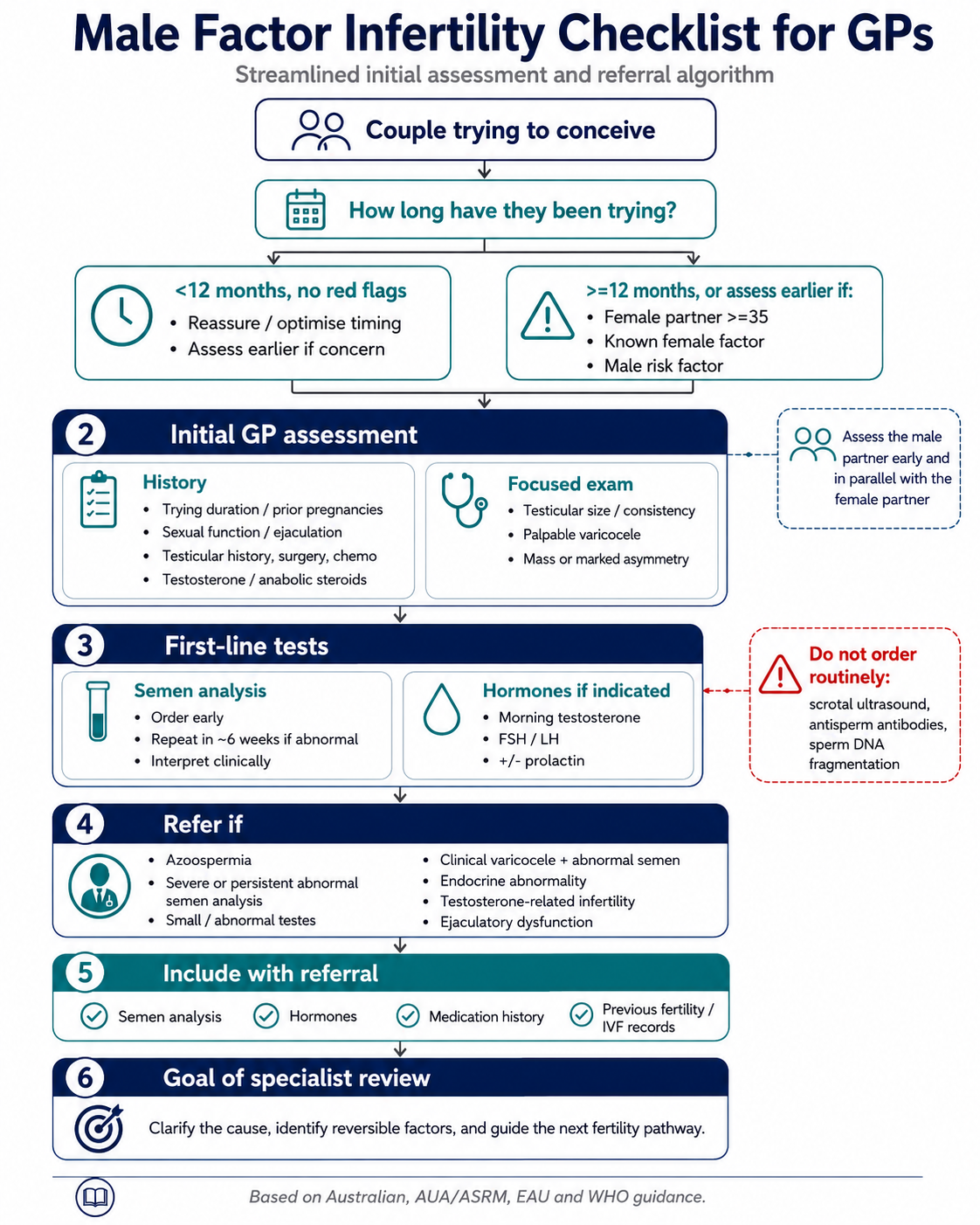
Male Factor Infertility Checklist for GPs
Male factors contribute to infertility in up to half of couples having difficulty conceiving. Current Australian and international guidance recommends assessing the male partner early and in parallel with the female partner, rather than waiting for the female assessment to be completed.[1–3]
For GPs, the initial work-up can usually be kept simple: focused history, examination where appropriate, semen analysis and targeted blood tests.
1. When should male fertility assessment start?
Consider assessment after 12 months of regular unprotected intercourse, or earlier when time matters or a male risk factor is present.[1,3]
Consider earlier assessment when the female partner is ≥35 years, there is a known female fertility factor, or the man has:
Previous undescended testis, torsion, testicular trauma or surgery
Chemotherapy or radiotherapy
Previous vasectomy or pelvic/retroperitoneal surgery
Erectile or ejaculatory dysfunction
Testicular atrophy, scrotal mass or significant asymmetry
Current or previous testosterone/anabolic-steroid use
See: Male Infertility & Reproductive Urology
2. First-visit GP checklist
Ask about:
Duration trying and previous pregnancies
Sexual function, ejaculation and intercourse frequency
Cryptorchidism, infections, torsion, trauma and reproductive surgery
Significant febrile illness in recent months
Medications and supplements—particularly testosterone or anabolic steroids
Smoking/vaping, cannabis, alcohol and relevant occupational exposures
Where appropriate, examine testicular size and consistency and assess for a clinically palpable varicocele. A hard intratesticular mass requires prompt investigation rather than routine fertility follow-up.[1]
3. Order semen analysis early
Semen analysis is the key first-line investigation and should use current WHO laboratory methods.[1,4]
Importantly, a semen analysis does not provide a simple “fertile” or “infertile” result.
If the first semen analysis is abnormal, Australian guidance recommends repeating it approximately 6 weeks later, or longer when clinically appropriate.[1] However, do not delay referral simply to obtain another sample when azoospermia or severe abnormalities are present.
GPs and patients can use the Semen Analysis Interpreter to understand commonly reported parameters.
4. When should GPs order hormones?
If semen parameters are abnormal or there are features suggesting androgen deficiency or endocrine disease, consider morning:
Total testosterone
FSH
LH
Prolactin when clinically indicated[1–3]
Results should be interpreted alongside the semen analysis, examination and clinical history.
5. What should not be ordered routinely?
Routine initial testing generally does not require:
Scrotal ultrasound in every patient
Antisperm antibodies
Sperm DNA fragmentation testing[1]
Genetic testing is important in selected men with azoospermia or significant oligozoospermia but is usually best targeted after specialist assessment.[1,2]
6. Refer earlier when you find:
Azoospermia
Severe or persistent oligozoospermia
Markedly abnormal semen parameters
Small or abnormal testes
Clinical varicocele with abnormal semen analysis
Significant endocrine abnormalities
Infertility after testosterone/anabolic-steroid exposure
Significant ejaculatory dysfunction
Recurrent pregnancy loss or repeated assisted-reproduction failure where male reassessment may be relevant[1–3]
Men with azoospermia require assessment to distinguish obstructive from non-obstructive azoospermia, as investigation and treatment pathways differ.
Useful resources: Azoospermia | Fertility After Testosterone
What should you include in the referral?
Attach semen-analysis reports, hormone results, medication history, previous fertility/IVF records and relevant operative reports where available.
Patients can also complete the Male Fertility Assessment Checklist before review.
For patients outside Brisbane, initial assessment and record review may sometimes be undertaken before travel. See Interstate & International Patient Information.
A specialist assessment does not automatically mean treatment or surgery. The aim is to clarify the likely cause, identify potentially reversible factors and help determine an appropriate pathway based on both partners' circumstances.
References
Katz DJ, O'Donnell L, McLachlan RI, Moss TJ, Boothroyd CV, Jayadev V, et al. The first Australian evidence-based guidelines on male infertility. Med J Aust. 2025;223(11):653-663. doi:10.5694/mja2.70080.
Schlegel PN, Sigman M, Collura B, De Jonge CJ, Eisenberg ML, Lamb DJ, et al. Diagnosis and treatment of infertility in men: AUA/ASRM guideline part I. Fertil Steril. 2021;115(1):54-61. doi:10.1016/j.fertnstert.2020.11.015.
European Association of Urology. EAU Guidelines on Sexual and Reproductive Health: Male Infertility. Arnhem: EAU Guidelines Office; 2026.
World Health Organization. WHO laboratory manual for the examination and processing of human semen. 6th ed. Geneva: World Health Organization; 2021.
Schlegel PN, Sigman M, Collura B, De Jonge CJ, Eisenberg ML, Lamb DJ, et al. Diagnosis and treatment of infertility in men: AUA/ASRM guideline part II. Fertil Steril. 2021;115(1):62-69. doi:10.1016/j.fertnstert.2020.11.016.
Medical Disclaimer
This article provides general educational information for health professionals and patients and is not a substitute for individual medical advice. Investigation, treatment and referral should be tailored to the individual patient, partner factors, local laboratory standards and clinical circumstances.