


Peyronie’s Disease & Penile Reconstruction for International Patients
Specialist assessment for men travelling to Australia with significant penile curvature, hourglass deformity, narrowing, hinge instability, shortening concerns, erectile dysfunction or previous treatment failure.
You do not need to book flights before making contact. Understanding the deformity, erection quality, previous treatment and whether the condition is stable should come first.
The angle of the curve is only one part of the problem
Two men with apparently similar curvature can require very different treatment because penile shape, erection quality, available length, disease stability and functional difficulty all influence management.
Peyronie’s disease involves scar tissue within the tunica albuginea. It can cause curvature, indentation, narrowing, hourglass deformity, hinge instability, shortening, pain and erectile dysfunction.
For international patients, the first objective is to understand these features before major travel arrangements are made.
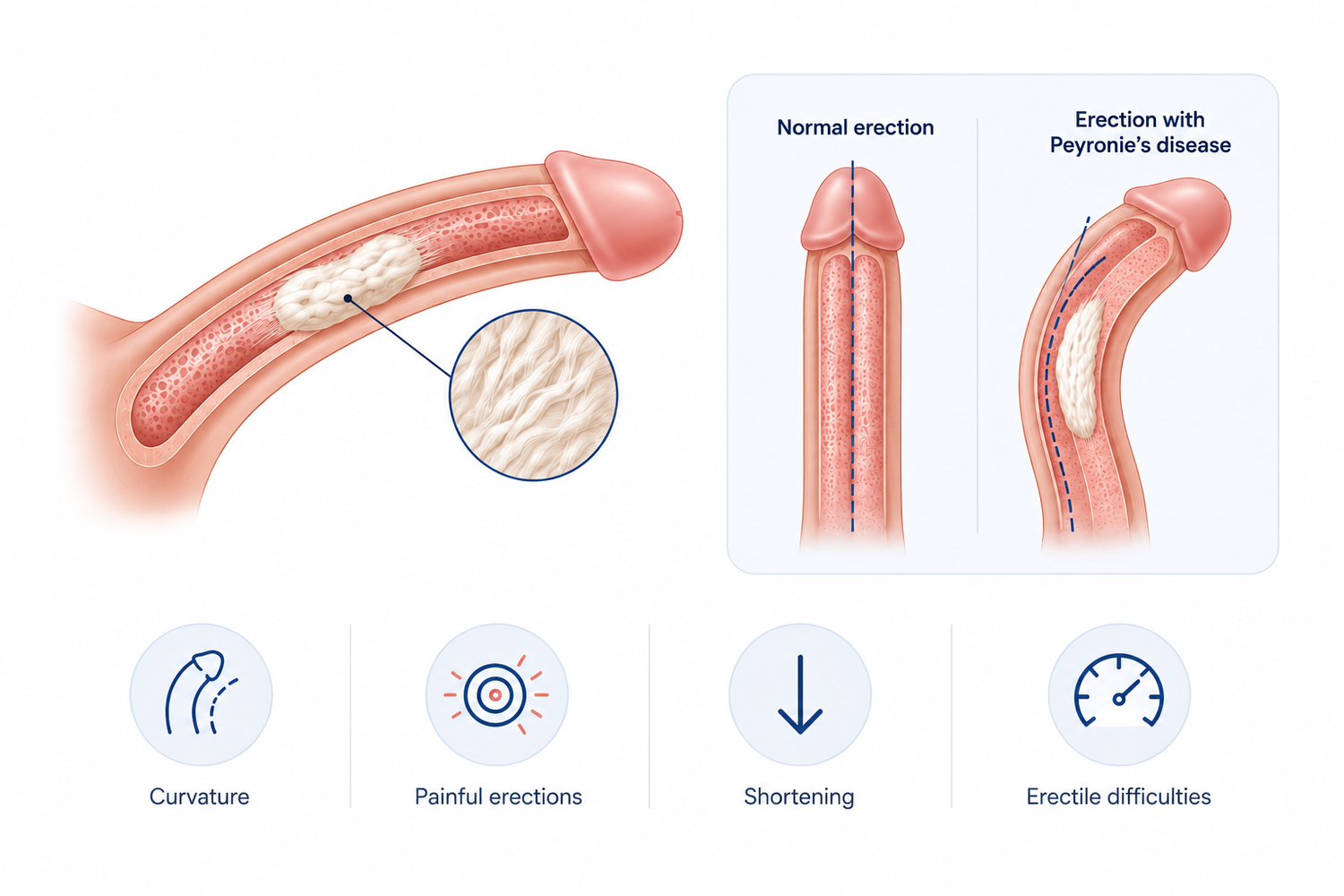
What problem are you trying to correct?
Treatment planning is based on the whole deformity rather than simply the measured angle.
Penile curvature
The penis may curve upwards, downwards or to either side, and some men have more than one plane of curvature.
Hourglass deformity
Circumferential or near-circumferential narrowing may reduce shaft stability even when the overall curve is not severe.
Focal narrowing
One side of the shaft may develop a significant indentation or reduced girth associated with the plaque.
Hinge instability
A narrowed area may buckle during penetration despite otherwise reasonable erection rigidity.
Perceived or measured shortening
Scar-related asymmetry and loss of tissue elasticity may change perceived or functional penile length.
Erectile dysfunction
Reduced rigidity can coexist with Peyronie’s disease and may substantially change which surgical options are reasonable.
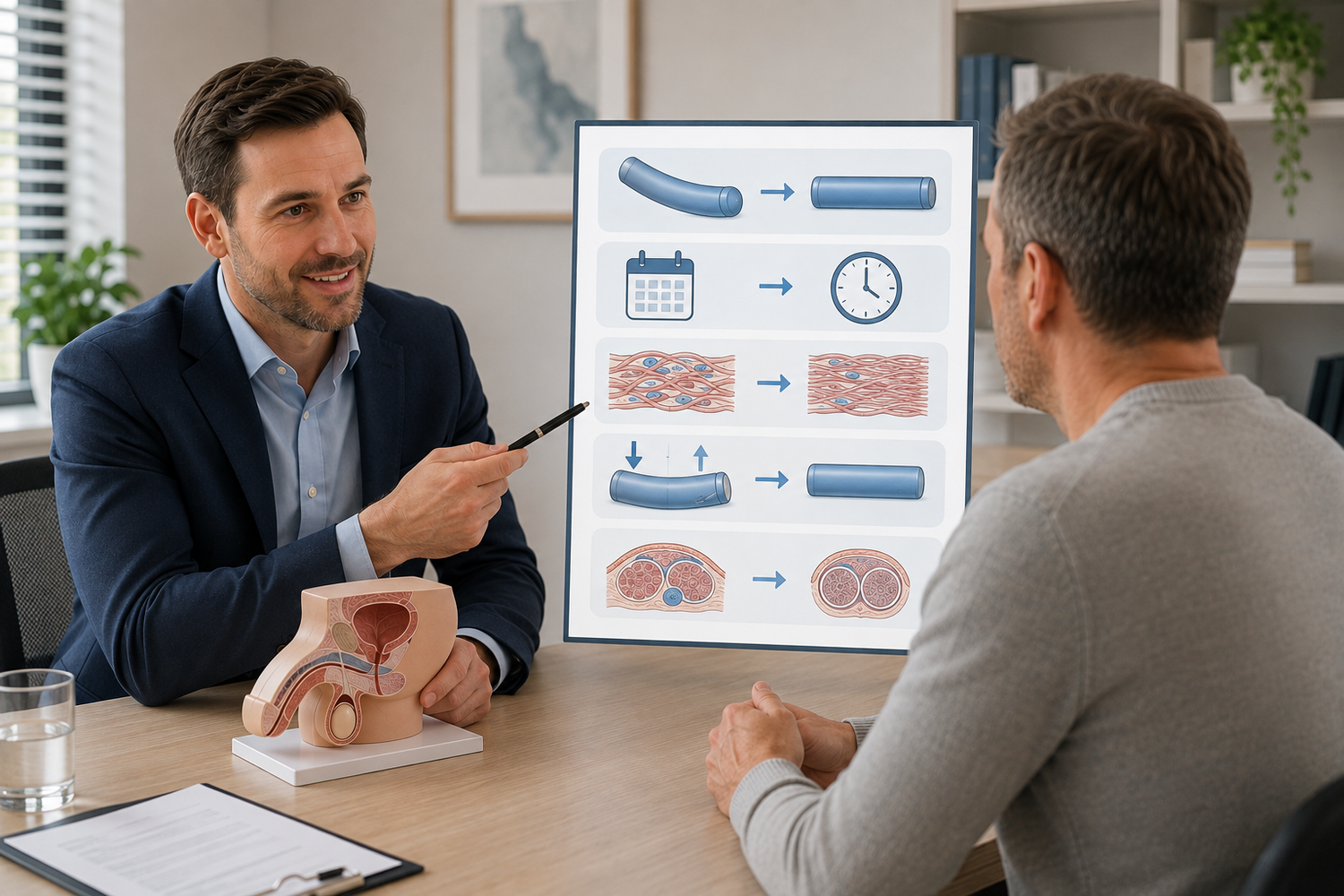
Photographs can help document curvature
Erection photographs can provide useful information about the direction and complexity of penile deformity, particularly when the patient is travelling from interstate or overseas.
Curvature photographs can remain on your own phone and be shown during consultation. Do not send intimate photographs through an ordinary website form or normal email unless the clinical team has specifically advised an appropriate secure method.
Is your Peyronie’s disease still changing?
Surgery is generally considered once the disease has become stable and the deformity is causing meaningful functional difficulty.
The shape may still be evolving
Earlier Peyronie’s disease may involve pain, increasing curvature, new indentation or continuing changes in penile length or shape.
The initial discussion may therefore focus on documenting the condition, erection quality and appropriate conservative strategies rather than immediately planning reconstruction.
The deformity has stopped changing
Reconstructive surgery may be discussed when penile deformity has remained stable and it continues to compromise sexual function or cause substantial functional difficulty.
The specific operation still depends on erection quality, available penile length, the degree and complexity of deformity and individual priorities.
Three questions strongly influence reconstruction
There is no single Peyronie’s operation that is appropriate for every patient.
Are erections reliably firm?
Good erectile rigidity allows consideration of straightening procedures that preserve the patient's natural erectile mechanism. Significant treatment-resistant erectile dysfunction may favour a different pathway.
Is the deformity simple or complex?
A straightforward curve is different from hourglass narrowing, hinge instability, multiplanar curvature or a markedly shortened penis.
What matters most to you?
Penile straightness, preservation of length, erectile rigidity, recovery, surgical complexity and risk tolerance all form part of shared decision-making.
Different deformities require different approaches
The aim of reconstruction is generally to create a penis that is sufficiently straight and stable for functional sexual activity while balancing length, erectile function and surgical risks.
Plication surgery
Plication straightens the penis by shortening the longer side opposite the Peyronie’s plaque.
It may be considered in appropriately selected men with good erections, adequate penile length and less complex deformity. Perceived or measured shortening can occur.
Plaque incision & grafting
A grafting procedure releases the shortened side of the penis and covers the resulting tunical defect.
It may be considered for selected men with good erectile function and more severe or complex deformity, including some hourglass or hinge problems. Erectile dysfunction is an important recognised consideration when counselling for grafting.
Penile implant ± straightening
When significant erectile dysfunction coexists with Peyronie’s disease and erections are not adequately restored with appropriate non-surgical management, penile prosthesis surgery may address both rigidity and deformity.
Additional modelling or reconstructive manoeuvres may sometimes be required depending on residual curvature.
Observation or non-surgical management
Surgery is not necessary simply because penile curvature is present. Some patients are better suited to observation or conservative management, particularly while the disease is evolving or when function remains satisfactory.
Traction and other non-surgical strategies may be discussed in selected circumstances. Expected benefits and limitations vary.
Hourglass, hinge and previous surgery deserve separate consideration
Some international referrals involve more than a simple bend.
Complex deformity can affect shaft stability, penile length and erection quality and may require more detailed reconstructive planning.
From your first enquiry to returning home
The exact pathway depends on your deformity and proposed treatment, but international assessment generally follows these stages.
Start an international enquiry
Tell the rooms where you live, how long you have had Peyronie’s disease, whether the deformity is changing and what previous treatment you have received.
Prepare relevant information
Previous specialist letters, penile ultrasound reports, operation reports and curvature photographs may be useful where available.
Specialist assessment
Disease stability, deformity, erection quality, functional impact, available length and individual priorities are considered.
Define the treatment pathway
The next step may be observation, further non-surgical management, plication, grafting, penile prosthesis surgery or another individualised reconstructive approach.
Brisbane treatment and early recovery
If surgery is appropriate, the operation and early postoperative review are planned around the procedure and individual medical circumstances.
Return home and follow-up
Wound care, activity restrictions, timing of sexual activity, erectile function and any postoperative rehabilitation or local follow-up are discussed before return travel.
Avoid planning the trip around an operation that has not yet been confirmed
International reconstructive surgery requires enough time for assessment, examination, surgery where appropriate and early postoperative review.
If curvature is still changing, immediate reconstructive surgery may not be the appropriate next step.
Curvature photographs are useful, but examination and additional assessment may still be required.
Plication, grafting and implant-based reconstruction have different recovery and follow-up requirements.
Travel timing should take account of wound healing, discomfort, mobility and the procedure performed.
There is no single recommended length of stay for every Peyronie’s operation. Complex grafting or prosthetic reconstruction may require a different pathway from straightforward plication.

What is Peyronie’s surgery trying to achieve?
The aim is generally functional correction rather than guaranteeing a perfectly straight penis or restoration of the penis to exactly how it was before Peyronie’s disease developed.
Residual or recurrent curvature can occur after reconstructive surgery.
Surgery cannot guarantee restoration of previous penile length and some operations may cause or be associated with shortening.
Erectile function is an important consideration before surgery and may change following some reconstructive procedures.
Altered sensation or numbness can occur after penile reconstructive surgery.
Correction is primarily directed toward function and cannot guarantee a particular cosmetic result.
Persistent deformity, erectile dysfunction or another postoperative issue can occasionally require further management.

Dr Jack Crozier
Dr Jack Crozier is a Brisbane urologist and fellowship-trained andrologist with subspecialty practice in Peyronie’s disease, penile reconstruction, erectile dysfunction and penile prosthetic surgery.
His advanced andrology fellowship experience at University College London Hospitals included Peyronie’s disease surgery, penile prosthetic surgery, reconstructive andrology, male infertility and genital reconstruction.
International patients can seek assessment for both straightforward curvature and more complex reconstructive problems including hourglass deformity, significant erectile dysfunction and previous penile surgery.
Are you the patient or the referring urologist?
International patients can contact the practice directly. Overseas clinicians can use the dedicated clinician referral pathway.
Begin assessment before arranging major travel
Tell the rooms where you live, how long the deformity has been present, whether it is still changing, whether erections remain firm and what previous treatment you have received.
Refer an international patient
Clinicians can refer patients requiring specialist assessment for complex Peyronie’s disease, hourglass or hinge deformity, previous surgery, penile reconstruction or Peyronie’s disease with erectile dysfunction.
Explore Peyronie’s and penile reconstruction
Questions patients commonly ask before travelling
Can my Peyronie’s disease be assessed before I travel to Australia?
Where clinically appropriate and permitted, previous records, history and photographs may contribute to an initial assessment before travel. An in-person examination or additional investigations may still be required before definitive surgical treatment is confirmed.
What photographs should I bring for penile curvature?
Photographs of the fully erect penis taken looking down from above and from the side can help document curvature. They can remain on your own phone and be shown during consultation. Avoid sending intimate photographs through ordinary email or an unsecured web form.
Does every man with Peyronie’s disease need surgery?
No. Treatment depends on disease phase, deformity, erection quality, functional effect and individual priorities. Mild or changing disease may not be best managed with surgery.
When is Peyronie’s surgery usually considered?
Surgery is generally considered when the disease is stable and penile deformity causes meaningful difficulty with sexual function or penetration. Individual circumstances still need specialist assessment.
How do I know whether I need plication or grafting?
The decision depends on erection quality, penile length, curvature severity, the presence of hourglass or hinge deformity, previous surgery and individual priorities. A simple angle measurement cannot determine the operation by itself.
Is grafting better because it avoids shortening?
Not necessarily. Grafting can be useful for selected complex deformities and avoids deliberately shortening the longer side in the same way as plication, but it has its own risks, including the possibility of postoperative erectile dysfunction. The balance of benefits and risks is individual.
What if I have Peyronie’s disease and erectile dysfunction?
Erection quality is a major part of treatment planning. If significant erectile dysfunction does not respond adequately to appropriate non-surgical treatment, penile prosthesis surgery with straightening where required may be considered rather than a straightening-only procedure.
Can Peyronie’s surgery restore the length I have lost?
No procedure can guarantee restoration of the penis to its exact previous dimensions. Plication can cause additional shortening, while lengthening procedures have different risks and limitations. Expectations regarding length should be discussed before surgery.
I have an hourglass deformity but not a large curve. Can this still be significant?
Yes. Hourglass narrowing may create an unstable or hinged segment and interfere with penetration even when the measured curvature is modest. The entire penile shape and stability should be assessed.
I already had Peyronie’s surgery elsewhere. Can I still be assessed?
Yes. Previous plication, grafting, implant surgery or other penile reconstruction can be reviewed. Previous operation reports are particularly helpful because prior surgery can change penile anatomy and available reconstructive options.
How long should I stay in Brisbane?
There is no single timeframe for every patient. The required stay depends on the assessment required, the procedure performed and early postoperative recovery. Complex grafting or prosthetic reconstruction may require a different itinerary from simpler surgery.
When can I fly home after surgery?
Return travel should be discussed after the likely procedure is established. Appropriate timing depends on wound healing, discomfort, mobility, medical history and the operation performed. Avoid booking inflexible flights too early.
When can sexual activity restart after surgery?
This varies with the operation and healing. Patients should follow their individual postoperative instructions rather than assuming a fixed timeframe before surgery.
Can you work with my urologist after I return home?
Where appropriate, postoperative care can involve the patient's local urologist or other treating clinician. A clear plan should be established for routine follow-up and for unexpected problems after returning home.
Is penile curvature, narrowing or instability affecting sexual function?
Begin by clarifying the deformity, erection quality, disease stability and previous treatment. The appropriate international treatment pathway can then be discussed before major travel arrangements are made.
Medical information disclaimer: This page provides general educational and travel-planning information and does not replace individual medical advice, diagnosis or informed consent. Peyronie’s disease varies between patients and not every deformity requires surgery. Potential treatments have different benefits, limitations and risks. Penile reconstructive surgery may involve risks including bleeding, infection, residual or recurrent curvature, penile shortening, altered sensation, erectile dysfunction, palpable sutures or graft-related issues, wound complications and the possibility of further surgery. Penile implant surgery carries additional device-related risks. No treatment can guarantee a perfectly straight penis, restoration of previous penile dimensions, preserved erectile function or a particular sexual outcome. Suitability for consultation, telehealth, surgery and international travel depends on individual clinical circumstances and applicable professional, legal and administrative requirements.